
Sound
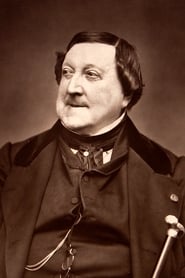
Gioachino Rossini
Born — Died
1792-02-29 — 1868-11-13
Place of birth
Pesaro, Marche, Italy
Known for
Sound
Credits
14 titles
Gioachino Antonio Rossini was an Italian composer who gained fame for his 39 operas, although he also wrote many songs, some chamber music and piano pieces, and some sacred music. He set new standards for both comic and serious opera before retiring from large-scale composition while still in his thirties, at the height of his popularity. Rossini began to compose by the age of 12 and was educated at music school in Bologna. His first opera was performed in Venice in 1810 when he was 18 years old. In 1815 he was engaged to write operas and manage theatres in Naples. In the period 1810–1823 he wrote 34 operas for the Italian stage that were performed in Venice, Milan, Ferrara, Naples and else…
Known for
 NR
NRSet to the backdrop of the Highlanders revolt against the Crown of Scotland, three men are in love with the same woman, Elena, the daughter of the king’s main opponent: Rodrigo, a warrior highlander, Malcolm, a valiant servant of the cause and Uberto, aka King Giacomo V, in disguise. Triumphant both militarily and politically, the king finally extends his pardon to Douglas’ family and offers Elena’s hand to the man she loves, Malcolm…
La Donna del Lago
2018
 7.4
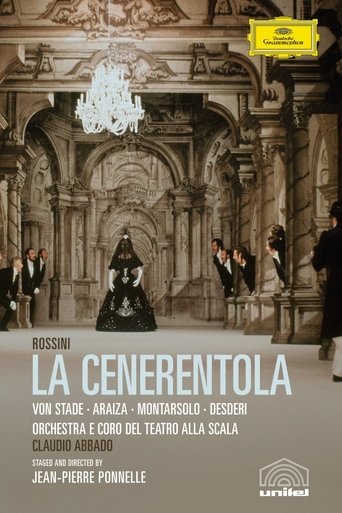
7.4The Prince, Don Ramiro (who has changed places with his valet, Dandini), meets Cenerentola and they are instantly attracted to each other. When the Philosopher, Alidoro, later takes Cenerentola (dressed in magnificent clothing) to the palace, Dandini (still posing as the prince) tries to talk of love to her, but Cenerentola rejects him, saying that she is in love with his 'valet'. Ramiro, who has overheard this comment, is overjoyed, and immediately proposes to her, but Cenerentola says that he must first seek her out and then, if he still felt the same way, she would marry him. She gives him one of a matching pairs of bracelets, telling him to look for its companion on her right arm (she then leaves the palace). Ramiro ends the masquerade, and he and Dandini resume their true identities. The Prince then sets out on his quest - little realising that destiny, in the form of a violent thunderstorm, is about to take a hand in the affair.
La Cenerentola
1981
 8.3
8.3The career of Maria Callas was just a bit too early and too brief to receive full and satisfying video documentation like that now being accorded to such singers as Renée Fleming and Luciano Pavarotti. This black-and-white televised recital (Callas's Paris debut) took place at the Paris Opera on December 19, 1958 when television was still in its infancy. We might wish that it had happened earlier, when her voice was in better condition, or later, when video recording technology was more advanced--so that, for example, we would not have to take the narrator's word that Callas is wearing a red dress. But this is probably the best available Callas video recording, and her fans will welcome it warmly. Visual elements were as important as the vocal dimensions in her art.
Maria Callas: Toujours (Paris 1958)
1958
 NR
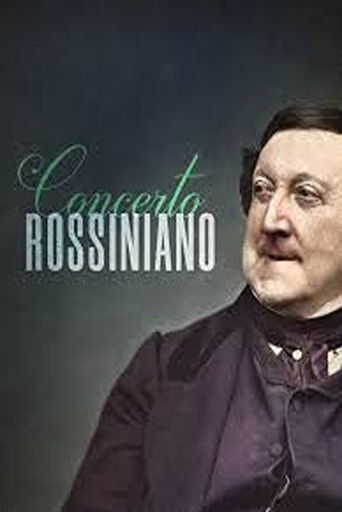
NRFrom the Rai Auditorium in Turin, a concert featuring music by Gioachino Rossini. Conductor Tiziano Severini, choir director Bruno Casoni, soprano Mariella Devia, contralto Bernadette Manca Di Nissa, tenor Rockwell Blake, baritone Roberto Servile. Rai Turin Symphony Orchestra.
Concerto rossiniano
2025
 NR
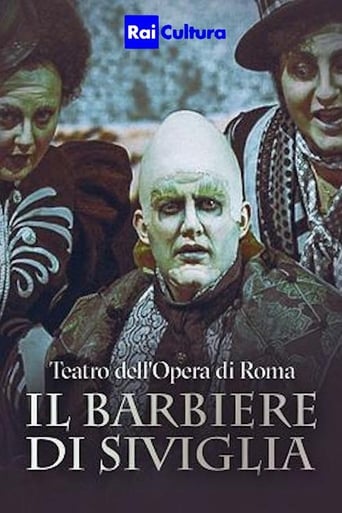
NRThe staging of Gioacchino Rossini's two-act comic opera, with libretto by Cesare Sterbini, at the Teatro dell'Opera di Roma during the 2016/2017 season.
Il barbiere di Siviglia
2017
 NR
NRA feathered thief, a servant wrongly sentenced to death and a corrupt, power-hungry politician: those are the protagonists of Rossini’s semi-serious opera whose overture, with its drum rolls and oboe solo, is one of the best-known pieces in the history of music. La gazza ladra (The Thieving Magpie) is set in a time of great social upheaval. When Ninetta is accused of stealing a silver spoon, a series of unfortunate events begins that initially makes the happy ending expected from an opera semiseria seem highly unlikely. What sort of world is it where a person can be executed for the alleged theft of a spoon? Tobias Kratzer, successful as a director throughout Europe, now debuts in Vienna with Rossini’s opera that received its first performance in 1817 and traces the uncertainty felt by people in a politically and socially destabilised world.
Rossini: La gazza ladra
2022
Film credits
2000s · 2 titles
 NR
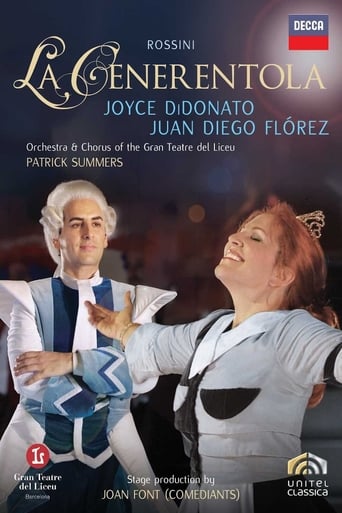
NRThis is an excellent version of one of the greatest of all comic operas, featuring superb singing and orchestral playing. And it's not just the two headliners; listen, for example, to the entrance of the stepsisters at the beginning of Act One. Nevertheless, some viewers may find the staging problematic, with singers in clown-like costumes and sets featuring human-sized rodents. Those seeking a more conventional production might want to consider the Houston Grand Opera DVD, also on Decca, with Cecilia Bartoli and Raul Jimenez. Both sets are wonderful, but, for me, Joyce Didonato and Juan Diego Florez are slightly to be preferred. Highly recommended.
Rossini La Cenerentola
2008
 8.0
8.0LA PIETRA DEL PARAGONE (The Touchstone) concerns the Count Asdrubale who is wealthy and therefore of great interest to many women – notably Aspasia, Fulvia, and Clarice. Only Clarice, however, loves him for something other than his riches. There are also male hangers-on: the corrupt journalist Macrobio, the poetaster Pacuvio, and Giocondo, who is Asdrubale's true friend, but who has his own eyes on Clarice. To test his friends and would-be fiancées, Asdrubale pretends that he has been bankrupted. Sure enough, only Clarice and Giocondo stand by him, and when his fortune is "miraculously" saved, the three have the last laugh on everyone else... or do they? This production is set in what looks like the early 1960s. But the real innovation is the use of blue screen technology: using tiny cameras and sets, along gigantic screens hanging over the stage, a kind of video mixing makes the singers appear to inhabit any number of fanciful settings and perform a myriad of improbable actions.
La pietra del paragone
2007
1980s · 2 titles
7.4The Prince, Don Ramiro (who has changed places with his valet, Dandini), meets Cenerentola and they are instantly attracted to each other. When the Philosopher, Alidoro, later takes Cenerentola (dressed in magnificent clothing) to the palace, Dandini (still posing as the prince) tries to talk of love to her, but Cenerentola rejects him, saying that she is in love with his 'valet'. Ramiro, who has overheard this comment, is overjoyed, and immediately proposes to her, but Cenerentola says that he must first seek her out and then, if he still felt the same way, she would marry him. She gives him one of a matching pairs of bracelets, telling him to look for its companion on her right arm (she then leaves the palace). Ramiro ends the masquerade, and he and Dandini resume their true identities. The Prince then sets out on his quest - little realising that destiny, in the form of a violent thunderstorm, is about to take a hand in the affair.
La Cenerentola
1981
 7.0
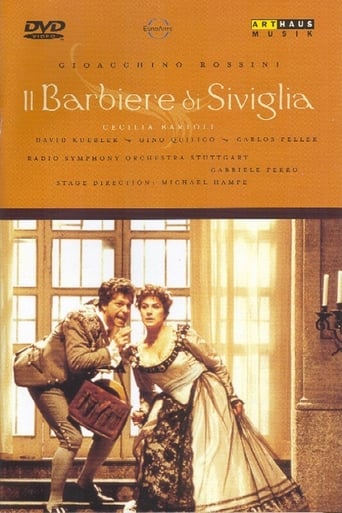
7.0Live performance from Schwetzinger Festspiele, 1988. What sets this IL BARBIERE DI SIVIGLIA apart from all others available is its elegant realism. None of its visuals are the least bit cartoonish or blatantly designed for comedy. Dr. Bartolo’s house is a stark, stern-looking structure of plastered brick with a comfortable yet plain, white-curtained interior, while the costumes are highly realistic 18th century garb in subdued colors. Yet despite its fairly austere appearance the production is delightful, thanks to its performers and staging. The stage business is lively, witty and free of excessive slapstick, and every singer brings his or her character to life, all offering rich, vibrant characterizations that strike a perfect balance between comedy and humanity.
Il Barbiere di Siviglia
1988
Behind the camera
NRSet to the backdrop of the Highlanders revolt against the Crown of Scotland, three men are in love with the same woman, Elena, the daughter of the king’s main opponent: Rodrigo, a warrior highlander, Malcolm, a valiant servant of the cause and Uberto, aka King Giacomo V, in disguise. Triumphant both militarily and politically, the king finally extends his pardon to Douglas’ family and offers Elena’s hand to the man she loves, Malcolm…
La Donna del Lago
2018
8.3The career of Maria Callas was just a bit too early and too brief to receive full and satisfying video documentation like that now being accorded to such singers as Renée Fleming and Luciano Pavarotti. This black-and-white televised recital (Callas's Paris debut) took place at the Paris Opera on December 19, 1958 when television was still in its infancy. We might wish that it had happened earlier, when her voice was in better condition, or later, when video recording technology was more advanced--so that, for example, we would not have to take the narrator's word that Callas is wearing a red dress. But this is probably the best available Callas video recording, and her fans will welcome it warmly. Visual elements were as important as the vocal dimensions in her art.
Maria Callas: Toujours (Paris 1958)
1958
NRFrom the Rai Auditorium in Turin, a concert featuring music by Gioachino Rossini. Conductor Tiziano Severini, choir director Bruno Casoni, soprano Mariella Devia, contralto Bernadette Manca Di Nissa, tenor Rockwell Blake, baritone Roberto Servile. Rai Turin Symphony Orchestra.
Concerto rossiniano
2025
NRThe staging of Gioacchino Rossini's two-act comic opera, with libretto by Cesare Sterbini, at the Teatro dell'Opera di Roma during the 2016/2017 season.
Il barbiere di Siviglia
2017
NRA feathered thief, a servant wrongly sentenced to death and a corrupt, power-hungry politician: those are the protagonists of Rossini’s semi-serious opera whose overture, with its drum rolls and oboe solo, is one of the best-known pieces in the history of music. La gazza ladra (The Thieving Magpie) is set in a time of great social upheaval. When Ninetta is accused of stealing a silver spoon, a series of unfortunate events begins that initially makes the happy ending expected from an opera semiseria seem highly unlikely. What sort of world is it where a person can be executed for the alleged theft of a spoon? Tobias Kratzer, successful as a director throughout Europe, now debuts in Vienna with Rossini’s opera that received its first performance in 1817 and traces the uncertainty felt by people in a politically and socially destabilised world.
Rossini: La gazza ladra
2022
 NR
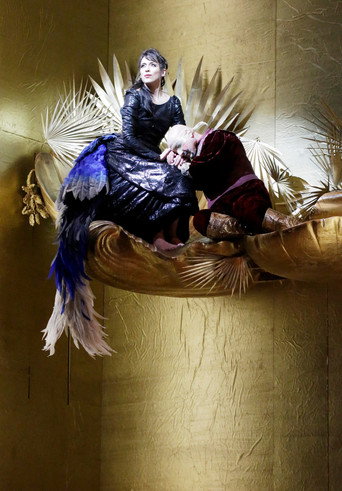
NRGioachino Rossini’s Armida (1817) is a spectacular but relatively rarely performed opera seria, based on Tasso’s Gerusalemme liberata: the sorceress Armida seduces the crusader Rinaldo, creating a conflict between love and military/religious duty. The 2014 Rossini Opera Festival production in Pesaro was directed by Luca Ronconi, with Carlo Rizzi conducting. It featured Carmen Romeu as Armida and John Osborn as Rinaldo, with a notably demanding vocal cast. Ronconi’s staging emphasized the opera’s dreamlike, magical and theatrical dimension rather than treating it as straightforward medieval epic. It was particularly notable for showcasing Rossini’s extreme vocal virtuosity and elaborate ensembles, including the famous Act II finale and the spectacular series of transformations surrounding Armida’s magic.
Rossini: Armida - ROF
2014
 7.5
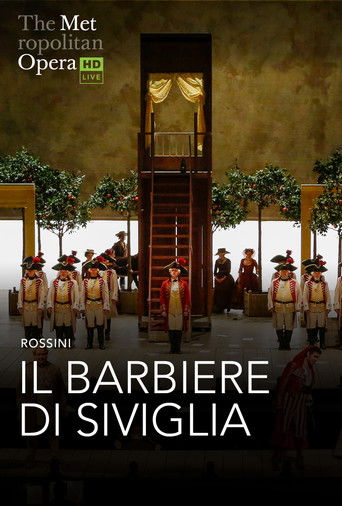
7.5Mezzo-soprano Aigul Akhmetshina headlines a winning ensemble as the feisty heroine, Rosina, alongside high-flying tenor Jack Swanson, in his Met debut, as her secret beloved, Count Almaviva. Baritone Andrey Zhilikhovsky stars as Figaro, the titular barber of Seville, with bass-baritone Peter Kálmán as Dr. Bartolo and bass Alexander Vinogradov as Don Basilio rounding out the principal cast.
The Metropolitan Opera: Il Barbiere di Siviglia
2025
 NR
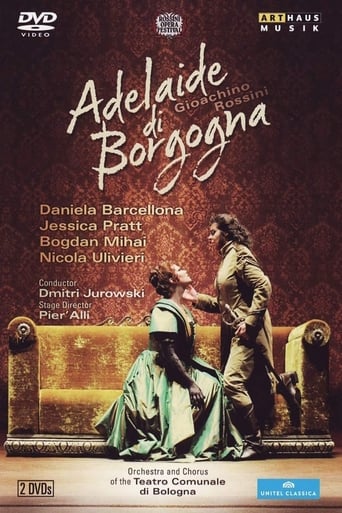
NR"It can be truly said of Adelaide di Borgogna that, like a rose, it bloomed but a day - l'espace d'un matin." First performed in Rome on the 27th December 1817, it enjoyed very few revivals. In 2011 the Rossini Festival in Pesaro presented the second staged performance of Adelaide di Borgogna since 1825. The story of the opera was taken from a historical event that took place in the medieval period, marking the end of an independent Italian kingdom and leading to the birth of the German Holy Roman Empire through the efforts of Otto I of Saxony. Caught between political rivalry and the love of two men, Adelaide of Burgundy struggles to fight for her people and chooses Otto, the better ruler, for herself and her kingdom.
Adelaide Di Borgogna
2013