

Sound
Modeste Moussorgsky
Born — Died
1839-03-21 — 1881-03-28
Place of birth
Karevo, Pskov Governorate, Russian Empire [now Russia]
Known for
Sound
Credits
11 titles
Known for
 7.3
This is the Andrei Tarkovsky production of the famous Pushkin/Mussorgsky opera, performed in 1990. Modest Mussorgsky's opera in prologue and four acts is performed by the Kirov Opera with performances from Olga Borodina, Alexei Steblianko and Sergei Leiferkust. Boris Godunov has obtained the throne of Russia by murdering the rightful heir Dmitry. An old monk, Pimen, witnessed this, and convinces his apprentice Grigory to avenge Dmitry's death. In the following years Grigory poses as Dmitry, raising an army against Boris, who is now convinced that he is being punished for the murder. Filmed in Russia during the collapse of the Soviet Union, this particular production of Mussorgsky's 1872 tale of political upheaval is considered a highly unique and historical moment in opera. Robert Lloyd stars in the title role of Boris Godunov.
Boris Godunov
1990
 NR
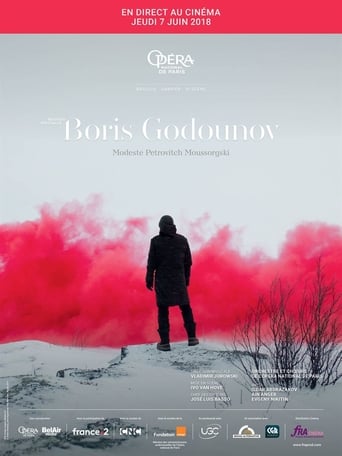
There are elements of Macbeth in this political fable, in which the ghost of the child that Boris has had killed in order to seize the throne appears as an impostor. Adapting Pushkin's epic poem, Mussorgsky composed a meditation on the solitude of power, a populist drama in which the real protagonist is the Russian people with its burden of eternal suffering. Ivo Van Hove is no stranger to grand political frescos. This is his first production for the Paris Opera.
Mussorgsky: Boris Godunov
2018
 1.0
This performance, recorded live at the Bolshoi Opera in 1979, stars the great Russian bass Evgeny Nesterenko as Dosifei, the Old Believer at religious and psychological war with the new order, led by Prince Ivan Khovansky. The manipulative Khovansky is powerfully portrayed here by Alexander Vedernikov, another of the world’s greatest basses, little known outside of the Soviet Union. Marfa, one of Dosifei’s followers and a fortune teller, is sung by the legendary mezzo-soprano Irina Arkhipova in a performance of great authority and dignity. Russian opera at the Bolshoi is the genuine article and the remainder of the cast is equally impressive, from the mistrusting Prince Galitsyn of Evgeny Raikov to the clever, informing Shaklovity of Vladislav Romanovsky. The Bolshoi chorus and orchestra is conducted by Yuri Simonov.
Khovanshchina
1979
 NR
Stephen Wadsworth’s production of Mussorgsky’s epic masterpiece brilliantly captures the suffering and ambition of the Russian people at a critical time in their nation’s history. René Pape is riveting as the Tsar of the title, giving a commanding and charismatic performance of one of the greatest bass roles in the repertoire—his Boris is dominating, tortured, flawed and utterly unforgettable. The extraordinary cast and the Met Orchestra and Chorus are led by Russian maestro Valery Gergiev, the foremost Mussorgsky interpreter of our time.
The Metropolitan Opera: Boris Godunov
2010
 NR
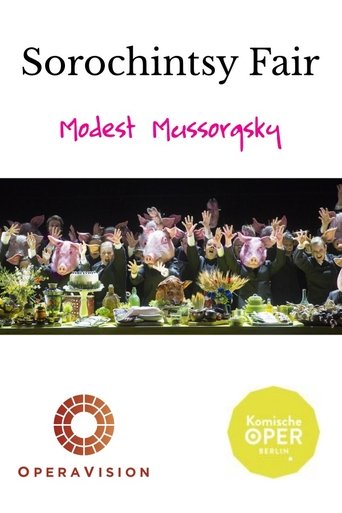
A devil is at work in the Ukrainian village of Sorochintsy, terrifying residents and travellers alike. Among them a farmer whose daughter is not allowed to marry her lover because her quarrelsome stepmother is against it.
Mussorgsky: Sorochintsy Fair (Komische Oper Berlin)
2017
 9.0
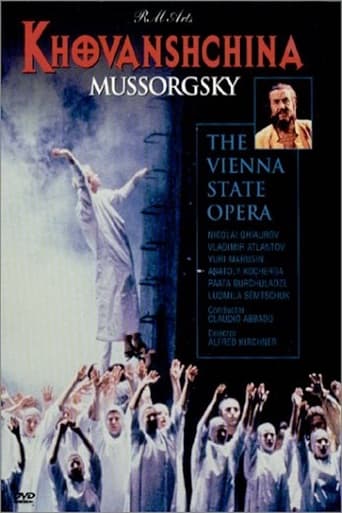
The last and arguably finest opera of Modest Mussorgsky is captured in one of its most powerful interpretations in this 1989 recording from the Vienna State Opera, conducted by Claudio Abbado. A moody opera that is thematically broad at times and intimately personal in others, "Khovanshchina" tells the story of the 17th-century clash between Russian conservatives and Peter the Great's reformists. Among the singers is renowned basso Nicolai Ghiaurov and Paata Burchuladze, as well as Anatoly Kocherga, Ludmila Semtchuk, and Heinz Zednik.
Khovanshchina
1989
Behind the camera
7.3This is the Andrei Tarkovsky production of the famous Pushkin/Mussorgsky opera, performed in 1990. Modest Mussorgsky's opera in prologue and four acts is performed by the Kirov Opera with performances from Olga Borodina, Alexei Steblianko and Sergei Leiferkust. Boris Godunov has obtained the throne of Russia by murdering the rightful heir Dmitry. An old monk, Pimen, witnessed this, and convinces his apprentice Grigory to avenge Dmitry's death. In the following years Grigory poses as Dmitry, raising an army against Boris, who is now convinced that he is being punished for the murder. Filmed in Russia during the collapse of the Soviet Union, this particular production of Mussorgsky's 1872 tale of political upheaval is considered a highly unique and historical moment in opera. Robert Lloyd stars in the title role of Boris Godunov.
Boris Godunov
1990
NRThere are elements of Macbeth in this political fable, in which the ghost of the child that Boris has had killed in order to seize the throne appears as an impostor. Adapting Pushkin's epic poem, Mussorgsky composed a meditation on the solitude of power, a populist drama in which the real protagonist is the Russian people with its burden of eternal suffering. Ivo Van Hove is no stranger to grand political frescos. This is his first production for the Paris Opera.
Mussorgsky: Boris Godunov
2018
1.0This performance, recorded live at the Bolshoi Opera in 1979, stars the great Russian bass Evgeny Nesterenko as Dosifei, the Old Believer at religious and psychological war with the new order, led by Prince Ivan Khovansky. The manipulative Khovansky is powerfully portrayed here by Alexander Vedernikov, another of the world’s greatest basses, little known outside of the Soviet Union. Marfa, one of Dosifei’s followers and a fortune teller, is sung by the legendary mezzo-soprano Irina Arkhipova in a performance of great authority and dignity. Russian opera at the Bolshoi is the genuine article and the remainder of the cast is equally impressive, from the mistrusting Prince Galitsyn of Evgeny Raikov to the clever, informing Shaklovity of Vladislav Romanovsky. The Bolshoi chorus and orchestra is conducted by Yuri Simonov.
Khovanshchina
1979
NRStephen Wadsworth’s production of Mussorgsky’s epic masterpiece brilliantly captures the suffering and ambition of the Russian people at a critical time in their nation’s history. René Pape is riveting as the Tsar of the title, giving a commanding and charismatic performance of one of the greatest bass roles in the repertoire—his Boris is dominating, tortured, flawed and utterly unforgettable. The extraordinary cast and the Met Orchestra and Chorus are led by Russian maestro Valery Gergiev, the foremost Mussorgsky interpreter of our time.
The Metropolitan Opera: Boris Godunov
2010
NRA devil is at work in the Ukrainian village of Sorochintsy, terrifying residents and travellers alike. Among them a farmer whose daughter is not allowed to marry her lover because her quarrelsome stepmother is against it.
Mussorgsky: Sorochintsy Fair (Komische Oper Berlin)
2017
9.0The last and arguably finest opera of Modest Mussorgsky is captured in one of its most powerful interpretations in this 1989 recording from the Vienna State Opera, conducted by Claudio Abbado. A moody opera that is thematically broad at times and intimately personal in others, "Khovanshchina" tells the story of the 17th-century clash between Russian conservatives and Peter the Great's reformists. Among the singers is renowned basso Nicolai Ghiaurov and Paata Burchuladze, as well as Anatoly Kocherga, Ludmila Semtchuk, and Heinz Zednik.
Khovanshchina
1989
 NR
The libretto is by Mussorgsky himself and takes the eponymous “romantic tragedy” by the celebrated Russian poet Alexander Pushkin as its starting point. Boris Godunov is Mussorgsky’s masterpiece and his only complete opera. It’s a vast sprawling tapestry of Russian life, which centres on the Russian people – represented in the opera by a large and powerful chorus – rather than on the title figure. The staging was produced at the Gran Teatre del Liceu in Barcelona and is based on the original version of the score.
Boris Godunov
2004
 NR
No synopsis available yet.
Boris Godounov à l’Opéra national du Capitole
2023
 3.3
Universally acknowledged as the greatest of all Russian operas, this is a faithful and often dazzling production of the standard Rimsky-Korsakov version taped live at the Bolshoi in 1978. As Boris, the renowned Yevgeni Neterenko is as justifiably identified with the role in his generation as Chaliapin, London and Kipness were in theirs. Nesterenko gives a remarkably vivid, human portrait of the tormented half-crazed Tsar, and is supported by a first rate ensemble in a richly designed and costumed production that represents opera at its grandest. Particularly outstanding are Vladislav Piavko as the Pretender, Valery Yaroslavtsev as Pimen, Irina Arkhipova as Marina (a role generally associated with Vishnevskaya), Galina Kalinina as Xenia, and Alexsei Maslennikov as the Simpleton.
Boris Godunov
1978
 5.0
Mussorgsky's quintessential Russian opera is captured live on stage in this performance by the Bolshoi Opera featuring Rimsky-Korsakov's revised vision and starring Evgeny Nesternko and Vladislav Piavko.
Boris Godunov
1987
 NR
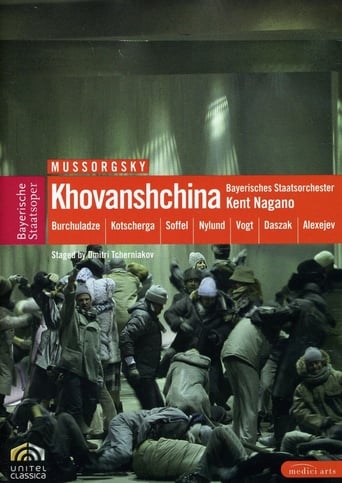
Kent Nagano superbly masters the challenges presented by this score, shapes the dynamics with subtle intensity, and casts the score in a mellow glow. As Marfa, the spurned lover of Ivan Khovansky‘s son Andrei, Doris Soffel unfolds such a rich palette of sonorities, from the pathos of the lower ranges to shaded discant heights, that “one is tempted to speak of a Russian mezzo”. The final chorus, which Mussorgsky did not compose, is played in the orchestrally transparent version of Igor Stravinsky – the third great Russian composer who contributed to making “Khovanshchina“ a timeless, gripping stage work. With his stripped-down sets and historicising costumes, director Dmitri Tcherniakov, one of the new voices of contemporary Russian theatre, builds a bridge to the political present. A lesson in history and music!
Mussorgsky: Khovanshchina
2012