

Directing
Gao Guodong
Place of birth
Anshan,Liaoning Province,China
Known for
Directing
Credits
6 titles
Known for
 NR
Liu Zeyuan is a farmer on the edge of the desert at the junction of Inner Mongolia and Ningxia. He grows food and raises camels, and his family's annual income is 5,000 yuan. Liu Picheng is a fisherman on Jingwa Island, part of the isolated Liaodong Peninsula; he is unwilling to attract attention and becomes hostile to the camera. The living environment and conditions of these two families are different, but the directors try to find some common ground while expressing the two respective unique lifestyles. In fact, these lives are firmly swayed by nature: sand storms can destroy everything, just as the ocean tide can destroy everything, and for the two protagonists, the difficult grasp of the future and their children also brings them the same loneliness. Filmed in 1989, Sand and Sea received the Grand Prix award from the 1991 Asian Broadcasting and Television Union.
Sand and Sea
1991
 NR
A 1995 film co-directed by Kang Jianning and Gao Guodong that, most likely, grew out of their earlier film Sand and Sea, and saw at least Kang returning to the family in the desert that he interviewed for that film. Not to be confused with another film of this same title by Kang, from 2003, which includes more up-to-date footage, was itself edited down for broadcast on Chinese TV as part of the 'The Weight of Time' series, and does not include any contributions from Gao Guodong.
Life
1995
 NR
Documentary on a family of Nu ethnic group.
The Nu Family
1992
For this 53-minute film from the People's Republic of China (1996), director Gao Guodong spent a year following a family of nomadic herders on the Qiangtang prairie in the mountains of northern Tibet.
Nomads in the Sky
1996
 NR
Never broadcasted feature film by Chinese documentary filmmaker Kang Jianning.
Lugu Lake
1993
 NR
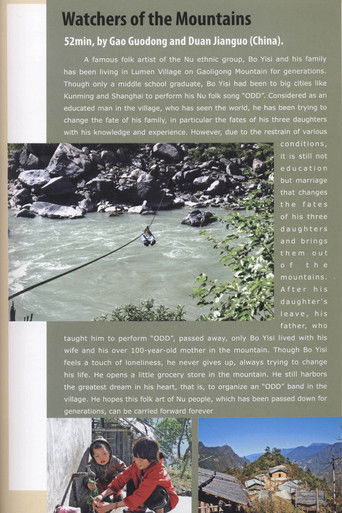
Update version of Gao Guodong's The Nu Family, shot from 1992 to 2007.
Watchers of the Mountains
2008
Behind the camera
NRLiu Zeyuan is a farmer on the edge of the desert at the junction of Inner Mongolia and Ningxia. He grows food and raises camels, and his family's annual income is 5,000 yuan. Liu Picheng is a fisherman on Jingwa Island, part of the isolated Liaodong Peninsula; he is unwilling to attract attention and becomes hostile to the camera. The living environment and conditions of these two families are different, but the directors try to find some common ground while expressing the two respective unique lifestyles. In fact, these lives are firmly swayed by nature: sand storms can destroy everything, just as the ocean tide can destroy everything, and for the two protagonists, the difficult grasp of the future and their children also brings them the same loneliness. Filmed in 1989, Sand and Sea received the Grand Prix award from the 1991 Asian Broadcasting and Television Union.
Sand and Sea
1991
NRA 1995 film co-directed by Kang Jianning and Gao Guodong that, most likely, grew out of their earlier film Sand and Sea, and saw at least Kang returning to the family in the desert that he interviewed for that film. Not to be confused with another film of this same title by Kang, from 2003, which includes more up-to-date footage, was itself edited down for broadcast on Chinese TV as part of the 'The Weight of Time' series, and does not include any contributions from Gao Guodong.
Life
1995
NRDocumentary on a family of Nu ethnic group.
The Nu Family
1992
For this 53-minute film from the People's Republic of China (1996), director Gao Guodong spent a year following a family of nomadic herders on the Qiangtang prairie in the mountains of northern Tibet.
Nomads in the Sky
1996
NRNever broadcasted feature film by Chinese documentary filmmaker Kang Jianning.
Lugu Lake
1993
NRUpdate version of Gao Guodong's The Nu Family, shot from 1992 to 2007.
Watchers of the Mountains
2008