
Writing
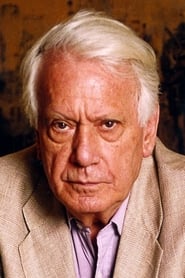
Jorge Semprún
Born — Died
1923-12-10 — 2011-06-07
Place of birth
Madrid, Spain
Known for
Writing
Credits
29 titles
Jorge Semprún Maura was a Spanish writer and politician. From 1953 to 1962, during the dictatorship of Francisco Franco, Semprún lived clandestinely in Spain working as an organizer for the exiled Communist Party of Spain, but was expelled from the party in 1964. After Franco's death and the change to a democratic government, he was Spain's Minister of Culture from 1988 to 1991. He was screenwriter for two successive films by Greek director Costa-Gavras. In 1996 he became the first non-French author to be elected a member of the Académie Goncourt, which awards an annual literary prize.
Known for
 3.6
3.6No synopsis available yet.
Vivement dimanche
1998
 8.5
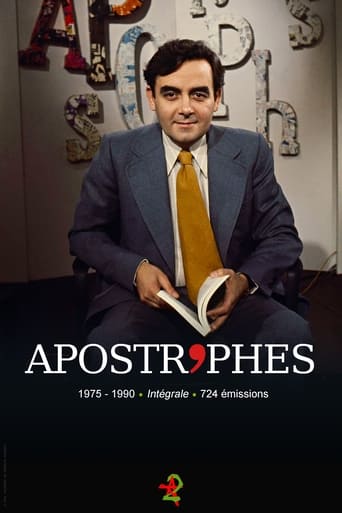
8.5Apostrophes was a live, weekly, literary, prime-time, talk show on French television created and hosted by Bernard Pivot. It ran for fifteen years (724 episodes) from January 10, 1975, to June 22, 1990, and was one of the most watched shows on French television (around 6 million regular viewers). It was broadcast on Friday nights on the channel France 2 (which was called "Antenne 2" from 1975 to 1992). The hourlong show was devoted to books, authors and literature. The format varied between one-on-one interviews with a single author and open discussions between four or five authors.
Apostrophes
1975
 5.0
5.0No synopsis available yet.
Ciné regards
1978
 NR
NRNo synopsis available yet.
Lo + plus
1995
 7.8
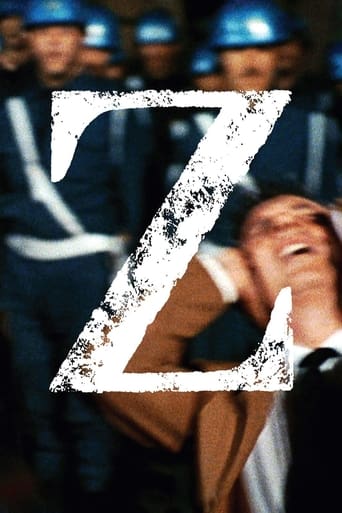
7.8A prominent politician is murdered during a demonstration. The government and army are trying to suppress the truth, but a tenacious magistrate is determined not to let them get away with it.
Z
1969
 6.5
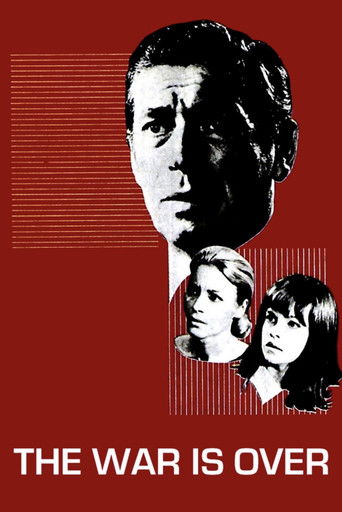
6.5On his way from Madrid to Paris, Diego, a chief of the Spanish Communist Party, is arrested at the border for an ID check but manages to flee. When he arrives in Paris, he searches for one of his comrades to prevent him from going to Madrid where he could be arrested.
The War Is Over
1966
Film credits
2020s · 2 titles
 7.2
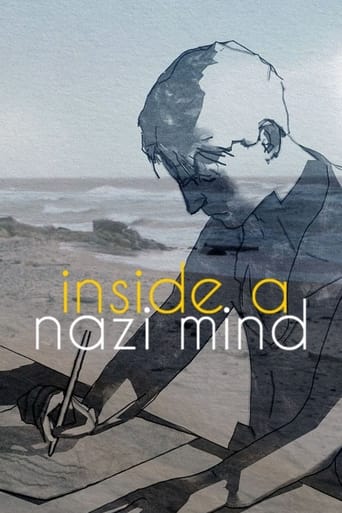
7.2An analysis of The Kindly Ones, Jonathan Littell's controversial novel, published in 2006, which dissects the ruthless mechanisms of the Shoah from the detached point of view of Maximilian Aue, a high-ranking Nazi officer.
Inside a Nazi Mind: The Kindly Ones by Jonathan Littell
2023
 6.0
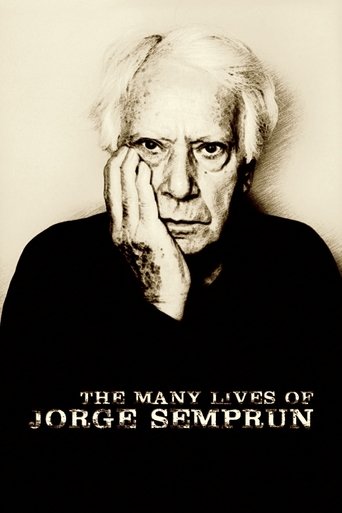
6.0The incredible life of Jorge Semprún (1923-2011): son of a republican intellectual; exiled in the early days of the Spanish Civil War; survivor of the Buchenwald concentration camp during World War II; clandestine communist in Spain during Franco's dictatorship; controversial socialist politician; acclaimed writer, screenwriter and filmmaker.
The Many Lives of Jorge Semprún
2023
1990s · 2 titles
 NR
NRA document of Perestroika, to be viewed as (nearly) unedited rushes of a voyage to Moscow, preserved by compatriot Costa-Gavras. Says Émilie Cauquy of the French Cinémathèque, "Astonishing unpublished travel diary, shot by Chris Marker in analog video on the occasion of a screening of L'Aveu in Moscow in 1990 [...] Armed with his camcorder, Marker films and records the comments, takes on the role of contemporary capital according to this unique ethnographic method that he has perfected".
Rush - Voyage à Moscou
1990
 7.0
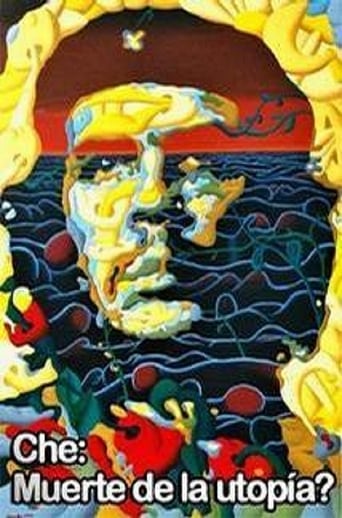
7.0What does Che Guevara"s mythic presence represent to people at the turn of the century, and how do people define their concept of utopia?
Che: muerte de la utopia?
1999
1970s · 3 titles
 8.0
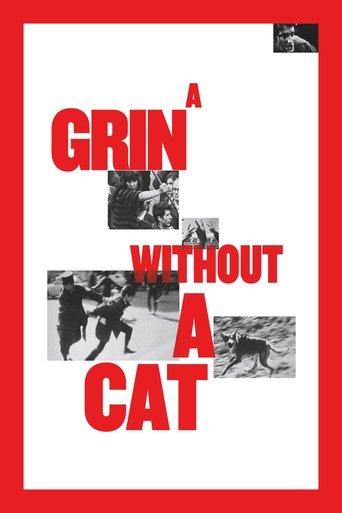
8.0Chris Marker’s A Grin Without a Cat is an epic political essay tracing the rise and decline of the global left from the 1960s to the 1970s. Through archival footage and commentary, the film examines revolutionary movements in France, Latin America, and beyond, reflecting on the ideals, failures, and fading hopes of a generation.
A Grin Without a Cat
1977
 6.0
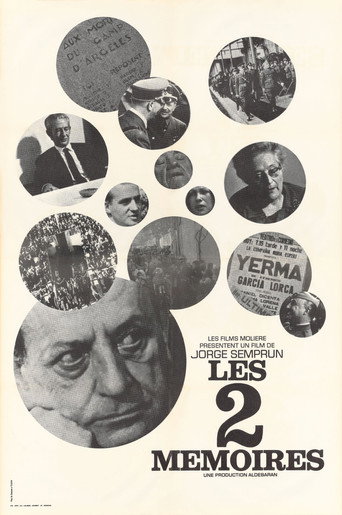
6.0The Two Memories, “an investigation into Republican and Francoist memories”, in the words of Jorge Semprún, is based on interviews conducted in 1972 in France and Spain, archival footage of the Civil War and newsreels from the Franco period.
Les Deux mémoires
1974
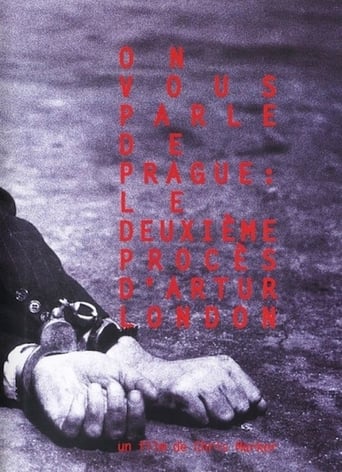 6.6
6.6Artur London was arrested in 1951 in a Stalinist purge, imprisoned and tortured for two years and forced to confess in the Slansky Trial, one of the last Stalinist "show trials" in Eastern Europe. The documentary explores some of the reasons for the controversy aroused by Costa-Gavras' The Confession, which had been accused of being anti-communist, and it highlights the political importance of filmmaking which, by its nature, is a fiction intended for the general public.
You Speak of Prague: The Second Trial of Artur London
1971
Series credits
3.6No synopsis available yet.
Vivement dimanche
1998
8.5Apostrophes was a live, weekly, literary, prime-time, talk show on French television created and hosted by Bernard Pivot. It ran for fifteen years (724 episodes) from January 10, 1975, to June 22, 1990, and was one of the most watched shows on French television (around 6 million regular viewers). It was broadcast on Friday nights on the channel France 2 (which was called "Antenne 2" from 1975 to 1992). The hourlong show was devoted to books, authors and literature. The format varied between one-on-one interviews with a single author and open discussions between four or five authors.
Apostrophes
1975
5.0No synopsis available yet.
Ciné regards
1978
NRNo synopsis available yet.
Lo + plus
1995
No synopsis available yet.
Literatur im Foyer
2000
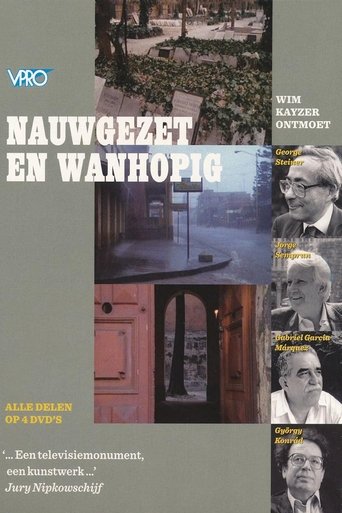 NR
NRThe history of the 20th century told through the memories and reflections of the Spanish writer/politician Jorge Semprún, the Hungarian writer György Konrád, the cosmopolitan writer/literary critic George Steiner and the Latin American writer Gabriel Garcia Márquez.
Meticulous and Desperate
1989
Behind the camera
7.8A prominent politician is murdered during a demonstration. The government and army are trying to suppress the truth, but a tenacious magistrate is determined not to let them get away with it.
Z
1969
6.5On his way from Madrid to Paris, Diego, a chief of the Spanish Communist Party, is arrested at the border for an ID check but manages to flee. When he arrives in Paris, he searches for one of his comrades to prevent him from going to Madrid where he could be arrested.
The War Is Over
1966
 5.9
5.9Biarritz, 1933. Charm and talent assist small-time swindler Serge Alexandre, alias Stavisky, to bribe his way into the centre of French politics. But when his great scam involving millions is exposed, he brings the government to the verge of collapse and the country to the brink of civil war.
Stavisky...
1974
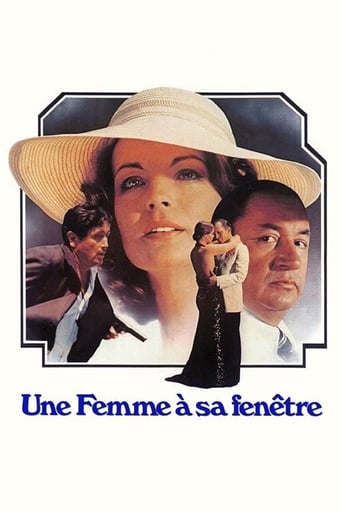 5.8
5.8Greece, 1936. An aristocratic woman engages in a series of loveless affairs before finding herself falling for a political activist.
A Woman at Her Window
1976
 7.3
7.3In 1950s communist Czechoslovakia, a government minister, a war veteran long a loyal party man, leads a relatively comfortable life with his wife. However, he soon finds himself under surveillance, then under arrest. Unclear what his offense is, agents for the totalitarian regime interrogate and torture him, aiming to use their unending power to gain a false confession for these supposed crimes against the state.
The Confession
1970
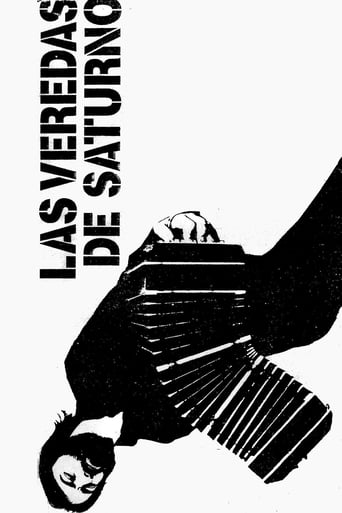 6.0
6.0Hugo Santiago and writers Juan José Saer and Jorge Semprún move back and forth between Paris and the city of Aquilea in a shadowy fable about exile. The frontier between one city and the other begins to blur after Bandoneonist Rodolfo Mederos is visited by his sister, a member of a guerrilla organization.
The Sidewalks of Saturn
1986
 4.5
4.5France, 1975. Jean, an exiled Spanish Communist, is a successful screenwriter who, after a tragic event, struggles with his political commitment, his love for his country, under the boot of General Franco, whose death he and his comrades have waited for years, and his complicated relationship with his son. (A sequel to “The War Is Over,” 1966.)
Roads to the South
1978
 1.8
1.8Manuel passes 18 months at Buchenwald before his return to Paris. He wonders even before his arrival who will have the patience and passion to listen to his narrative. He chooses silence.
Le Temps du silence
2011
 7.1
7.1In Nazi-occupied France, a German officer is assassinated. The Germans demand justice, and the Vichy government is quick to capitulate. Unable to apprehend the actual culprits, Minister of Justice Joseph Barthélémy decides the execution of token Frenchmen will suffice, but the problem is finding judges and jurors eager to participate in a sham trial of innocent men. The solution is a Special Section, a court comprised of individuals handpicked for this exact purpose.
Special Section
1975
6.0The Two Memories, “an investigation into Republican and Francoist memories”, in the words of Jorge Semprún, is based on interviews conducted in 1972 in France and Spain, archival footage of the Civil War and newsreels from the Franco period.
Les Deux mémoires
1974
6.0The Two Memories, “an investigation into Republican and Francoist memories”, in the words of Jorge Semprún, is based on interviews conducted in 1972 in France and Spain, archival footage of the Civil War and newsreels from the Franco period.
Les Deux mémoires
1974
 5.9
5.9In 1894, the French Army discovered the existence of a traitor Alsatian and Jewish, the French officer Alfred Dreyfus makes an ideal culprit. For lack of evidence, the War Ministry creates a damning document Dreyfus overwhelming. Judged and sentenced, Dreyfus is deported to Devil's Island. In 1896, the Army flushed out the real culprit. The truth broke out in 1898 thanks to the mobilization of intellectuals shaken by Zola's "J'accuse!"
L'Affaire Dreyfus
1995
 6.0
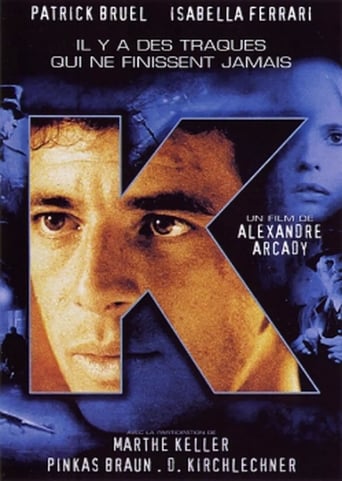
6.0In this French crime film, set during the time of the Gulf War, an elderly German tourist is murdered in Paris by junk dealer Joseph Katz (Pinkas Braun), a friend of Paris detective Sam Bellamy (singer Patrick Bruel). Romantically involved with the victim's daughter Emma Guter (Isabella Ferrari), Bellamy covers up the crime he witnessed. Joseph then mysteriously vanishes, and Bellamy heads for Berlin where the victim's possessions are auctioned. After Bellamy finds the source of the well-hidden traffic in art stolen by Nazis from French Jews, he discovers a Nazi war criminal is blackmailing past associates. Incorporating background from journalist Hector Feliciano's Lost Museum, the film is adapted from Guy Konopnicki's novel, Pas de Kaddish pour Sylberstein (No Kaddish for Sylberstein).
K
1997
 5.9
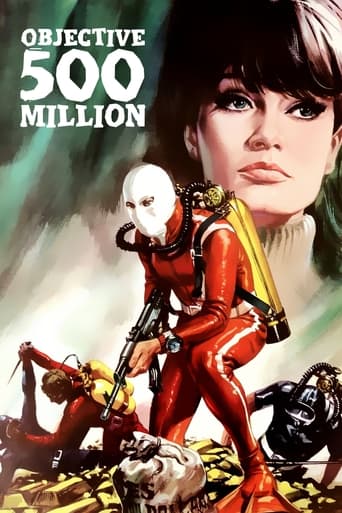
5.9Reichau, a former army captain, is back in France after serving three years in prison for belonging to the OAS (Secret Armed Organization), a dissident paramilitary group during the Algerian War. Marked by his past, he does not believe in the values of his country any more. At a loss to know what to do with his life, he agrees one day to take part in a heist set up by Pierre, a pilot, the very man who gave him away in Oran. The operation, in which Yo, a gorgeous woman, participates, consists in stealing a bag containing 55 million francs during a Paris-Bordeaux flight...
Objective: 500 Million
1966