
Directing
Fernando Krichmar
Known for
Directing
Credits
14 titles
Known for
 8.0
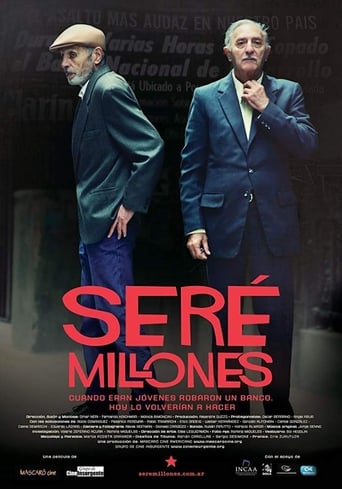
In January 1972, during General Lanusse's dictatorship in Argentina, a group of revolutionary activists occupied the National Development Bank, just meters from the Government House, expropriating 450 million pesos (approximately 10 million dollars today) for their cause. This was made possible by Oscar Serrano and Ángel Abus—activists and bank employees—who spent two years preparing what would become the biggest blow to the dictatorship's finances. Forty years later, Oscar and Ángel, along with a group of actors, recreate those events that changed their lives. In this dialogue between generations, the young people transform their perspective on activism and commitment during those years. Narrated through several cinematic layers, Seré Millones (I Will Be Millions) offers an innovative story that blends humor, rigorous historical research, and the epic spirit of the era.
Seré millones
2014
 NR
The petrochemical pole installed in Ingeniero White hand in hand with the discourse of "progress" promises that Bahía Blanca will become Argentine California. The reality is much harsher. But in this bleak panorama, the voices and bodies of the popular resistance emerge.
El futuro llegó
2017
 NR
A group of young actors attempts to recreate some of the key scenes that tell the story of the Manuel Rodriguez Patriotic Front, the guerrilla group created by the Chilean Communist Party, 10 years after the start of the dictatorship of the genocidal Augusto Pinochet in December 1983.
No son 30 pesos
2023
 NR
On September 16, 2003, the Guaraní community of El Tabacal was repressed and evicted by the San Martín del Tabacal sugar mill, owned by the multinational Seaboard Corporation. Children and elderly people were beaten and subjected to mock executions. The 150 families claiming the territory known as La Loma are still fighting for their ancestral lands.
Yaipota ñande igüi - Queremos nuestra tierra
2006
 8.0
Exploitative labor practices at Northen-Argentina sugar plantation/refinery, documented in the wake of the "desaparecidos" protests of the 1980s.
Diablo, familia y propiedad
1999
From the rediscovery of Argentine documentary cinema, cruelly persecuted and hidden by the Argentine dictatorship, filmmakers from very different political and social backgrounds embarked on a collective aesthetic and counter-information movement that accompanied the struggles against the neoliberal project of the 1990's and uprising of December 19 and 20, 2001. From this movement, a reactivation of Argentine documentary filmmaking was generated, which today, almost coming full circle, is more present than ever.
In Praise Of Rebellion
2025
Behind the camera
8.0In January 1972, during General Lanusse's dictatorship in Argentina, a group of revolutionary activists occupied the National Development Bank, just meters from the Government House, expropriating 450 million pesos (approximately 10 million dollars today) for their cause. This was made possible by Oscar Serrano and Ángel Abus—activists and bank employees—who spent two years preparing what would become the biggest blow to the dictatorship's finances. Forty years later, Oscar and Ángel, along with a group of actors, recreate those events that changed their lives. In this dialogue between generations, the young people transform their perspective on activism and commitment during those years. Narrated through several cinematic layers, Seré Millones (I Will Be Millions) offers an innovative story that blends humor, rigorous historical research, and the epic spirit of the era.
Seré millones
2014
NRThe petrochemical pole installed in Ingeniero White hand in hand with the discourse of "progress" promises that Bahía Blanca will become Argentine California. The reality is much harsher. But in this bleak panorama, the voices and bodies of the popular resistance emerge.
El futuro llegó
2017
NRThe petrochemical pole installed in Ingeniero White hand in hand with the discourse of "progress" promises that Bahía Blanca will become Argentine California. The reality is much harsher. But in this bleak panorama, the voices and bodies of the popular resistance emerge.
El futuro llegó
2017
NRA group of young actors attempts to recreate some of the key scenes that tell the story of the Manuel Rodriguez Patriotic Front, the guerrilla group created by the Chilean Communist Party, 10 years after the start of the dictatorship of the genocidal Augusto Pinochet in December 1983.
No son 30 pesos
2023
NROn September 16, 2003, the Guaraní community of El Tabacal was repressed and evicted by the San Martín del Tabacal sugar mill, owned by the multinational Seaboard Corporation. Children and elderly people were beaten and subjected to mock executions. The 150 families claiming the territory known as La Loma are still fighting for their ancestral lands.
Yaipota ñande igüi - Queremos nuestra tierra
2006
8.0Exploitative labor practices at Northen-Argentina sugar plantation/refinery, documented in the wake of the "desaparecidos" protests of the 1980s.
Diablo, familia y propiedad
1999
From the rediscovery of Argentine documentary cinema, cruelly persecuted and hidden by the Argentine dictatorship, filmmakers from very different political and social backgrounds embarked on a collective aesthetic and counter-information movement that accompanied the struggles against the neoliberal project of the 1990's and uprising of December 19 and 20, 2001. From this movement, a reactivation of Argentine documentary filmmaking was generated, which today, almost coming full circle, is more present than ever.
In Praise Of Rebellion
2025
 7.3
A tribute to Santiago Álvarez, a great innovator in the language of Cuban newsreel images, presented by the ICAIC over the course of thirty years. This unique figure in Latin American cinema is reconstructed. Told as a game of Chinese boxes (documentaries within documentaries, authors within authors, images within images), Álvarez's obsession is revealed to be identical to that of his disciples: to confront the reality of Cuba with other realities, staging aesthetic operations that are nevertheless political operations, always in favor of the Revolution.
El camino de Santiago: Periodismo, cine y revolución
2013
7.3A tribute to Santiago Álvarez, a great innovator in the language of Cuban newsreel images, presented by the ICAIC over the course of thirty years. This unique figure in Latin American cinema is reconstructed. Told as a game of Chinese boxes (documentaries within documentaries, authors within authors, images within images), Álvarez's obsession is revealed to be identical to that of his disciples: to confront the reality of Cuba with other realities, staging aesthetic operations that are nevertheless political operations, always in favor of the Revolution.
El camino de Santiago: Periodismo, cine y revolución
2013
No synopsis available yet.
L’hachumyajay (Nuestra manera de hacer las cosas)
1997
No synopsis available yet.
L’hachumyajay (Nuestra manera de hacer las cosas)
1997