

Sound
Juli Saragosa
Known for
Sound
Credits
14 titles
Juli Saragosa, a multifaceted filmmaker and sound designer, embarked on her artistic journey driven by curiosity and experimentation. Juli graduated from Humber College’s Film and Television Production Program in 1996 and immediately began interning at the top-notch post-production sound facility, Tattersall Sound. Over the following 8 years, Juli gleaned valuable skills and knowledge in the post-production Film & TV industry of Toronto, working on feature films, TV series, and independent short films. She received an MPSE Golden Reel award for best sound editing on the mini-series “The Hunchback” in 1998, and a Gemini nomination for sound editing on the TV series “DaVinci’s Inquest” in 1999…
Known for
A hand-made film that explores a 21st-century ritual celebration - Toronto's Gay Pride Parade (2000). The contrast between the images' archival quality with the 90's dance music makes us wonder whether we are watching an event of some forgotten culture, or something urban and modern.
Parade
2001
Amoré (1min, 16mm film loop, experimental installation) In 2005, Amoré won the Best Canadian Film award at Toronto’s International One-minute Film Festival and in 2011, it won the Jury Prize for Experimental Film at the Toronto Underground Film Festival.
Amoré
2004
 10.0
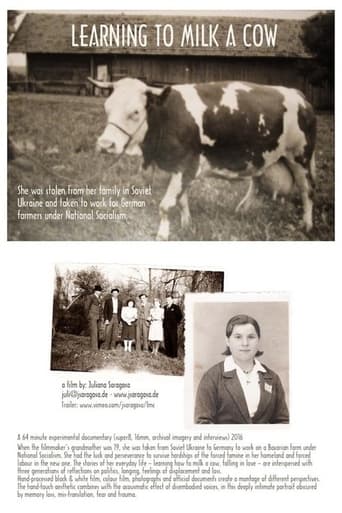
10.0A daring documentary delving into the experiences of a Ukrainian forced labourer in Germany during World War II, exploring themes of love, loss, and profound longing. When the filmmaker’s grandmother was 19, she was taken from Soviet Ukraine to Germany to work on a Bavarian farm under National Socialism. She had the luck and perseverance to survive the hardships of the forced famine in her homeland and forced labour in the new one. The stories of her everyday life – learning how to milk a cow, and falling in love – are interspersed with three generations of reflections on politics, longing, feelings of displacement and loss. Hand-processed black & white film, colour film, photographs and official documents create a montage of different perspectives. The hand-touch aesthetic combines with the acousmatic effect of disembodied voices, in this deeply intimate portrait obscured by memory loss, mistranslation, fear and trauma.
Learning to Milk a Cow
2016
A Super-8 short-film adaptation of S.E. Hinton's "The Outsiders" styled as a music video/silent-film -- director Juli Saragosa has a different take on greaser masculinity than did Francis Ford Coppola.
The Outsiders
2005
 NR
NR2005 They Dance Alone (5mins, 16mm, personal-poetic)
They Dance Alone
2005
 NR
NRThis Super 8 film was first presented as part of a ritual performance where Saragosa is naked and pulls a white piece of fabric out of her "yoni", pinning it up and projecting the film onto it in reverse, while speaking the words on the film. The performance was part of a collective recreation of Carolee Schneemann’s ‘Interior Scroll.’
Film Scroll
2004
Film credits
2000s · 2 titles
A Super-8 short-film adaptation of S.E. Hinton's "The Outsiders" styled as a music video/silent-film -- director Juli Saragosa has a different take on greaser masculinity than did Francis Ford Coppola.
The Outsiders
2005
NRThis Super 8 film was first presented as part of a ritual performance where Saragosa is naked and pulls a white piece of fabric out of her "yoni", pinning it up and projecting the film onto it in reverse, while speaking the words on the film. The performance was part of a collective recreation of Carolee Schneemann’s ‘Interior Scroll.’
Film Scroll
2004
Behind the camera
A hand-made film that explores a 21st-century ritual celebration - Toronto's Gay Pride Parade (2000). The contrast between the images' archival quality with the 90's dance music makes us wonder whether we are watching an event of some forgotten culture, or something urban and modern.
Parade
2001
Amoré (1min, 16mm film loop, experimental installation) In 2005, Amoré won the Best Canadian Film award at Toronto’s International One-minute Film Festival and in 2011, it won the Jury Prize for Experimental Film at the Toronto Underground Film Festival.
Amoré
2004
10.0A daring documentary delving into the experiences of a Ukrainian forced labourer in Germany during World War II, exploring themes of love, loss, and profound longing. When the filmmaker’s grandmother was 19, she was taken from Soviet Ukraine to Germany to work on a Bavarian farm under National Socialism. She had the luck and perseverance to survive the hardships of the forced famine in her homeland and forced labour in the new one. The stories of her everyday life – learning how to milk a cow, and falling in love – are interspersed with three generations of reflections on politics, longing, feelings of displacement and loss. Hand-processed black & white film, colour film, photographs and official documents create a montage of different perspectives. The hand-touch aesthetic combines with the acousmatic effect of disembodied voices, in this deeply intimate portrait obscured by memory loss, mistranslation, fear and trauma.
Learning to Milk a Cow
2016
A Super-8 short-film adaptation of S.E. Hinton's "The Outsiders" styled as a music video/silent-film -- director Juli Saragosa has a different take on greaser masculinity than did Francis Ford Coppola.
The Outsiders
2005
NR2005 They Dance Alone (5mins, 16mm, personal-poetic)
They Dance Alone
2005
NRThis Super 8 film was first presented as part of a ritual performance where Saragosa is naked and pulls a white piece of fabric out of her "yoni", pinning it up and projecting the film onto it in reverse, while speaking the words on the film. The performance was part of a collective recreation of Carolee Schneemann’s ‘Interior Scroll.’
Film Scroll
2004
NRThis Super 8 film was first presented as part of a ritual performance where Saragosa is naked and pulls a white piece of fabric out of her "yoni", pinning it up and projecting the film onto it in reverse, while speaking the words on the film. The performance was part of a collective recreation of Carolee Schneemann’s ‘Interior Scroll.’
Film Scroll
2004
 NR
NRSet in the near future, a collective of queer-feminist superhero*ines make use of their different identities, backgrounds and experiences to fight back against sexual and gender-based violence – a fusion of science, technology, magic, and ritual. Clashes and conflicts arise as they negotiate and try to come to a consensus on their aim of disrupting toxic hierarchies. The project is currently in post-production.
Reasons to Scream!
—
NRSet in the near future, a collective of queer-feminist superhero*ines make use of their different identities, backgrounds and experiences to fight back against sexual and gender-based violence – a fusion of science, technology, magic, and ritual. Clashes and conflicts arise as they negotiate and try to come to a consensus on their aim of disrupting toxic hierarchies. The project is currently in post-production.
Reasons to Scream!
—
NRSet in the near future, a collective of queer-feminist superhero*ines make use of their different identities, backgrounds and experiences to fight back against sexual and gender-based violence – a fusion of science, technology, magic, and ritual. Clashes and conflicts arise as they negotiate and try to come to a consensus on their aim of disrupting toxic hierarchies. The project is currently in post-production.
Reasons to Scream!
—
 NR
NRA long process of experimentation with a variety of different filmmaking techniques while examining an evolving queer identity. The film shows an emergence of the Pink Fairy. Part femme, part tomboy, part fairy, the characters come together to subvert the idea of a fixed identity. Luminescent imagery is imprinted by hand using hand-processed colour footage, optically printing Super 8 to 16mm, 16mm to 16mm, negative to positive, video to film, and repeating motifs, to explore the intricacies of the celluloid medium. Audio emotes through random manipulations in a Brion Gysin-like cut-up technique.
Pink Fairy
2007