
Acting
Vladimir Horowitz
Born — Died
1903-10-01 — 1989-11-05
Place of birth
Kiev, Russian Empire [now Ukraine]
Known for
Acting
Credits
11 titles
Vladimir Samoylovich Horowitz (19031989) was an American classical pianist and composer born in the Russian Empire. He was acclaimed for his virtuoso technique, his tone color, and the excitement engendered by his playing. He is recognized as one of the greatest pianists of all time.
Known for
 NR
NRA stimulating study which features concert footage and interviews with the master pianist. Includes many of his favorite pieces.
Horowitz: The Last Romantic
1985
 NR
NRCelebrated American pianist Vladimir Horowitz in his first televised piano recital, taped at Carnegie Hall on February 1, 1968, and broadcast nationwide by CBS on September 22 of that year.
Vladimir Horowitz: A Television Concert at Carnegie Hall
1968
 NR
NRAlexander Scriabin (1872–1915) born in Moscow, was an innovative, mystical, avant-garde Russian pianist and composer. This film explores Scriabin’s profound vision of art's unity — where music, movement, light and colour merge to create transcendent experiences. Some claim Scriabin pioneered atonality before Schoenberg. Key works: Poème, Op. 32 No. 1 (1903) and Vers la flamme, Op. 72 (1914). Featuring commentary from esteemed musicians like Eduard Artemyev, Vladimir Ashkenazy and Vladimir Horowitz, Artist: Hermann Nitsch, conductor Mikhail Pletnev and insights from Scriabin’s daughter: Marina Scriabine, this documentary offers a unique glimpse into the life and works of one of music’s most enigmatic figures. Shot across stunning locales in Switzerland, Italy and Russia, enriched with Scriabin’s own writings and rare archival materials. The highlight includes a historic recording of Scriabin himself, playing his Poem Op. 32 No. 1 on a Welte Mignon player-piano, recorded in 1908.
Alexander Scriabin – Towards the Light / Calculation and Ecstasy
1996
 9.3
9.3This is a film that encapsulates the essence of a great pianistic age that married virtuosity and musicianship with the most thrilling aspect of individual showmanship.
The Art of Piano - Great Pianists of 20th Century
1999
 NR
NRVladimir Horowitz's piano recital in 1987 at the Musikvereinssaal in Vienna.
Horowitz in Vienna
1987
Piano Vladimir Horowitz in a televised recital from the White House on 26 January 1978, on the occasion of the 50th anniversary of his US debut, at the invitation of President & Mrs Carter. On the program, Chopin's Sonata #2 in B-flat minor, Waltzes in A minor and C-sharp minor, and Polonaise in A-flat, followed by encores by Schumann, Rachmaninoff, and Horowitz's own Carmen Variations.
Horowitz at the White House
1978
Film credits
1990s · 4 titles
NRAlexander Scriabin (1872–1915) born in Moscow, was an innovative, mystical, avant-garde Russian pianist and composer. This film explores Scriabin’s profound vision of art's unity — where music, movement, light and colour merge to create transcendent experiences. Some claim Scriabin pioneered atonality before Schoenberg. Key works: Poème, Op. 32 No. 1 (1903) and Vers la flamme, Op. 72 (1914). Featuring commentary from esteemed musicians like Eduard Artemyev, Vladimir Ashkenazy and Vladimir Horowitz, Artist: Hermann Nitsch, conductor Mikhail Pletnev and insights from Scriabin’s daughter: Marina Scriabine, this documentary offers a unique glimpse into the life and works of one of music’s most enigmatic figures. Shot across stunning locales in Switzerland, Italy and Russia, enriched with Scriabin’s own writings and rare archival materials. The highlight includes a historic recording of Scriabin himself, playing his Poem Op. 32 No. 1 on a Welte Mignon player-piano, recorded in 1908.
Alexander Scriabin – Towards the Light / Calculation and Ecstasy
1996
9.3This is a film that encapsulates the essence of a great pianistic age that married virtuosity and musicianship with the most thrilling aspect of individual showmanship.
The Art of Piano - Great Pianists of 20th Century
1999
 7.5
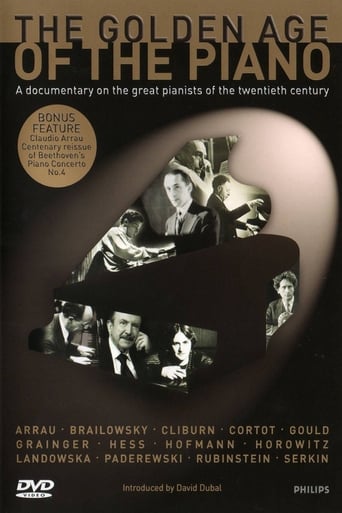
7.5Academician and piano expert David Dubal narrates this absorbing documentary chronicling the instrument's history and featuring some of the 20th century's finest pianists via archival film clips. Among the keyboard virtuosos are Vladimir Horowitz, Claudio Arrau, Van Cliburn and Glenn Gould. Extras include Arrau's 1983 performance of Ludwig van Beethoven's Piano Concerto no. 4, accompanied by the Philadelphia Orchestra under maestro Riccardo Muti.
The Golden Age of the Piano
1993
 7.0
7.0Wanda Horowitz reminisces about her husband, the great pianist Vladimir Horowitz, with clips from his television appearances.
Horowitz: A Reminiscence
1993
1980s · 5 titles
NRA stimulating study which features concert footage and interviews with the master pianist. Includes many of his favorite pieces.
Horowitz: The Last Romantic
1985
NRVladimir Horowitz's piano recital in 1987 at the Musikvereinssaal in Vienna.
Horowitz in Vienna
1987
 5.2
5.2A recording of Horowitz's historic 1986 recital in Moscow, the program also includes highlights of his return to his native Soviet Union--his first visit in 61 years.
Horowitz in Moscow
1986
 8.0
8.0In March 1987, pianist Vladimir Horowitz embarked on an extraordinary project. For the first time in 35 years, he agreed to record with a symphony orchestra in a studio. He chose the conductor, Carlo Maria Giulini, the orchestra, the La Scala Philharmonic, and the location, the Abanella recording studio of La Scala in Milan. Horowitz steadfastly refused to allow the month-long sessions to be filmed, until the evening before the last scheduled session when he unexpectedly changed his mind. His manager, Peter Gelb, immediately telephoned Albert Maysles and Susan Froemke in New York, the co-filmmakers of "Vladimir Horowitz: The Last Romantic." That same night, the Maysles film crew flew from New York.
Horowitz Plays Mozart
1987
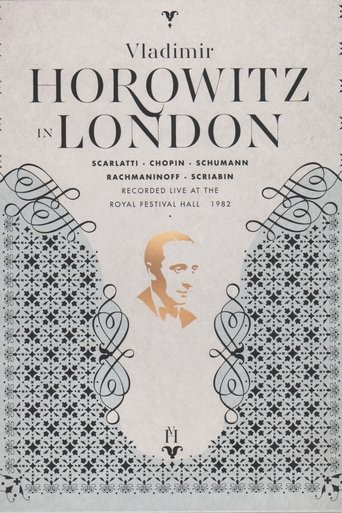 NR
NRVladimir Horowitz's piano recital in 1982 at Royal Festival Hall in London.
Horowitz in London
1982