

Directing
DeeDee Halleck
Born 1940-01-05
DeeDee Halleck is an internationally renowned filmmaker, teacher and media activist, who has campaigned passionately for media democracy for more than 40 years. As co-founder of Paper Tiger Television and the Deep Dish Satellite Network, she planted an array of technologies — home video, cable television and online and satellite broadcasting — firmly in the hands of community organizers and low-income media-makers. Halleck has served as a trustee of the American Film Institute, Women Make Movies, and the Instructional Telecommunications Foundation. She has received the George Stoney Award from the Alliance for Community Media, the Lifetime Achievement Award of the National Alliance for Media Arts and Culture (NAMAC), and the 2003 Herbert Schiller Award.
Acting credits
Behind the camera
A portrait of an 88-year-old neighbor who canes chairs and ruminates on women and morality.
Mr. Story
1969
 NR
NRA performance by Margo Lee Sherman, Christian DuPavillon, and Kenny Eisenstat based on a dream that Elka Schumann had about the French Revolution. Originally filmed in 16mm in Glover Vermont. Direction by Peter Schumann. The digital version was edited by DeeDee Halleck and Mary Feaster in 2019.
The Dream of the Dirty Woman
1975
 NR
NRA film about a Ukrainian woman who was an ardent supporter of the Soviet Union. She bakes pirogi and speaks of her life. She was the cook at a popular Ukrainian cafeteria on the Lower East Side for years and later ran a boarding house on the Burlingham Road near Bloomingburg, New York. Music by the Penny Whistlers.
Jaraslawa
1974
 NR
NRA pentacostal baptism service at a large church (former movie theater) in the South Bronx, shot 1977, edited 1979. Begun as a landscape film about the destruction of the Bronx in the 1970s. Camera: Richard Serra, DeeDee Halleck, and Babette Mangolte, Jane Warrenbrand, Stuart Math, and Ted Glass.
Bronx Baptism
1979
 NR
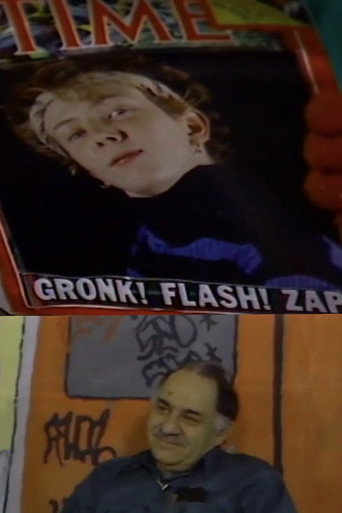
NRHistorian, political philosopher, environmentalist, and anarchist Murray Bookchin demonstrates how Time magazine obliterates time in this 1982 episode of Paper Tiger Television. Time is soothing. The events in Time look nothing like the events experienced by those at them. The news in Time happens elsewhere, happens to others. Time is reliable. It comes each week, and with it, past, present, and future merge to the point of disappearance. Like television, Time lulls readers into complacency because the news is given an even, consistent tone. All issues are treated the same, with the same bland distance. Time makes a reality so unreal, so colorless. The news in Time comes written and photographed in a comforting tone that treats events as inconsequential and thus encourages a notion of not just a false sense of security, but a sense that our actions are without consequence.
Murray Bookchin Reads Time Magazine
1982
 NR
NRJudith Williamson examines consumer culture in America, from the multiplication of products and their functions to capitalism’s colonization of the body. What is the meaning of freedom in modern day America? Is it the freedom to change the world or the freedom to change our socks?
Sock Ads: Judith Williamson Consumes Passionately in Southern California
1987
 4.0
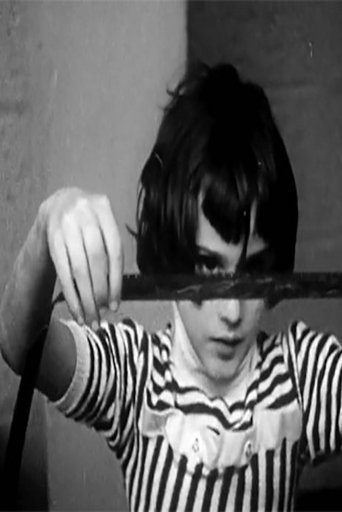
4.0This is documentation of a workshop held at the Lillian Wald Recreation Rooms and Settlement. It shows two filmmaking projects by youth. This film was shown at a UNESCO conference in 1962 in Oslo, Norway and was commended for being the "most spontaneous" and "drawing the most applause" by Jonas Mekas in a review in the Village Voice.
Children Make Movies
1961
 9.0
9.0Oscar nominated documentary short from 1965
Mural on Our Street
1965
 NR
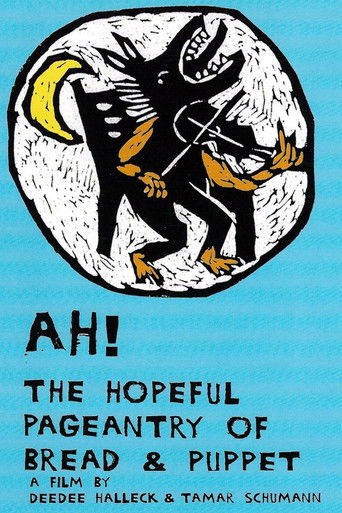
NRA documentary about the Bread and Puppet Theater made from over 200 hours of footage shot at the Bread and Puppet Domestic Resurrection Circus from 1990-1998. Neither a straight documentary nor an “educational” rendition of theater history, Ah! is more like a Bread and Puppet film, one that captures the spirit and essence of this influential theater group.
Ah! The Hopeful Pageantry of Bread and Puppet
2002
 NR
NRFantastical, larger-than-life puppetry and rambunctiously playful choreography is framed against an Edenic backdrop of Vermont farm country in George Griffin and DeeDee Halleck’s luminous, lyrical short film, which documents the 1974 edition of the Bread and Puppet Theater’s annual Domestic Resurrection Circus, taking place soon after the company’s relocation from downtown Manhattan to the rural New England enclave where it remains headquartered to this day.
The Meadows Green
1975
 7.0
7.0Documentary about the strained relations that Latin America has with the United States. Halleck says at the beginning that the images of Latin America she saw in Hollywood films didn't match the reality she knew growing up in Cuba. She then uses footage of old Hollywood films, newsreels and corporate advertising films to show that, even in the early 20th century, these problematic relations between Latin America and the US were well known to Americans, even if they didn't want to recognize them.
The Gringo in Mananaland
1995
7.0Documentary about the strained relations that Latin America has with the United States. Halleck says at the beginning that the images of Latin America she saw in Hollywood films didn't match the reality she knew growing up in Cuba. She then uses footage of old Hollywood films, newsreels and corporate advertising films to show that, even in the early 20th century, these problematic relations between Latin America and the US were well known to Americans, even if they didn't want to recognize them.
The Gringo in Mananaland
1995
7.0Documentary about the strained relations that Latin America has with the United States. Halleck says at the beginning that the images of Latin America she saw in Hollywood films didn't match the reality she knew growing up in Cuba. She then uses footage of old Hollywood films, newsreels and corporate advertising films to show that, even in the early 20th century, these problematic relations between Latin America and the US were well known to Americans, even if they didn't want to recognize them.
The Gringo in Mananaland
1995