
Directing
Thomas Renoldner
Known for
Directing
Credits
13 titles
Born in 1960 in Linz, he studied psychology and educational theory (1979–83), followed by painting and animation film studies at the Academy of Applied Arts in Vienna (1989–94). A self-taught filmmaker since his youth, he also works in music, painting, installation, and performance. Renoldner has directed numerous experimental, animated, and documentary films as well as commercials, and is active as a producer, teacher, film historian, festival organiser, and curator for animated films.
Known for
The psychological inner life of a child that has experienced sexual violence. This film essay symbolically tells of violence and the dynamics of hurting in the language of an inoccent child.
Wüstenherzen
1993
 5.0
5.0Twenty-eight well-known filmmakers living and working in Austria were invited by WIENER MOZARTJAHR 2006, to produce associative miniatures on Mozart. Requirement: they had to be one-minute artistic short films. The directors come from a whole range of different backgrounds, ranging from animated, experimental and short film to documentaries and feature films. The result is a multi-facetted sampler of diverse formal and contextual positions with regard to Mozart’s person and his influence on today’s society, art and culture. The contributions run the gamut from experimental-conceptual statements through socio-critical and documentary observations to pithy short feature films.
The Mozart Minute
2006
 10.0
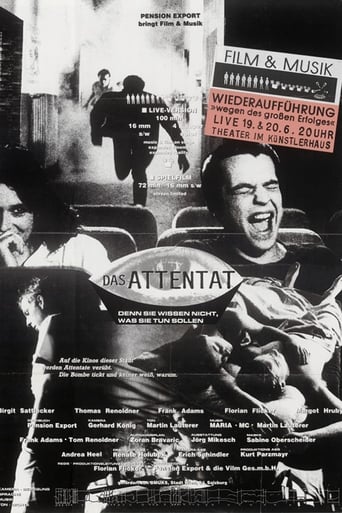
10.0Sabotage acts are committed on the film theaters of a city for no apparent reason. Two secretaries of "Mega Film", which has been damaged by a sabotage act, decide to try to find the saboteurs in order to determine what their motives are.
The Assault - They didn't know what to do
1989
 5.3
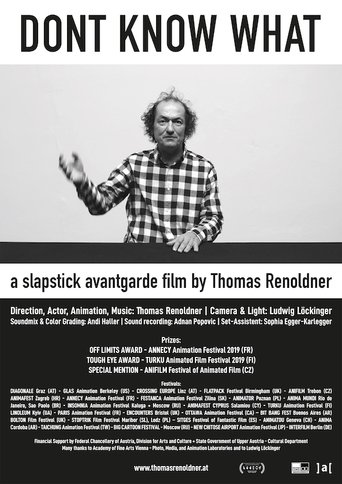
5.3A man gazes into the camera, breaths, speaks, and blinks. In playfully formal austerity, Thomas Renoldner explores the borders of the cinematic genre. Real film becomes stop-motion, language a hammering noise staccato. The film draws comical and intellectual potential from the transformation of organic movements and sounds into mechanical ones, from the dissolution of the world into abstraction and rhythm.
Don't Know What
2018
 NR
NRNot my first, but quite early animation "test films" realized back in approx. 1985.
How to Do a Trickfilm
1985
 NR
NRThe film is uncommonly poetic and refined. The pictures come from a book by Federica Pagnucco and Linda Wolfsgruber, realized with printed characters in wood and lead. An old printing tecnique, well blended with wood-printed shapes, which gives a special aura of magic to the book, and subsequently to its animated version, thanks to the participation of Thomas Renoldner and the evocative soundtrack by Peter Rosmanith. It is a precious film owing to the rare suspension of the atmosphere and time, actually fixed and focusing on small things, habits, interstices, in the end, worlds...
l'alfabeto delle cose piccole
2015
Film credits
Behind the camera
5.0Twenty-eight well-known filmmakers living and working in Austria were invited by WIENER MOZARTJAHR 2006, to produce associative miniatures on Mozart. Requirement: they had to be one-minute artistic short films. The directors come from a whole range of different backgrounds, ranging from animated, experimental and short film to documentaries and feature films. The result is a multi-facetted sampler of diverse formal and contextual positions with regard to Mozart’s person and his influence on today’s society, art and culture. The contributions run the gamut from experimental-conceptual statements through socio-critical and documentary observations to pithy short feature films.
The Mozart Minute
2006
5.3A man gazes into the camera, breaths, speaks, and blinks. In playfully formal austerity, Thomas Renoldner explores the borders of the cinematic genre. Real film becomes stop-motion, language a hammering noise staccato. The film draws comical and intellectual potential from the transformation of organic movements and sounds into mechanical ones, from the dissolution of the world into abstraction and rhythm.
Don't Know What
2018
5.3A man gazes into the camera, breaths, speaks, and blinks. In playfully formal austerity, Thomas Renoldner explores the borders of the cinematic genre. Real film becomes stop-motion, language a hammering noise staccato. The film draws comical and intellectual potential from the transformation of organic movements and sounds into mechanical ones, from the dissolution of the world into abstraction and rhythm.
Don't Know What
2018
NRNot my first, but quite early animation "test films" realized back in approx. 1985.
How to Do a Trickfilm
1985
NRThe film is uncommonly poetic and refined. The pictures come from a book by Federica Pagnucco and Linda Wolfsgruber, realized with printed characters in wood and lead. An old printing tecnique, well blended with wood-printed shapes, which gives a special aura of magic to the book, and subsequently to its animated version, thanks to the participation of Thomas Renoldner and the evocative soundtrack by Peter Rosmanith. It is a precious film owing to the rare suspension of the atmosphere and time, actually fixed and focusing on small things, habits, interstices, in the end, worlds...
l'alfabeto delle cose piccole
2015
 1.0
1.0The confrontation of “kind of” an avant-garde film with “kind of” a music video, and consequently puts questions about the standard taboos and clichés of different filmgenres. Both avant-garde film and music video use music and sound “typical for their genre”.
Sunny Afternoon
2012
No synopsis available yet.
Die Begrenzungslinien der Projektionsfläche
—
The generating material for Rhythm 94 is a sequence of photographs taken by the cinematographic pioneer Eadweard Muybridge. The sequence is transposed into a single movement across the screen. The basic pattern arising out of the abstract nature of the photo animation is available for repetition at various speeds and in various spatial relationships.
Rhythmus 94
1994
 4.0
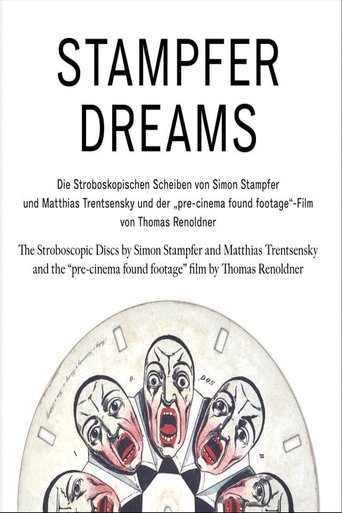
4.0In 1833, mathematician Simon von Stampfer introduced the stroboscopic disc in Vienna—one of the earliest cinema prototypes. The discs feature all forms of animation: abstract and narrative, documentary and (quite literally!) experimental. This film is based on images from Stampfer’s discs.
Stampfer Dreams
2024
4.0In 1833, mathematician Simon von Stampfer introduced the stroboscopic disc in Vienna—one of the earliest cinema prototypes. The discs feature all forms of animation: abstract and narrative, documentary and (quite literally!) experimental. This film is based on images from Stampfer’s discs.
Stampfer Dreams
2024