

Camera
Grigoriy Aleksandrov
Born — Died
1904-09-30 — 1990-08-20
Place of birth
Poltava, Poltavskaya guberniya, Russian Empire [now in Poltavs'ka oblast', Ukraine]
Known for
Camera
Credits
2 titles
Known for
 NR
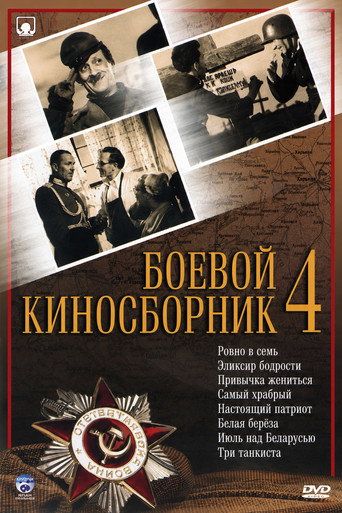
Collection of Films for the Armed Forces #4 was filmed at the Moscow film studio Soyuzdetfilm during the days of the German offensive on Moscow. It consists of three short stories, linked by the emcee performances of Lyubov Orlova as the mail carrier Strelka, the heroine of the comedy "Volga, Volga," who delivers new films along with the letters. It was released on September 9, 1941.
Collection of Films for the Armed Forces #4
1941
Famed Russian revolutionary film director Sergei Eisenstein traveled to Mexico in December 1930 to experience firsthand its “geographical, ethnological, cultural and historical diversity” and to make the feature film known to the world as ¡QUE VIVA MÉXICO! After shooting 200,000 feet of 35mm film footage, drawing hundreds of outlandish sketches and writing volumes of theoretical texts, he departed in April 1932 without a completed film. We will never know what Eisenstein might have edited given the chance — perhaps he did not know himself — but we can show you what he actually directed and shot in Mexico. IDOLS BEHIND ALTARS is a two-screen rearrangement of images from Jay Leyda’s 1955 genre-breaking EISENSTEIN’S MEXICAN FILM: EPISODES FOR STUDY, now newly restored and featuring a new score by Paul D. Miller, a.k.a. DJ Spooky.
Idols Behind Altars: A Poetic Reverie for Anita Brenner
2026
Behind the camera
NRCollection of Films for the Armed Forces #4 was filmed at the Moscow film studio Soyuzdetfilm during the days of the German offensive on Moscow. It consists of three short stories, linked by the emcee performances of Lyubov Orlova as the mail carrier Strelka, the heroine of the comedy "Volga, Volga," who delivers new films along with the letters. It was released on September 9, 1941.
Collection of Films for the Armed Forces #4
1941
Famed Russian revolutionary film director Sergei Eisenstein traveled to Mexico in December 1930 to experience firsthand its “geographical, ethnological, cultural and historical diversity” and to make the feature film known to the world as ¡QUE VIVA MÉXICO! After shooting 200,000 feet of 35mm film footage, drawing hundreds of outlandish sketches and writing volumes of theoretical texts, he departed in April 1932 without a completed film. We will never know what Eisenstein might have edited given the chance — perhaps he did not know himself — but we can show you what he actually directed and shot in Mexico. IDOLS BEHIND ALTARS is a two-screen rearrangement of images from Jay Leyda’s 1955 genre-breaking EISENSTEIN’S MEXICAN FILM: EPISODES FOR STUDY, now newly restored and featuring a new score by Paul D. Miller, a.k.a. DJ Spooky.
Idols Behind Altars: A Poetic Reverie for Anita Brenner
2026