
Acting
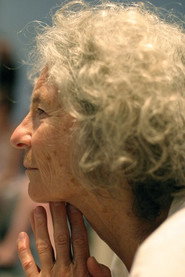
Simone Forti
Born 1935-03-25 · Florence, Tuscany, Italy
Simone Forti (March 25, 1935 – July 29, 2026) was an American postmodern artist, dancer, choreographer, and writer. From the 1950s onward, she exhibited, performed, and taught workshops throughout the world. Her innovations in Postmodern dance, including her seminal 1961 body of work, Dance Constructions, along with her contribution to the early Fluxus movement, have influenced many notable dancers and artists.
Acting credits
 NR
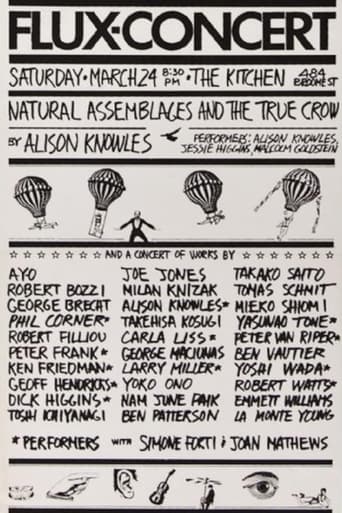
NROn March 24, 1979, The Kitchen presented a two-part program dedicated to the work of various Fluxus artists. The programming began with the premiere of Alison Knowles’s “Natural Assemblages and the True Crow.” For the piece, Knowles engaged in a dialogue with her own taped voice, which read aloud selections from various natural history books. Simultaneously, violinist Michael Goldstein provided an improvised score while dancer Jessie Higgins executed a number of one-movement phrases by following instructions on index cards. The second part of the night’s programming consisted of forty rapid performances—most sixty seconds or less—by various Fluxus members, including Yoko Ono, George Brecht, La Monte Young, and Nam June Paik. Ken Friedman and Larry Miller coordinated this portion of the event.
Flux-Concert
1979
Adopting the movements of various animals, Forti begins the performance by walking hypnotically in circles. She falls to the floor and begins a cycle of walking and crawling that becomes an open metaphor for evolution and aging. Through the course of the performance, the camera follows Forti's circling motion at increasingly close range, creating an interactive dance between camera and performer. While "rustic" in respect to the quality of the video image and sound, Solo No. 1 serves as an engaging document of Forti's dedicated study of natural movement.
Solo No. 1
1974
 NR
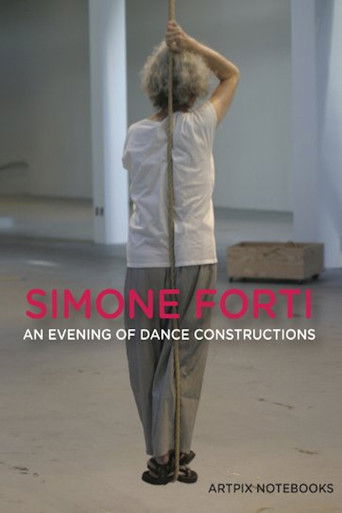
NRIn the spring of 1961 Simone Forti presented a program titled Five Dance Constructions and Some Other Things in a concert series organized by her friend, composer La Monte Young, at the New York loft studio of Yoko Ono. These radically new dances created circumstances for the performers’ direct, non-stylistic actions. Each of the pieces was performed in a different place in the loft, with the audience moving from location to location to view them. Some of the pieces required elementary structures – a hanging rope, rectangular wooden boxes – which were placed throughout the loft like a sculptural installation. In 2004 the Museum of Contemporary Art in Los Angeles invited Forti to re-create these dance constructions at the Geffen Contemporary space, in conjunction with the exhibition A Minimalist Future? Art as Object 1958 – 1986.
Simone Forti: An Evening of Dance Constructions
2009
 NR
NRMultimedia documentary project profiling pioneering, emerging, innovative and otherwise compelling Los Angeles-based female artists, philosophers and social entrepreneurs.
L.A. Woman
2013
 4.5
4.5Composed of just four shots in which Clara McHale-Ribot, Rachel Kushner, Richard Hebdige, and Simone Forti read quietly to themselves, the film offers portraits of its subjects while simultaneously serving as a mirror for the viewers, who perform a parallel stillness.
Readers
2017
Behind the camera
Video made by Simone Forti and Anne Tardos in 1977 and re-edited in 99.
Statues
1977
Adopting the movements of various animals, Forti begins the performance by walking hypnotically in circles. She falls to the floor and begins a cycle of walking and crawling that becomes an open metaphor for evolution and aging. Through the course of the performance, the camera follows Forti's circling motion at increasingly close range, creating an interactive dance between camera and performer. While "rustic" in respect to the quality of the video image and sound, Solo No. 1 serves as an engaging document of Forti's dedicated study of natural movement.
Solo No. 1
1974
NRIn the spring of 1961 Simone Forti presented a program titled Five Dance Constructions and Some Other Things in a concert series organized by her friend, composer La Monte Young, at the New York loft studio of Yoko Ono. These radically new dances created circumstances for the performers’ direct, non-stylistic actions. Each of the pieces was performed in a different place in the loft, with the audience moving from location to location to view them. Some of the pieces required elementary structures – a hanging rope, rectangular wooden boxes – which were placed throughout the loft like a sculptural installation. In 2004 the Museum of Contemporary Art in Los Angeles invited Forti to re-create these dance constructions at the Geffen Contemporary space, in conjunction with the exhibition A Minimalist Future? Art as Object 1958 – 1986.
Simone Forti: An Evening of Dance Constructions
2009
NRIn the spring of 1961 Simone Forti presented a program titled Five Dance Constructions and Some Other Things in a concert series organized by her friend, composer La Monte Young, at the New York loft studio of Yoko Ono. These radically new dances created circumstances for the performers’ direct, non-stylistic actions. Each of the pieces was performed in a different place in the loft, with the audience moving from location to location to view them. Some of the pieces required elementary structures – a hanging rope, rectangular wooden boxes – which were placed throughout the loft like a sculptural installation. In 2004 the Museum of Contemporary Art in Los Angeles invited Forti to re-create these dance constructions at the Geffen Contemporary space, in conjunction with the exhibition A Minimalist Future? Art as Object 1958 – 1986.
Simone Forti: An Evening of Dance Constructions
2009