
Directing
Mariano Donoso
Acting credits
 NR
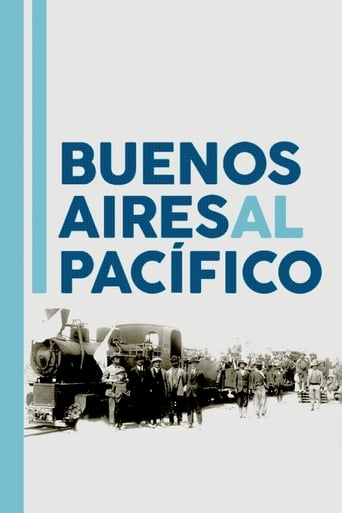
NRThere was once, in 1910, a train able to cross the wild territories between Argentina and Chile, making possible a mythical journey, joining two oceans with a single ticket, from Buenos Aires to Valparaiso. The last trip of the BAP was in 1979; in the nineties, its various branches were permanently abandoned. Since then, travelers have been inhabiting the railway landscape as they dream, desire, remember or yearn: as part of their own being and national history.
Buenos Aires al Pacífico
2019
 8.0
8.0In July 2002, an American Producer comissions director Mariano Donoso a documentary on the state of Education in San Juan, the province where he was born. On the first day of filming, a teachers’ strike begins, paralyzing classes in the whole province, and – indirectly – the film itself. Donoso consequently embarks on an odyssey (which is sometimes funny and sometimes sad), through the past and present of his homeland. Stikes, claims, Sarmiento, the earthquake, the province’s bureocracy and its relationship with Buenos Aires, and finally, the desert, await for Donoso in his venturesome journey.
Opus
2005
Behind the camera
 NR
NRThree decades later, the San Juan Civic Center construction project is back on track and, as if nothing had happened, the bureaucratic machinery seems to be united with the cranes and the human force and the megalomaniac desire that such an undertaking supposes. There, in that interruption and that return to activity, in the pharaonic recovery of lost dreams and projects that suddenly come back to life –as if they were architectural zombies–, there Mariano Donoso sees a movie.
Tekton
2009
NRThree decades later, the San Juan Civic Center construction project is back on track and, as if nothing had happened, the bureaucratic machinery seems to be united with the cranes and the human force and the megalomaniac desire that such an undertaking supposes. There, in that interruption and that return to activity, in the pharaonic recovery of lost dreams and projects that suddenly come back to life –as if they were architectural zombies–, there Mariano Donoso sees a movie.
Tekton
2009
 8.0
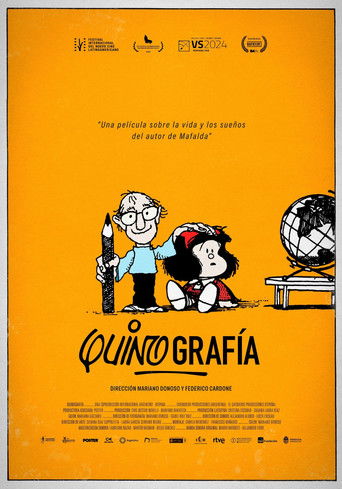
8.0With never-before-seen images and interviews, this documentary explores the life of Quino, one of Argentina's most important humorists.
Quinografía
2025
"Radiography of the desert" pretends to be, by extrapolation, what "Radiography of the pampa" (the 1933 book by Ezequiel Martínez Estrada) was for the humid and fertile area of the country. The documentary, filmed in the Lavalle drylands and the Andean foothills, observes several characters and their jobs related to the most arid areas of the province of Mendoza: a pilot who enters the summer storms, bombarding the clouds with silver iodide to prevent hail from damaging crops; a fisherman from the Nihuil lagoon who barely survives in a polluted dam; a family of wells who build cisterns and irrigation wells in rural desert areas; and a geographer in search of Francisco de Hoces's journey.
Radiografía del desierto
2013
"Radiography of the desert" pretends to be, by extrapolation, what "Radiography of the pampa" (the 1933 book by Ezequiel Martínez Estrada) was for the humid and fertile area of the country. The documentary, filmed in the Lavalle drylands and the Andean foothills, observes several characters and their jobs related to the most arid areas of the province of Mendoza: a pilot who enters the summer storms, bombarding the clouds with silver iodide to prevent hail from damaging crops; a fisherman from the Nihuil lagoon who barely survives in a polluted dam; a family of wells who build cisterns and irrigation wells in rural desert areas; and a geographer in search of Francisco de Hoces's journey.
Radiografía del desierto
2013
 NR
NRIn a warehouse, the remains of an abandoned mural are found. A broken mirror of collective memory, a puzzle to be reconstructed so that the university and society can recover their history. Because nothing is ever completely erased or rebuilt, but it does become transparent when the "Notes of Memory" are recovered. Thus, the fragments of political participation and repression at UNCuyo in the 1970s are united.
Apuntes de la Memoria
2014
NRThere was once, in 1910, a train able to cross the wild territories between Argentina and Chile, making possible a mythical journey, joining two oceans with a single ticket, from Buenos Aires to Valparaiso. The last trip of the BAP was in 1979; in the nineties, its various branches were permanently abandoned. Since then, travelers have been inhabiting the railway landscape as they dream, desire, remember or yearn: as part of their own being and national history.
Buenos Aires al Pacífico
2019
NRThere was once, in 1910, a train able to cross the wild territories between Argentina and Chile, making possible a mythical journey, joining two oceans with a single ticket, from Buenos Aires to Valparaiso. The last trip of the BAP was in 1979; in the nineties, its various branches were permanently abandoned. Since then, travelers have been inhabiting the railway landscape as they dream, desire, remember or yearn: as part of their own being and national history.
Buenos Aires al Pacífico
2019
No synopsis available yet.
Una serie de problemas matemáticos
2022
No synopsis available yet.
Una serie de problemas matemáticos
2022
8.0In July 2002, an American Producer comissions director Mariano Donoso a documentary on the state of Education in San Juan, the province where he was born. On the first day of filming, a teachers’ strike begins, paralyzing classes in the whole province, and – indirectly – the film itself. Donoso consequently embarks on an odyssey (which is sometimes funny and sometimes sad), through the past and present of his homeland. Stikes, claims, Sarmiento, the earthquake, the province’s bureocracy and its relationship with Buenos Aires, and finally, the desert, await for Donoso in his venturesome journey.
Opus
2005
8.0In July 2002, an American Producer comissions director Mariano Donoso a documentary on the state of Education in San Juan, the province where he was born. On the first day of filming, a teachers’ strike begins, paralyzing classes in the whole province, and – indirectly – the film itself. Donoso consequently embarks on an odyssey (which is sometimes funny and sometimes sad), through the past and present of his homeland. Stikes, claims, Sarmiento, the earthquake, the province’s bureocracy and its relationship with Buenos Aires, and finally, the desert, await for Donoso in his venturesome journey.
Opus
2005