
Directing
Ingela Romare
Born
1937-12-13 (88)
Place of birth
Stockholm, Sweden
Known for
Directing
Credits
14 titles
Known for
 NR
Birgitta Trotzig's "A Landscape" depicted from the mythology of the sore human deaths from which the drug has been collected.
Kyrie
1965
Documentary about US war crimes in Indochina.
Amerikaner vittnar om kriget
1971
Left-wing collective film targeting colonial politics in Northern Sweden (Norrland).
The Northlands Problem
1970
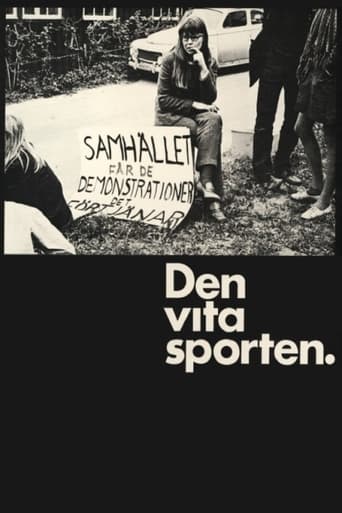 7.1
Documentary film about the protests against the 1968 Davis Cup tennis match between Sweden and Rhodesia, in Båstad, Sweden. In a series of interviews, demonstrators and members of the Swedish government give their views on sport, politics and civil disobedience.
The White Game
1968
Documentary from inside the liberation movement in Guinea-Bissau.
En nations födelse: Guinea-Bissau, en före detta portugisisk koloni
1974
A school class at Gärdesskolan in Stockholm got to try out filming themselves with 8 mm cameras during one school year. The experimental activities were led by a group from FilmCentrum and Teckningslärarinstitutet. At first, they made films that they themselves would most like to make – e.g. a trick film with Donald Duck, a horror film, etc. They also filmed the environment in the City and each other in a “documentary” way. Then they tried to create “neutral” material – images of cars, etc. that they filmed in the City without any particular intention. They divided themselves into two groups – one each against motoring and traffic in the city.
Kalle Anka - skräck och bilism
1970
Film credits

Behind the camera
NRBirgitta Trotzig's "A Landscape" depicted from the mythology of the sore human deaths from which the drug has been collected.
Kyrie
1965
Documentary about US war crimes in Indochina.
Amerikaner vittnar om kriget
1971
Left-wing collective film targeting colonial politics in Northern Sweden (Norrland).
The Northlands Problem
1970
7.1Documentary film about the protests against the 1968 Davis Cup tennis match between Sweden and Rhodesia, in Båstad, Sweden. In a series of interviews, demonstrators and members of the Swedish government give their views on sport, politics and civil disobedience.
The White Game
1968
Documentary from inside the liberation movement in Guinea-Bissau.
En nations födelse: Guinea-Bissau, en före detta portugisisk koloni
1974
Documentary from inside the liberation movement in Guinea-Bissau.
En nations födelse: Guinea-Bissau, en före detta portugisisk koloni
1974
A school class at Gärdesskolan in Stockholm got to try out filming themselves with 8 mm cameras during one school year. The experimental activities were led by a group from FilmCentrum and Teckningslärarinstitutet. At first, they made films that they themselves would most like to make – e.g. a trick film with Donald Duck, a horror film, etc. They also filmed the environment in the City and each other in a “documentary” way. Then they tried to create “neutral” material – images of cars, etc. that they filmed in the City without any particular intention. They divided themselves into two groups – one each against motoring and traffic in the city.
Kalle Anka - skräck och bilism
1970
Filmed in two cities in Tanzania in the autumn of 1969. The film tells about two of the literacy projects that are ongoing in Tanzania, how the work is carried out in the cities, what difficulties one has to fight against. One town is an ujamaa town - a so-called socialist city - north of Viktoriasjön, the second city a masaj city near Kilimanjaro, where a solitary teacher carries out pioneer work among his own people.
Att lära ett folk att läsa : Rapport från två byar i Tanzania
1970
In May-June 1971, Malmer and Romare accompanied a delegation of experts sent by the international committee to investigate US crimes in Indochina and then reported on their experiences in 'Att samla några bevis'. The visual material is partly unique: it concerns, among other things, the documentation of the US Air Force's conscious investment in so-called anti-personnel bombs and mines. The use of napalm and chemical warfare agents is also discussed in a few sections, where an old woman and two mothers, who were in sprayed areas during their pregnancies, talk about and show the damage to themselves and their deformed children.
Att samla några bevis
1971
"It was a day in May that you left, one day in May as we lost you. But when I now return to your grave, we are no longer lost."
Mod att leva
1983
Morocco. Ali Bourequat belongs to a distinguished family with contacts to the royal family. When Ali gets to know that a coup is planned for the king, he tries to warn this, but gets himself imprisoned as well as his two brothers. He was first interrogated for 7 years in a prison and then incarcerated 11 years in the dark in the secret prison Tazmamart.
On the Dignity of the Human Soul
1996