
Acting
Heiner Müller
Born — Died
1929-01-09 — 1995-12-30
Place of birth
Hamburg, Germany
Known for
Acting
Credits
41 titles
Heiner Müller was a German dramatist, poet, writer, essayist and theatre director. His "enigmatic, fragmentary pieces" are a significant contribution to postmodern drama and postdramatic theatre.
Known for
 NR
NRNo synopsis available yet.
Zeugen des Jahrhunderts
1979
 9.0
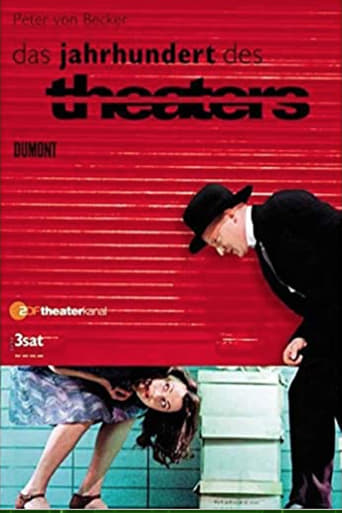
9.0"The Century of the Theater" - From the "birth of the director" to the "heroes of modernity" - an overview of the world of theater - illuminates the interaction with the history of the past hundred years is also shown.
Das Jahrhundert des Theaters
2002
No synopsis available yet.
Autoren erzählen
2012
 9.0
9.0Robert Wilson and the Civil Wars is an in-depth documentation of Robert Wilson’s ambitious attempt to stage an epic, twelve-hour, multinational opera for the 1984 Summer Olympics. Filmmaker Howard Brookner follows the avant-garde theatre director as he confronts a hectic work schedule, funding difficulties and relentless international travel in attempt to complete his preparations. The film examines Wilson’s unique theatrical style during The Civil Wars: A Tree Is Best Measured When It Is Down, which involves the continual creation of evocative stage sets, owing to a unique juxtaposition of movement, sound, text and image. Known for his precise, painterly images Wilson’s work derives more from visual art than the orthodox literary traditions of theatre. As a result, Wilson often challenges actors to perform in a boldly minimalist style, as well as collaborating with non-actors, such as young autistic poet Christopher Knowles in Einstein on the Beach.
Robert Wilson and the Civil Wars
1987
 NR
NRDocumentary by Thomas Heise filmed in East Berlin in 1987/88.
Der Ausländer
2004
 NR
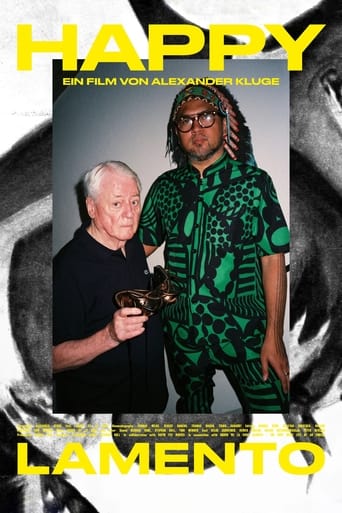
NROn the one hand, the beyond-Tropicália surreal, wild, ecstatic universe of Khavn de la Cruz, the Philippines’ internationally most venerated underground filmmaker. On the other, the Frankfurt School dialectics of Alexander Kluge, self-proclaimed arrière-guard eternal of 1960s modernist moviedom, Gandalf of all essay cinema. For Happy Lamento, Kluge mixed some of his weirder TV skits on electricity, the circus, revolution and early cinema (featuring Fassbinder-regular Peter Berling, theatre genius Heiner Müller, and DaDaism’s last man standing, Helge Schneider, among others) with some of the more outrageous scenes from Khavn’s 2016 Ang Napakaigsing Buhay Ng Alipato. Some 2017 G20 shots of Merkel and Trump et al inject the already heady brew with current affairs urgency.
Happy Lamento
2018
Film credits
2010s · 2 titles
NROn the one hand, the beyond-Tropicália surreal, wild, ecstatic universe of Khavn de la Cruz, the Philippines’ internationally most venerated underground filmmaker. On the other, the Frankfurt School dialectics of Alexander Kluge, self-proclaimed arrière-guard eternal of 1960s modernist moviedom, Gandalf of all essay cinema. For Happy Lamento, Kluge mixed some of his weirder TV skits on electricity, the circus, revolution and early cinema (featuring Fassbinder-regular Peter Berling, theatre genius Heiner Müller, and DaDaism’s last man standing, Helge Schneider, among others) with some of the more outrageous scenes from Khavn’s 2016 Ang Napakaigsing Buhay Ng Alipato. Some 2017 G20 shots of Merkel and Trump et al inject the already heady brew with current affairs urgency.
Happy Lamento
2018
Heiner Müller defines Stoicism as an attempt to deal with anarchy. For him, Erich Honecker is an example for "forced stoicism". Müller agrees with the following quote by Goethe: May God save me from self-awareness! For Müller, it represents a stoic attitude. When asked about "patriotism" in the sense of "What would you risk your life for, if necessary?", he can only come up with something "silly" at first: his daughter. But Müller is also a patriot of theater, in the sense of "maeeuticism", of putting-effort-into-it.
Rigor Was His Mark of Quality
2012
2000s · 2 titles
NRDocumentary by Thomas Heise filmed in East Berlin in 1987/88.
Der Ausländer
2004
This film not only illuminates Heiner Müller's life and works, it is more about questioning the "Sphinx" of the East and its saying about the loss of utopias and examining whether Heiner Müller's texts, as he himself said, were messages in a bottle for the future or not.
Ich will nicht wissen, wer ich bin - Heiner Müller
2009
1990s · 25 titles
 8.0
8.0From August 1989 to March 1990, Heiner Müller and the Deutsches Theater ensemble develop “Hamlet/Maschine” amid East Germany’s peaceful uprising. Actors help organize the November 4, 1989 Alexanderplatz demonstration. After the wall falls, artists split between a “third way” and reunification.
Die Zeit ist aus den Fugen
1990
In order to justify interpreting the Oresteia as a representation of the "birth of democracy" (P. Stein), one has to repress a lot, for example the sacrifice of Iphigenia or Elektra's feminist rebellion. The Oresteia represents an "Egyptian" material, situated between Europe and Asia, incomprehensible to both. That makes it interesting for a possible, currently necessary rapprochement between the two parts of the world. One would need, Müller says, to undertake a completely new translation, because in the existing ones the irrational elements have already been smoothed over.
I Owe the World a Dead Person
1994
A news magazine program on important aspects of the history of postrevolutionary Cuba, consisting of two documentary film sequences about Castro and two interview sequences with Heiner Müller. Castro speaks about his experiences in the revolution and about Che Guevara; he has himself filmed during the furnishing of a simple house. Heiner Müller, smoking, laments the decline in the quality of the "Davidoff" cigar following the American economic boycott against Cuba.
The Last of the Mohicans
1993
The discussion begins with the parable of a frog in boiling water. It comes from the book "Post-heroic Management: A Manual" by Dirk Baecker, which is what Heiner Müller is currently reading at the time of the discussion.
Epic Theater & Post-heroic Management
1996
One of Müllers's vocal cords was paralyzed as a result of a life-saving radical operation (1995). At the beginning of the discussion Müller observes that figures from Greek mythology live on today as trademarks for products (Ajax as a cleaning agent, Polydor as a record).
The Voice of the Playwright
1995
In this conversation, taking place shortly after the German reunification, Alexander Kluge and Heiner Müller discuss historical developments from the perspective of playwright Heiner Müller’s view on subjectivity. Among other things, they talk about the theoretical work of political philosopher Carl Schmitt, Russian literature, Müller’s play “Mauser” and an artwork by Anselm Kiefer.
“Wastage” of humans / Comrade Mauser / “Victim of History”
1991
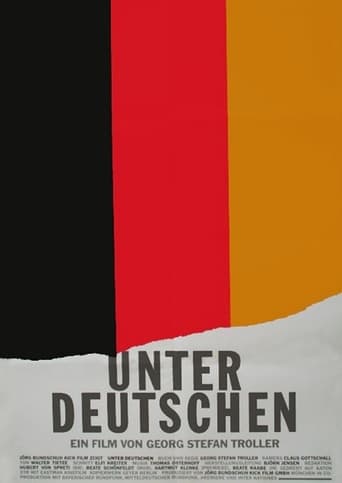 8.5
8.5Documentary filmmaker Troller criss-crosses post-reunified “Transgermania” for a year, probing German identity through festivals (Carnival, Oktoberfest), films, small towns and big cities. He attends a Black–Bavarian wedding at an “animal fair,” chats with chimney sweeps, students, artists and elites (from Grass to Müller), and asks uneasy questions about unity, memory and the future - all from his outsider’s lens.
Unter Deutschen
1995
The title of the interview is from a line in a poem written by an American about the battle of Ypern in World War I: “My rendezvous with Death took place in a trench.” Müller begins the interview by narrating how he prepared himself, both mentally and physically, for his throat operation to remove a cancer.
My Rendezvous with Death
1995
A few months before his death, Müller responded to the keywords "breathing" and "smoking" with an anecdote that interprets breathing as an indiscretion towards the dead. In his view, smoking is a means of practicing stoicism: "Whoever smokes looks cold-blooded" (Brecht) and "Whoever smokes becomes cold-blooded" (Müller).
He Who Smokes Looks Cold-Blooded
1996
Movie scenes, montages of images and text, as well as conversations between Alexander Kluge, playwright Heiner Müller and classicist Wilfried Stroh provide a multifaceted insight in the far-away world of Ancient Rome. The conversation with Müller revolves around Tacitus' representation of the Roman Empire around 112 AD. First, Müller reads passages from the historicist's annals that describe Tiberius' tragic death (37 AD). Kluge and Müller discuss the text's aesthetic qualities. Müller is interested in Tacitus for the aesthetic pleasures rather than out of historical curiosity. He describes Tacitus' style as "transition from chronicle to literature," which manifests in his "elliptical," sometimes laconic narration.
Rome, as Far Away as the Moon
1991
At the time of the conversation Heiner Müller was the president of the Academy of Arts - East. At the beginning he describes his daily routine to Kluge. He is an unwilling president who has to lead an academy - which will soon be absorbed into a "European Artists Society" - at a time of upheaval. As he is describing the only functional and innovative part of the academy, the "Music Section" that trains master's students, he starts talking about how he almost became a master's student of Brecht. In retrospect he is glad that he missed this chance and escaped Brecht's powerful influence, which took away the individual creative space of his collaborators. Müller describes how he got by with various jobs during his application period and afterwards in 1951: book reviewer, translator of Stalinist songs. When Kluge asks about the basic concept of an academy, the discussion returns to its starting point: Müller claims that the academy is a space that is free from the state.
Every Frozen Structure has its Academy
1991
Citing Nietzsche, Müller describes the motive of the philologist as "greed," "simply wanting to have everything, grasp everything, know everything." This "hunger" distinguishes the artist, but has become lost in modern art, which is so boring now because it has only "appetite."
The Death of Seneca
1993
In this interview Müller and Kluge explore the East German’s memories of the final days of the war. The session is introduced by a clip from the Russian film maker Sergei Parajanov’s 1961 film entitled The Ukranian Rhapsody. Here a soldier of the Red Army is writing a letter to his fiancee Oskana on the home front, describing to her his imagined vision of listening to Beethoven’s Moonlight Sonata in the middle of battle. “In the past I rarely listened to Beethoven,” he says, “if he had composed only the Moonlight Sonata, the war would have had to stop in front of it too.” The scene then is interrupted by the arrival of German tanks.
Some Kind of Shadow Machines Were Passing by
1990
Müller describes Ovid's Metamorphoses, Golding's translation of which (1603) was one of Shakespeare's sources, as an encyclopedia of the Greek myths, its dramatic central theme being the transformation of human beings into animals, plants, stones---either as a punishment or out of a need to escape.
Heiner Müller in Time Flight
1996
The central topic of the interview is the ancient concept of a necessary balance between the dead and the living, which also assumes the notion of a constant potential for force in the world. Müller and Kluge examine this mythical conception of life with reference to personal, historical, and political examples like the father-daughter relationship (Agamemnon and/or Müller himself), East Germans' hopes of finding a place in capitalism, or violence in the middle ages and in the modern period.
The World is Not Bad, but Full
1994
The conversation begins on the topic of Müller’s plans for new plays. Müller tells us that he has promised to write a libretto for Boulez, and that he wishes to use the myth of Heracles as material for a stage play.
On the Way to a Theater of Darknesses
1995
This "music magazine" is a montage of visually alienated historical film clips of tanks and soldiers (First and Second World War), pictorial reminiscences of Russian avant-garde art, and excerpts of interviews with Heiner Müller accompanied by heavy metal music (the "death & grind" music of the groups Abhorrence, Acrostichon, Toxaemia, and Disgrace).
Under the Sign of Mars
1994
Kluge here presents a portrait of Friedrich the Great by means of quotations, film clips, historical images, and film documents. The program is a contribution to a public discussion about the role of the Prussian king in German and European history that unfolded after the transfer of the Hohenzollern sarcophagi in 1991. The excerpt of an interview with Heiner Müller lasts 2:50 minutes. Müller calls Friedrich a "murdered Mozart," the only intellectual among the German rulers, and a source of dramatic material. He also talks about his play Gundling. An excerpt from an interview between Günter Gaus and Hans Bentzien, the former culture minister of the GDR, deals with the rescue of the Friedrich monument on Unter den Linden after 1945.
Frederick of Prussia
1992
"The metaphor is cleverer than the author" (Lichtenberg), a "screen," an "instrument for bundling" (Müller), because "everything changes so much" (Gertrude Stein) - Müller explicates these functions of figurative language with reference to the use of metaphors in Shakespeare. This use of metaphor corresponds to the acceleration of the Elizabethan age (the second half of the sixteenth century), the consolidation of which compels Shakespeare to use an allegorizing language in his last plays.
Heiner Müller on Legal Questions
1990
The horizon of this conversation is marked by Müller's personal memories, reflections about ongoing themes in his work, thoughts about his current production and the nearness to death that has been brought by his illness.
Queen of Hearts on Judgment Day
1995
Heiner Müller was invited to a conference in Japan on the fate of opera in the 20th and 21st century. He talks about his flight over Siberia and his fascination with this "giant ridge" that he characterizes as the "Asian time preserve of Russia." This is followed by thoughts about the past, present and future of opera and theater. He thinks that in earlier times opera could be a vessel for utopia, but now it is like a fraudulent enterprise: "When everything has been said, the voices become soft and then the opera comes."
Anti-Opera
1993
The point of departure for this discussion is the question of whether the collapse of the Soviet Union is dramatic material. Müller answers with this Brechtian sentence: "Oil resists the five acts." He describes how difficult it is to make a dramatic adaptation of structures or massive processes that are not bound to biographies.
The Poet as Metaphor Slingshot
1997
Citing Nietzsche, Müller defines intellectuals as the "ploughshares of evil," whose task it is "to create chaos, to destroy conceptions of order." Not "trace elements of reason," but rather chaos can perhaps bring about enlightenment.
Plowshare of Evil
1993
In this journal, Alexander Kluge and Heiner Müller talk about the dark side and the inevitability of democracy. Heiner Müller believes that democracy has its roots in the tragedy of the Atreidae.
Omnivore Democracy
1995
Here Müller and Kluge explicitly address a theme that is latently present in many of their conversations: the relation of intellectuals to reigning political power. Given his many writings on Frederick the Great, it is not surprising that Müller begins the discussion with the “love-hate” relationship between the 18th Century Prussian King and the French Philosopher Voltaire. Moving to the 20th Century, the conversation then focuses for the most part on intellectuals and their relationship to totalitarian regimes. An initial sketch of an encounter between the Russian writer Maxim Gorky and Vladimir Lenin in the post-revolutionary Soviet Union segues into a treatment of the German writer Ernst Jünger in the Third Reich (1933-1945). Müller follows this up with remarks about the importance of Jünger for his own thinking as a writer before and after the founding of the German Democratic Republic.
Mind, Power, Castration
1993
1980s · 5 titles
9.0Robert Wilson and the Civil Wars is an in-depth documentation of Robert Wilson’s ambitious attempt to stage an epic, twelve-hour, multinational opera for the 1984 Summer Olympics. Filmmaker Howard Brookner follows the avant-garde theatre director as he confronts a hectic work schedule, funding difficulties and relentless international travel in attempt to complete his preparations. The film examines Wilson’s unique theatrical style during The Civil Wars: A Tree Is Best Measured When It Is Down, which involves the continual creation of evocative stage sets, owing to a unique juxtaposition of movement, sound, text and image. Known for his precise, painterly images Wilson’s work derives more from visual art than the orthodox literary traditions of theatre. As a result, Wilson often challenges actors to perform in a boldly minimalist style, as well as collaborating with non-actors, such as young autistic poet Christopher Knowles in Einstein on the Beach.
Robert Wilson and the Civil Wars
1987
 NR
NRAn issue of the magazine Kino 81, designed for the film department of WDR by staff of FILMKRITIK
"Kino 81" - Stillness, a film magazine by film critics
1981
On the run from her criminal Italian husband, a young French woman meets a German lover in West Berlin who offers her shelter but who also gets entangled in her threatened life ever deeper.
Keine Hand wäscht die Andere
1988
This portrait of Heiner Müller on the occasion of his 60th birthday is devoted for the most part to having Müller recount events and memories from the first quarter of his life, starting with his birth on January 9, 1929 and closing with his immediate postwar experiences in the mid-1940's. This part memoire, part biographical sketch of his early life includes descriptions of his parents’ background and employment activities, the arrest and incarceration of his father in a concentration camp in 1933, Müller’s recollections of school life in Nazi Germany, Müller’s brief detention in an American POW camp at the end of the war and, upon release, his adventurous return to his home in the Soviet Zone in eastern Germany. These snapshots of his first 16 years also include anecdotes about Peter the Great and Andrei Platonov’s “Sluices of Epiphany” as well a meditation on a scene from Shakespeare’s Titus Andronicus.
Portrait of Heiner Müller for his 60th Birthday
1989
In 1989, Heiner Müller staged an unabridged seven-and-a-half hour Hamlet, because in the process of German reunification "a leave-taking from the Hamlet principle in favor of the market economy" was taking place. In this interview, he elaborates on the parallels between the play and contemporary reality in terms of the plot and the characters (for example, Günter Schabowski as well as the problematic role of Fortinbras).
Conversation with Heiner Müller in Garath
1989
Series credits
NRNo synopsis available yet.
Zeugen des Jahrhunderts
1979
9.0"The Century of the Theater" - From the "birth of the director" to the "heroes of modernity" - an overview of the world of theater - illuminates the interaction with the history of the past hundred years is also shown.
Das Jahrhundert des Theaters
2002
No synopsis available yet.
Autoren erzählen
2012
Behind the camera
Scenes relating to a theater production on the nazi era in Germany.
Die Schlacht - Szenen aus Deutschland
1976
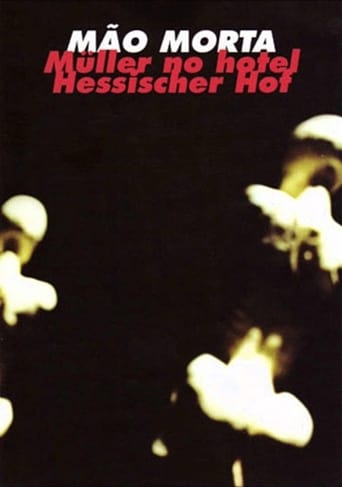 10.0
10.0Documentary on Mão Morta's three sole concerts.
Mão Morta Müller no Hotel Hessischer Hof
1998
 NR
NRA filmed Musical adaption of Heiner Müller's 1977 play HAMLETMACHINE preformed at The Castillo Theater in 2002.
Hamletmachine
—