

Directing
Mario Schifano
Born — Died
1934-09-20 — 1998-01-26
Place of birth
Homs, Libya
Known for
Directing
Credits
29 titles
One of the greatest Italian painters of the post-war era, who achieved international acclaim in the 1960s and 1970s as an exponent of another possible pop art, Schifano has left behind a boundless body of work. After a decisive trip to the United States in 1963, he began to make short 16mm films, nearly always "edited in the camera", including Round Trip 1964 and Anna Carini in agosto vista dalle farfalle 1967. He then made a trilogy of feature-length films – Satellite 1968, Umano non umano / Human, Inhuman 1969 and Trapianto, consunzione e morte di Franco Brocani 1969 – which are anomalous from the circles of experimental and art cinema in Rome, of which he was never a part. He therefore re…
Known for
 6.8
Before the three feature films, Mario Schifano directs the camera towards the people around him to create real film diaries. His friends, his time partner and the artists he frequented are portrayed in their everyday life or object of the mechanical gaze of the camera, a filter through which to look at the outside world.
Film
1967
 NR
A (temporary) leave of many friends who are my truest world, with the attempt of getting them together in an ideal summary conceived to support me during my being far away. –A. L.
Book of Saints of Eternal Rome
1968
 NR
No synopsis available yet.
Mario Schifano tutto
2001
 6.2
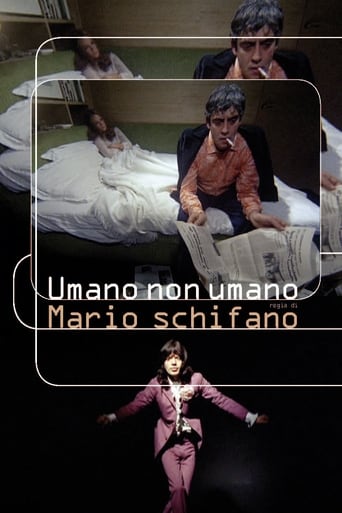
Artists and poets meet in a dreamlike space between walks and performances.
Umano Non Umano
1969
 NR
William Berger and his wife Carol are the protagonists of this silent film, in which bodies come to the fore and the gaze becomes obsessive.
Carol + Bill
1967
 6.0
A man drifts around Rome's tourism spots.
Souvenir
1967
Film credits
2020s · 1 titles

2000s · 1 titles
1960s · 3 titles
NRA (temporary) leave of many friends who are my truest world, with the attempt of getting them together in an ideal summary conceived to support me during my being far away. –A. L.
Book of Saints of Eternal Rome
1968
The documentary, black and white, has "space" as theme, both as an abstract category and as a scope and "scene" of human relations.
By Now My Return to Knossos Is Certain
1967
 8.0
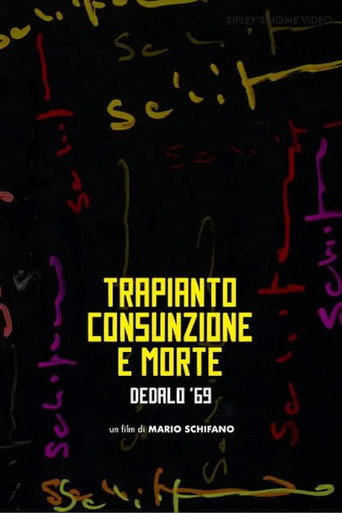
Trapianto heralds the end of utopia, the death of that underground, but is also the best prologue in Necropolis, which is not by chance found alive. It 's a film that establishes the passage of rolling between two friends, and Brocani Schifano, shared the same passions, and from living the cinema as a challenge urgent and vital, suspended between dream and action.
Transplantation, Consumption and Death of Franco Brocani
1969
Undated · 1 titles

Behind the camera
6.8Before the three feature films, Mario Schifano directs the camera towards the people around him to create real film diaries. His friends, his time partner and the artists he frequented are portrayed in their everyday life or object of the mechanical gaze of the camera, a filter through which to look at the outside world.
Film
1967
6.2Artists and poets meet in a dreamlike space between walks and performances.
Umano Non Umano
1969
NRWilliam Berger and his wife Carol are the protagonists of this silent film, in which bodies come to the fore and the gaze becomes obsessive.
Carol + Bill
1967
6.0A man drifts around Rome's tourism spots.
Souvenir
1967
6.0A man drifts around Rome's tourism spots.
Souvenir
1967
 NR
16mm short by Mario Schifano.
Ferreri
1967
 10.0
A young filmmaker advocates the creation of a new type of film, devoid of a traditional plot and composed of blocks of sequences that have no specific interdependence. Subsequently, the theoretical statement leads to practical demonstration: abstract images flow across the screen, accompanied, for the most part, by snippets of conversation on a wide variety of topics.
Satellite
1968
8.0Trapianto heralds the end of utopia, the death of that underground, but is also the best prologue in Necropolis, which is not by chance found alive. It 's a film that establishes the passage of rolling between two friends, and Brocani Schifano, shared the same passions, and from living the cinema as a challenge urgent and vital, suspended between dream and action.
Transplantation, Consumption and Death of Franco Brocani
1969
 NR
Anna Carini, Mario Schifano’s partner at the time, is the protagonist of the film. The young woman is observed, followed, questioned in close-up, in both indoor and outdoor settings, by the camera that partially strays into the scene and then briefly makes room for the author himself. —Tate Modern
Anna (Anna Carini Naturale)
1970
Experimental short by Mario Schifano.
Futurismo Rivisitato
1974
A 1967 short film by Mario Schifano.
Anna Carini in agosto vista dalle farfalle
1967
 NR
A spot for Absolut Vodka shot on video by Mario Schifano.
Absolut '94
1994
 NR
Experimental short featuring fashion photographer Bob RIchardson at work in his studio.
Reflex
1964
NRExperimental short featuring fashion photographer Bob RIchardson at work in his studio.
Reflex
1964
 NR
A spot for Absolut Vodka shot on video by Mario Schifano and Roberto Lucca Taroni.
Absolut '94
1994
Experimental film based on promotional material of vodka brand Absolut.
Absolut Schifano
1985
Experimental film based on promotional material of vodka brand Absolut.
Absolut Schifano
1985
A 1967 short film by Mario Schifano.
Serata
1967
a short filmed on the set of Jean-Luc Godard's "Weekend"
Jean-Luc Cinema Godard
1967
 NR
Unlike Reflex, Schifano's center of interest in this very short film is Gattinoni's models and not the photographer.
Fotografo
1967
A 1964 short film by Mario Schifano.
Round Trip
1964
 NR
The Vietnam War was extensively televised, and Mario Schifano, in turn, filmed it from the television, in fragments, in keeping with a typical procedure of pop art and a fundamental technique of his work in painting. The director Marco Ferreri appears at the start of the film.
Vietnam
1967
NRThe Vietnam War was extensively televised, and Mario Schifano, in turn, filmed it from the television, in fragments, in keeping with a typical procedure of pop art and a fundamental technique of his work in painting. The director Marco Ferreri appears at the start of the film.
Vietnam
1967