
Directing
Gary Hill
Born
1951-04-04 (75)
Known for
Directing
Credits
42 titles
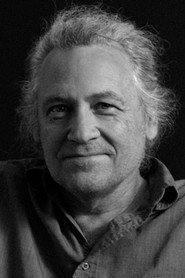
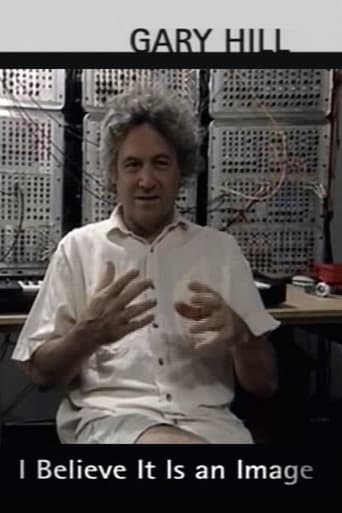
Gary Hill (b. 1951, Santa Monica, CA) has worked with a broad range of media – including sculpture, sound, video, installation and performance – since the early 1970’s, producing a large body of single-channel videos, mixed-media installations, and performance work. His longtime work with intermedia continues to explore an array of issues ranging from the physicality of language, synesthesia and perceptual conundrums to ontological space and viewer interactivity. (Vimeo)
Known for
 NR
NRA humanoid form strikes its body while making primal guttural sounds. At times the form is “stopped” and “started” using the pause of a reel-to-reel video player—a frozen line of noise (an asynchronous frame) cuts through the image reinforcing the sense of physicality. The sounding form is eventually set in an electronically generated landscape with temple-like forms of undulating feedback. Further processing of the voice and additional rhythmic electronic sounds are suggestive of ritual.
Earth Pulse
1975
The strategy for recording and composing Air Raid was derived from sound rather than image. This produced some unusual juxtapositions between images found in the everyday: a lawnmower, the wrapping of fruit with tin foil, a cement mixer, record player, television, and among others, the eerie image of an air raid siren. A negative double of the image horizontally slides away every so often as if ruptured by the violence of the sound. The last image shows a butterfly opening and closing its wings as if it were tuning the only silent segment of the work.
Air Raid
1974
 NR
NRIn Mirror Road, Hill uses the camera and image processing devices to explore the malleability of electronic colors and image density. Amorphous structures move across the monitor like drifting clouds, changing color and direction. From time to time structures of fantastic color landscapes move past one another in the lower and upper halves of the picture (the rearview mirror takes up the upper half of the frame), only to be recombined into an amorphous unity.
Mirror Road
1976
“The image plane is divided into three sections. In the lower half, a close-up of two hands form a circle out of a metal rod. The upper half of the screen is vertically divided into two parts. On the right, a concurrent view of bending the rod with the entire body is visible in high contrast black and white. On the left is the green trace of an oscilloscope. A sine wave tone is first heard corresponding with the static green trace, a horizontal line. I drone a ‘similar’ tone that together with the sine wave changes the trace into a wavering circle. The steadier the sound I make, the steadier the circle. As I expend more energy bending the rod to ‘copy’ the electronically generated circle, my voice struggles to maintain pitch. Consequently the circle vibrates, collapses and morphs into multiple forms, mirroring the strain of my voice."
Full Circle
1978
 NR
NR“A structural work (with humor) that uses indeterminacy to forge an abstract landscape upon which the ‘vision’ of an ox appears. A sequence of words—hierarchically ordered from the utilitarian (functions and processes of the tools being used to make the piece) to the more abstract and conceptual, ‘content,’ ‘concept,’ and ‘vision’—become the building blocks of a linguistic picture story.”
Picture Story
1979
 NR
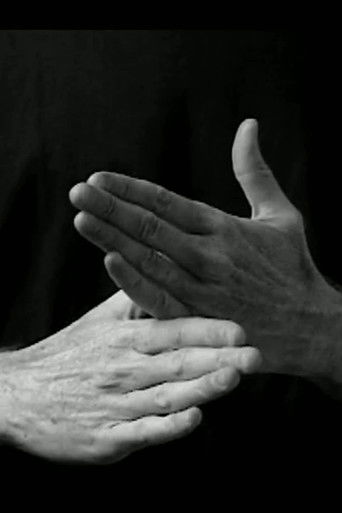
NRGoats and Sheep uses the source material of the installation Withershins, 1995, consisting of two simultaneous views of a person signing: the hands and arms are framed in one, and the back of the head and top of the shoulders in the other. This latter view catches the hands when they refer to the head during signing. For Goats and Sheep, Hill changed the color image into black-and-white, re-recorded his own voice and “re-synchronized” it to the original signing. The stereo field is used to double the voice with about a second of delay added to the sound. This doubling mirrors the hands and numerous references and repetitions heard in the text.
Goats & Sheep
2001
Film credits
Behind the camera
NRA humanoid form strikes its body while making primal guttural sounds. At times the form is “stopped” and “started” using the pause of a reel-to-reel video player—a frozen line of noise (an asynchronous frame) cuts through the image reinforcing the sense of physicality. The sounding form is eventually set in an electronically generated landscape with temple-like forms of undulating feedback. Further processing of the voice and additional rhythmic electronic sounds are suggestive of ritual.
Earth Pulse
1975
The strategy for recording and composing Air Raid was derived from sound rather than image. This produced some unusual juxtapositions between images found in the everyday: a lawnmower, the wrapping of fruit with tin foil, a cement mixer, record player, television, and among others, the eerie image of an air raid siren. A negative double of the image horizontally slides away every so often as if ruptured by the violence of the sound. The last image shows a butterfly opening and closing its wings as if it were tuning the only silent segment of the work.
Air Raid
1974
NRIn Mirror Road, Hill uses the camera and image processing devices to explore the malleability of electronic colors and image density. Amorphous structures move across the monitor like drifting clouds, changing color and direction. From time to time structures of fantastic color landscapes move past one another in the lower and upper halves of the picture (the rearview mirror takes up the upper half of the frame), only to be recombined into an amorphous unity.
Mirror Road
1976
“The image plane is divided into three sections. In the lower half, a close-up of two hands form a circle out of a metal rod. The upper half of the screen is vertically divided into two parts. On the right, a concurrent view of bending the rod with the entire body is visible in high contrast black and white. On the left is the green trace of an oscilloscope. A sine wave tone is first heard corresponding with the static green trace, a horizontal line. I drone a ‘similar’ tone that together with the sine wave changes the trace into a wavering circle. The steadier the sound I make, the steadier the circle. As I expend more energy bending the rod to ‘copy’ the electronically generated circle, my voice struggles to maintain pitch. Consequently the circle vibrates, collapses and morphs into multiple forms, mirroring the strain of my voice."
Full Circle
1978
NR“A structural work (with humor) that uses indeterminacy to forge an abstract landscape upon which the ‘vision’ of an ox appears. A sequence of words—hierarchically ordered from the utilitarian (functions and processes of the tools being used to make the piece) to the more abstract and conceptual, ‘content,’ ‘concept,’ and ‘vision’—become the building blocks of a linguistic picture story.”
Picture Story
1979
NRGoats and Sheep uses the source material of the installation Withershins, 1995, consisting of two simultaneous views of a person signing: the hands and arms are framed in one, and the back of the head and top of the shoulders in the other. This latter view catches the hands when they refer to the head during signing. For Goats and Sheep, Hill changed the color image into black-and-white, re-recorded his own voice and “re-synchronized” it to the original signing. The stereo field is used to double the voice with about a second of delay added to the sound. This doubling mirrors the hands and numerous references and repetitions heard in the text.
Goats & Sheep
2001
The basis of this “sound/image construct,” recorded in real time, are three black-and-white still images: a keyboard, a flute, and an African drum. These motifs are altered through digitalization, solarization, and interframe switching. As they alternate, the images are accompanied acoustically by simple tonal routines of the instruments shown – little sequences of sound on the keyboard, some drum beats, a brief trill of the flute. The solarization effect of the images changes with the sounds. The work intensifies as it progresses, and images and sounds succeed one another ever more rapidly until a melody of the three instruments emerges. The frequency of the video images continues to increase, with the result that the images pulsate ever more quickly until they gradually overlay one another, producing a cinematographic effect through interferences. Parallel to this, the audio frequency of the melody rises until fundamental tones form, lasting several seconds.
Sums & Differences
1978
 8.0
8.0Returning to the primal source of language, Hill explores the physical and subconscious origins of speech. In a continuous shot of a rhythmic, linguistically inspired chant-performance by George Quasha and George Stein, the camera wanders from mouth to face to hands to figure in an open-ended visual search. The performers use the body as an acoustic instrument of sound and abstract utterances.
Tale Enclosure
1985
The work’s images appear as visualizations of electronically generated sounds. Initially, small pulsating pixel structures occasionally appear on the black screen. These monadic forms become larger, ultimately filling the picture plane and pulsating ever more intensely.
Electronic Linguistic
1977
 NR
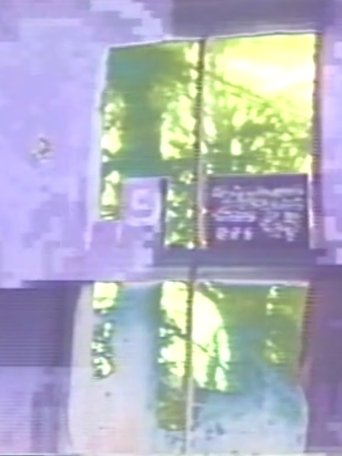
NRSilent or with minimal sound, Hill's early formalist works explore the manipulation of electronic color and image density through the camera obscura and image processing devices. Of these tapes, Hill has written that "much of the subject matter and the expressionistic method of working underline and in some sense parody the traditional medium of painting." In Windows, the image of windows in a darkened room is digitized, densely layered, and otherwise abstracted in a series of graphic compositions.
Windows
1978
“I was thinking of the camera as a kind of archeological tool that I could use to dig into or slice through the landscape —one among many studies toward using the camera in a highly physical way.”
AXIS
1975
 NR
NRIn this work, the field of Hill’s experimentation is the synchronization of visual and linguistic elements. For Equal Time, he sets up a minimalist arrangement, whereby two identical panels with grid patterns, starting respectively on the left and right side of the monitor, slowly move across the screen against a black background to the opposite side. As the panels overlap they produce moiré patterns. Each is associated with the voice of a different speaker, whose voices emerge from the left or right stereo channel. As soon as the panels completely overlap, the words of the two texts merge and the two voices, now in unison, produce a phasing sound similar to the visual moiré pattern of the panels.
Equal Time
1979
 NR
NRNo synopsis available yet.
Pacifier
—
 NR
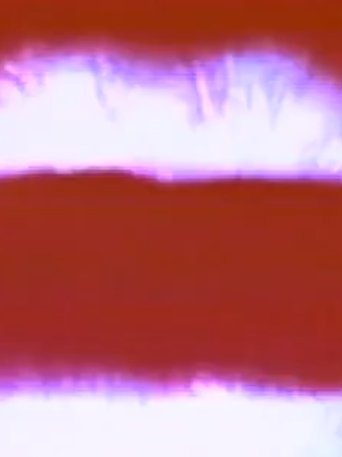
NRThe artist’s mouth fills the whole image plane. Silently the words “red,” “blue,” “green” are slowly and repeatedly articulated. The color of the screen switches from red to blue to green at a quickened rate. Utilizing the same rate, the spoken words, “red,” “blue,” and “green,” are cut together into syllabic combinations of the three words making up the asynchronous sound track. The individual words, barely intelligible as spoken, are more easily “read” on the uniformly moving lips. (Quasha, George and Charles Stein. An Art of Limina: Gary Hill’s Works and Writings. Barcelona: Ediciones Polígrafa, 2009, p. 589)
Primary
1978
 NR
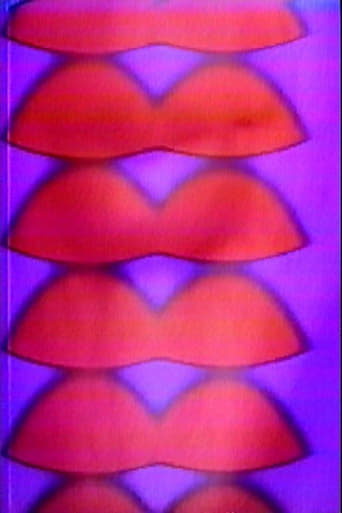
NRDave Jones prototype modules (keyers, color field generators, output amplifier), black-and-white camera, microphone and Serge audio modules (voltage controlled oscillators, filters, sequencer)
Mouthpiece
1978
Figuring Grounds – like Tale Enclosure, 1985 – was edited from three hours of recordings made at the Stained Glass Studio in Barrytown, New York, where Hill’s Why Do Things Get in a Muddle? (Come On Petunia), 1984, was also taped. Facing one another, Quasha and Stein begin vocalizing from the very grain of language, and the improvisational search for voices passes through recognizable swarms of phonemes with a possible word or phrase briefly coming into focus now and then. Camera movements and continual focal play mirror the highly nuanced vocal expression, tightly coupled with body and facial movements. The voices build upon one another, rising and falling in volume and pitch, sometimes in unison, other times in “conversation,” in a seeming attempt to let the primary roots of language speak for themselves.
Figuring Grounds
2008
Blind Spot constructs a space of living portraiture by “focusing time” on an exchange between the artist (the camera) and a man on the street in the small Algerian neighborhood of Belsunce in Marseille, France. As the camera zooms in slowly on its subject, the imagery is interrupted by longer and longer segments of black/silence, in essence slowing the scene down so that it almost reaches the photographic.
Blind Spot
2003
 NR
NRTwo color video cameras, two microphones, Dave Jones prototype modules (input amplifiers, variable soft/hard keyers, output amplifier, analog-to-digital converter, bit switch, digital-to-analog converter), assorted speaker cones, enclosed speaker, sand, large spike nails, lighter fluid, lighter, amplifier, wire, and water.
Soundings
1979
A single solid white line rotates 180 degrees, beginning at a vertical position in the middle of the screen. At first, it forms “stair-steps,” and then, approaching horizontality, it intermittently breaks up, literally between the (scan) lines. Continuing, the line reconstitutes itself as it reaches its initial vertical position.
Resolution
1979
In Bathing, as in his Mirror Road, Windows and Objects with Destinations, Hill uses the camera and image processing devices to explore the malleability of electronic colors and image density.
Bathing
1977
A fixed color camera is slightly defocused on the wire mesh of a window screen. Outside the window the leaves of trees are moving with the wind. The images, about one-half second each, are edited directly to the master tape at intervals based on the set-up time of each edit. The sound is of the room itself, which is, for the most part, the editing button being pushed down for each edit. With each edit the wire mesh and background colors shift slightly. The work is about ‘meshing’ time and view
Mesh
1976
This work is the single-channel version of a multi-channel installation of the same name. The picture plane is divided into a left and a right half. A changing background is formed by colorful, highly graphic patterns reminiscent of TV test signals and various monochrome surfaces. Two smaller rectangles appear on the surface, in which video sequences are running. The two image strands show landscapes, interiors, objects, graphical images and text that are sometimes used in contrast, and on other occasions the same image can be seen mirrored in each rectangle. They are accompanied by Hill’s recitation of a long text, whose syllabic sequence determines the rhythm of the images (the screen changes with each uttered syllable). His voice comes alternately out of the left and right stereo channels functioning like a dialogue. This is broken into sections by a singing, but electronically altered, voice.
Primarily Speaking
1981
 NR
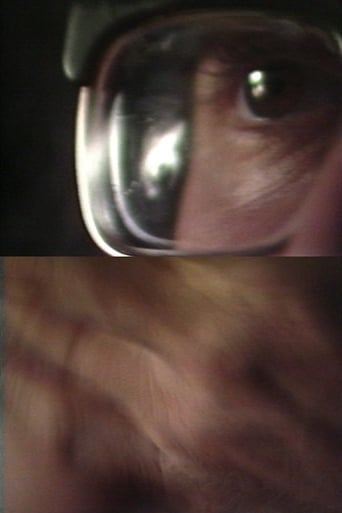
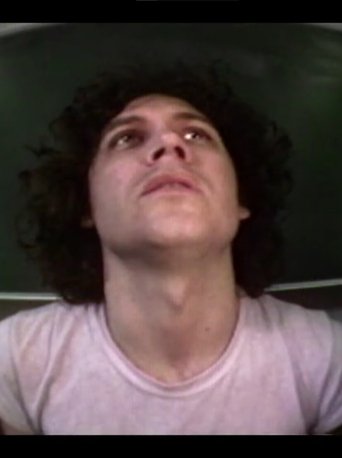
NR“Made just before Around & About, this work is something of a ‘manifesto in jest’ against television…. I’m a sit-in viewer looking slightly up at the screen making simple gestures into the camera. The mood is ambiguous as I seem to be watching a mirror, covering my face, reaching out to the camera, obstructing my head with a harsh (interrogator’s) lamp, and maybe more. The image, distorted through a fisheye lens, gives the impression of a concave monitor, as if the whole act were seen through a peephole or pinhole camera. In some sense I ‘play’ both sides of the screen—performer and viewer attempting to ‘connect’ either way. As ‘commentary’ it’s two-way, making it also a commentary on commentary.”
Commentary
1980
This rarely screened film was used to raise funds for the making of Energy and How to Get It. High-energy physicist Robert Golka was granted a lease on an airplane hangar once used to build B-29 bombers to further his experiments on ball lightning and free energy distribution. By the time Robert Frank and his crew arrived, Golka, his frisky older love interest Agnes Moon, and his dogs Nitro and Proton were facing eviction. — Museum of Modern Art
Project Tesla
1980
 NR
NR“In 1979-80, I was teaching in the Media Studies Department at the State University of New York at Buffalo, filling in for Woody and Steina Vasulka, who had left for Santa Fe. Midway in the year I abruptly had to leave my apartment and move into my office—a relatively small space with a desk, a couple of chalkboards, a couch, plus everything I owned, which was mostly media equipment. About all I could do was work, if only to keep from feeling claustrophobic (moving things around seemed to make the space bigger). Around & About came out of a ‘what if’ scenario. What if I were to cut images to every syllable of a spoken text? (A way to keep me busy?) A daunting task in the time of U-matic machines and sloppy controllers. I did it all manually, hitting the edit button for every syllable. With each rewind I would listen and anticipate the coming syllable, learning as I went along to adjust for delayed reaction."
Around & About
1980
Recorded on location in Japan, this work was inspired by the notion of “acoustic palindromes,” aural versions of written palindromes, located in the Japanese language. Hill creates this palindromic world as a site for excavation, uncovering new meanings and images by focusing on reversals and double reversals of spoken words and analogous actions. What ultimately can be seen as an inter-textual weaving of language, image, and time (or what Hill calls, “origami time”) exposes the archetypal protagonists of Noh drama: god, man, woman, lunatic, demon. These dramatis personae appear in and around a series of conceptual vignettes based on the Noh play Lady Aoi.
URA ARU
1986
 8.0
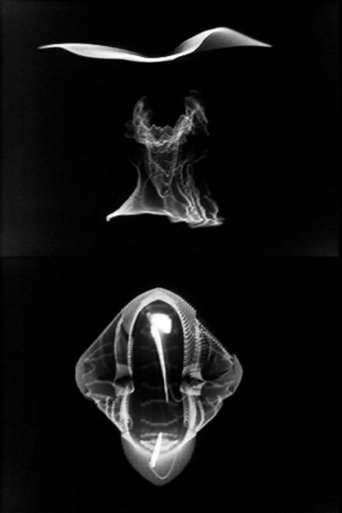
8.01980-81, 13:27 min, b&w, sound Videograms is an ongoing series of text/image constructs or syntaxes using the Rutt/Etra Scan Processor, a device that enables Hill to sculpt electronic forms on the screen. Each "videogram" relates literally or conceptually to Hill's accompanying spoken text, which is visually translated into abstract shapes. Hill writes, "The vocabulary and precision of this tool allowed me to expand the notion of an 'electronic linguistic' through textual narrative blocks created specifically for the electronic vocabulary inherent in the Rutt/Etra device."
Videograms
1981
 NR
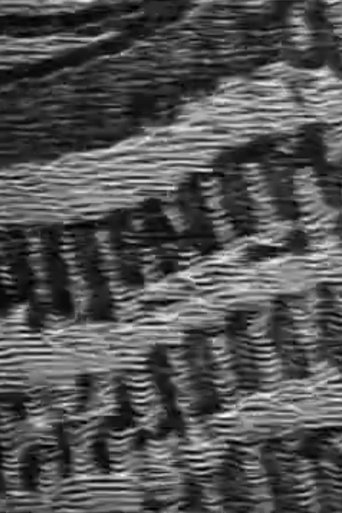
NROne of the earlier works Hill produced on the Rutt/Etra video synthesizer, Elements combines abstract “landscapes” with fragmented syllabic language. Undulating topological forms superimpose themselves on one another, changing their shape and direction of movement.
Elements
1978
This piece was originally planned by the artist as a reading for the Viewpoint series at New York’s Museum of Modern Art. “It was an attempt to circumscribe my work in the structure of a reading,” Hill explains. Processual Video is minimal with regards to an “image” but quite complex in terms of the interplay of language and image. In fact, the image as such functions more as a tracking device. On a black screen, a white line slowly rotates on its own axis, seemingly generating a spoken text that refers to itself. Depending on its position, the line gets narrower, then wider, finally dissipating horizontally into thin white strokes. While this is happening, Hill reads a text that triggers associations and wordplays with the precise position and detail of the continuously changing line.
Processual Video
1980
 NR
NR“The beginning of a remake of an earlier work [Soundings, 1979] in which I wanted to extend the reflexivity of each text in relation to the interaction between different physical substances—in this case, sand—and the speaker cone. A loudspeaker fills the screen and I begin to speak, referring to the speaker itself. This is followed by more declarations of what I am doing, ‘…a hand enters the picture….’ A hand filled with sand enters the picture and slowly releases it into the loudspeaker’s cone. Every nuance of speech vibrates the speaker’s cone (or membrane), bouncing the grains of sand into the air. The more I speak about what is happening, the more it changes—or feeds back into—the movement and patterns of the sand."
Mediations (towards a remake of Soundings)
1986
 NR
NROur visual field is dominated by gossamer layers that become distorted in fluid motion, break off, begin anew and continually change color. As we continue looking, they break down into seemingly amorphous constructions. We see details, textures and patterns from curtains, whose form responds to air movements and whose color alters through manipulation. Through or behind the veil-like fabric we can make out plants. As our gaze is increasingly directed outwards, we momentarily discern trees, branches, twigs and undergrowth before they vanish into electronic interferences. Hill uses video shots of these motifs as a basis for his artistic experiments in electronic alienation, overriding the colors and tone values to such an extent that the recorded structures become distorted and dissolve beyond the limits of their identifiability.
Bits
1977
Disturbance (among the jars) is a multi-lingual adaptation of selected Gnostic texts from the Nag Hammadi library discovered in 1945/46. The structure of the piece is based around the metaphor of fragmentation, more specifically, that of a broken sentence reflecting the original condition of many of the texts. In a completely white room lit with several thousand watts of light, a veranda with seven straight-back wooden chairs faces a low pedestal of the same height on which seven 27-inch bare cathode ray tubes (display bulbs of video monitors) are positioned to form a fragmented line. The positions of the monitors can be seen in a multiplicity of ways.
Disturbance (among the jars)
1988
 NR
NRWith startling precision, Site/Recite moves across and around a table-top graveyard — bones, butterfly wings, egg shells, seed pods, crumpled notes, skulls — in a series of seamless edits that present a continuous flow of detailed close-ups. This taxonomy of dispossession, "little deaths that pile up," is juxtaposed to a narration on the linkage between semantic self-consciousness and visual experience. Through the window of this text, the objects on the table come to model how consciousness affixes itself to material manifestations and how memory is constituted by the collection of empty vessels. Site/Recite is a prologue for Which Tree, an interactive videodisc installation that presents viewers with a maze of interconnected branch points, allowing them to wander through its forest of images and words to discover the "texts" of their own thinking patterns.
Site/Recite (a prologue)
1989
Our visual field is dominated by gossamer layers that become distorted in fluid motion, break off, begin anew and continually change color. As we continue looking, they break down into seemingly amorphous constructions. We see details, textures and patterns from curtains, whose form responds to air movements and whose color alters through manipulation. Through or behind the veil-like fabric we can make out plants. As our gaze is increasingly directed outwards, we momentarily discern trees, branches, twigs and undergrowth before they vanish into electronic interferences. Hill uses video shots of these motifs as a basis for his artistic experiments in electronic alienation, overriding the colors and tone values to such an extent that the recorded structures become distorted and dissolve beyond the limits of their identifiability.
Bits
1977
 NR
NRUsing the phenomenon of inverted (or negative) video feedback, this work constructs a one-to-one correspondence between recited text and image. Black and white rectangles, embedded one within another against a black background, are generated through a closed-circuit system: a camera’s signal is inverted and displayed on a monitor that the same camera is framing. The camera, as it were, sees itself seeing itself seeing itself and so on. (It’s the inversion itself that produces the alternating black and white rectangles). The number of rectangles is based on a precise score involving seven channels of chanted text (all in the voice of the artist)—a kind of “language canon.”
Black/White/Text
1980
 NR
NRThe associative stream of images and sounds treats the word as an abstract structure. Spoken and written text flows from image to image, morphing into the shape of a circle, triangle or square. The robotic voice mechanically decomposes the geometric word formation, depriving it of its original meaning, finding a new one.
Happenstance (part one of many parts)
1983
 NR
NRIn the video, Thomas the protagonist is played by Hill which confounds the self-reflexive nature of the book’s relationships all the more, making the video something of a “transcreation.” The “reader” begins in the liquidity of the text almost as if he were waking from drowning. Images of the sea ravishing the shore – small cliffs of sand eroding and collapsing – are inter-cut with extreme close-ups of text and the texture of the page and book itself being flooded with ocean waves. In scene after scene the reader attempts to re-enter the book only to find himself a part of intense dreams and hallucinations.
Incidence of Catastrophe
1988
NRIn the video, Thomas the protagonist is played by Hill which confounds the self-reflexive nature of the book’s relationships all the more, making the video something of a “transcreation.” The “reader” begins in the liquidity of the text almost as if he were waking from drowning. Images of the sea ravishing the shore – small cliffs of sand eroding and collapsing – are inter-cut with extreme close-ups of text and the texture of the page and book itself being flooded with ocean waves. In scene after scene the reader attempts to re-enter the book only to find himself a part of intense dreams and hallucinations.
Incidence of Catastrophe
1988
DVD insert of monograph Gary Hill: Around & About: A Performative View containing a compilation of Hill's performance art.
Performative images. My skin its skin (per)forming another skin where I voice from
2000
Recorded in Woodstock, New York, Rock City Road incorporates multiple levels of rescanned images of walking on different surfaces, including pavement and snow-covered terrain. The images have been rescanned and manipulated using reel-to-reel videotape recorders. Editing actions—fast forward, reverse, pause, as well as “scratching” through and between frames—remain present as the sounds they make. Noises inherent to the medium, they function as metaphoric links between the texture/materiality of the world and that of electronic media.
Rock City Road
1974