

Directing
Fotos Lambrinos
Known for
Directing
Credits
16 titles
Fotos Lambrinos was a graduate of the Moscow Film Institute (1965-1970) in the workshop of Mikhail Romm. He worked as a director in radio and theater, as well as as a film critic in the newspapers Avgi and Demokratiki Allagi. He also directed many documentaries and the feature films: Aris Velouchiotis – the dilemma (1981), Doxombous (1987), Birthday Party or A Silent Balkan Story (1995), Captain Kemal, the Comrade (2007), The Great Utopia (2017). He extensively researched, in collaboration with Costas Gavras, Nikos Svoronos and Dimitris Despotidis, the international newsreel film archives in Europe and the USA, which helped in the subsequent production of the Panorama of the Century series (…
Known for
 6.9
A reporter notices an old man in a border town who may be an important Greek politician who disappeared mysteriously years ago.
The Suspended Step of the Stork
1991
 6.6
On the morning of the World Cup final, Karamanos, an employee of the Greek Telecommunications Organization (TOE), connects his commander's personal computer to a devilishly complex and explosive device. He threatens to blow up the floor and the satellite dishes above if he is not allowed to appear on the national network 10 minutes before the football match to denounce all the wrongs that plague the lives of Greek citizens and make them victims of a partisan and corrupt state.
Living Dangerously
1987
Sergei Paradjanov, the great Soviet filmmaker of Armenian origin who was born and grew up in Tbilisi, Georgia, studied film in Moscow and worked for many years in Ukraine, talks on camera to Fotos Lamprinos about his life, his films, and events in the USSR under Gorbachev’s Perestroika, a few short months before he died and while the state of his health was already deteriorating. The film includes rare footage of the massacre of Georgian civilians by the Soviet Army in April 1989 and unpublished material from the Ukrainian prison in which Paradjanov served his sentence.
Sergei Parajanov, The Exile
2009
 5.8
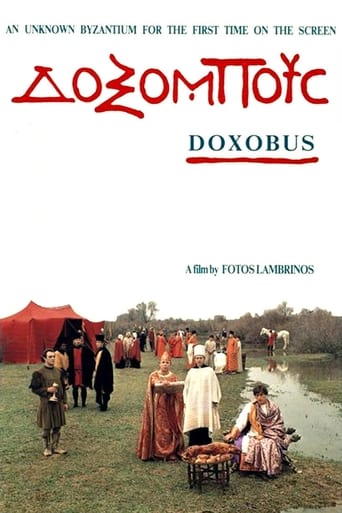
By the 14th century, the Byzantine Empire was, if not on the verge of actual collapse, at least seriously decadent and clearly on its last legs. The hungry wolves of Europe were preparing to dine on its corpse, and as a result the Byzantine army and its allies were constantly engaged in battles and skirmishes. In this story, a widow lives in the 14th-century Byzantine village of Doxobus with her son Xenos. She forms a relationship with a village elder, and when she gives birth to the elder’s son, her son from her previous marriage is sent to live in a monastery.
Doxobus
1987
 NR
An end of study film for this film director who graduated from the Gerasimov Institute of Cinematography (VGIK) in Moscow, it was produced from audiovisual archives found in Russia. Inspired by the film "Triumph over Violence", produced in 1965 by Mikhail Romm, a study director and film director, "Visit Greece" tells the story of the first tourists – usually armed and not invited – to visit Greek territory at various periods of its history.
Visit Greece
1970
 10.0
The film is dedicated to the centennial of cinema and, through a pastiche of excerpts from Balkan silent films, pays tribute to a cinema that has been almost completely forgotten. Old photographs and a modern- day train trip through the Balkans highlight the coincidences, the similarities, and the affinities that link Balkan filmmakers. A film about all the things that unite the neighbouring countries of the peninsula, which, perhaps, are many more than the things that divide them.
Birthday Celebration, or a Silent Balkan Story
1995
Film credits
Behind the camera
Sergei Paradjanov, the great Soviet filmmaker of Armenian origin who was born and grew up in Tbilisi, Georgia, studied film in Moscow and worked for many years in Ukraine, talks on camera to Fotos Lamprinos about his life, his films, and events in the USSR under Gorbachev’s Perestroika, a few short months before he died and while the state of his health was already deteriorating. The film includes rare footage of the massacre of Georgian civilians by the Soviet Army in April 1989 and unpublished material from the Ukrainian prison in which Paradjanov served his sentence.
Sergei Parajanov, The Exile
2009
5.8By the 14th century, the Byzantine Empire was, if not on the verge of actual collapse, at least seriously decadent and clearly on its last legs. The hungry wolves of Europe were preparing to dine on its corpse, and as a result the Byzantine army and its allies were constantly engaged in battles and skirmishes. In this story, a widow lives in the 14th-century Byzantine village of Doxobus with her son Xenos. She forms a relationship with a village elder, and when she gives birth to the elder’s son, her son from her previous marriage is sent to live in a monastery.
Doxobus
1987
NRAn end of study film for this film director who graduated from the Gerasimov Institute of Cinematography (VGIK) in Moscow, it was produced from audiovisual archives found in Russia. Inspired by the film "Triumph over Violence", produced in 1965 by Mikhail Romm, a study director and film director, "Visit Greece" tells the story of the first tourists – usually armed and not invited – to visit Greek territory at various periods of its history.
Visit Greece
1970
10.0The film is dedicated to the centennial of cinema and, through a pastiche of excerpts from Balkan silent films, pays tribute to a cinema that has been almost completely forgotten. Old photographs and a modern- day train trip through the Balkans highlight the coincidences, the similarities, and the affinities that link Balkan filmmakers. A film about all the things that unite the neighbouring countries of the peninsula, which, perhaps, are many more than the things that divide them.
Birthday Celebration, or a Silent Balkan Story
1995
 NR
1917-1933. The Bolshevik Revolution – Holodomor. The greatest Utopia mankind has ever known. An Utopia that shocked the world and was buried in mass graves along with millions of victims. The film narrates the global influence of the Revolution, the establishment of dozens of Communist Parties, the hopes created in millions of people around the world and this so full of promise yet tragic course of “The Great Utopia.” The film is a tribute to the centenary of the October Revolution (1917-2017)
The Great Utopia
2017
 9.0
A documentary on the assassination of Greek politician Grigoris Lambrakis, by a political group of the extreme right.
One Hundred Hours of May
1963
 NR
Historical-political documentary about the life and activity of a mythical figure of EAM Movement and the National Resistance, that the captain of ELAS Ari Velouhioti.
Aris Velouchiotis - The Dilemma
1981
NRHistorical-political documentary about the life and activity of a mythical figure of EAM Movement and the National Resistance, that the captain of ELAS Ari Velouhioti.
Aris Velouchiotis - The Dilemma
1981
 NR
A Turkish man decides in 1947 to illegally visit the Greek north-eastern mountains at Thrace in order to fight in the Greek Civil War on the side of the Greek Guerrillas (Communists). Today, at the age of 92, he makes a journey back to Greece where he fought to visit again the battle fields.
Captain Kemal, A Comrade
2009
NRA Turkish man decides in 1947 to illegally visit the Greek north-eastern mountains at Thrace in order to fight in the Greek Civil War on the side of the Greek Guerrillas (Communists). Today, at the age of 92, he makes a journey back to Greece where he fought to visit again the battle fields.
Captain Kemal, A Comrade
2009