
Known for
 8.0
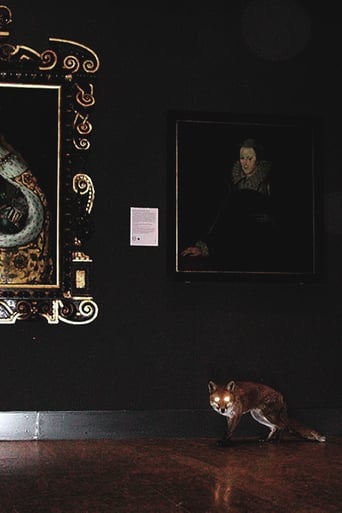
The Nightwatch documents an action realised by Alÿs in 2004 in which he released a fox into London’s National Portrait Gallery in the middle of the night and used the museum’s CCTV system to follow its movements. The institution was chosen because unlike other institutions it does not conceal its CCTV cameras.
The Nightwatch
2004
 NR
For an indeterminate period of time, the magnetized metal collector takes a daily walk through the streets and gradually builds up a coat mad of any metallic residue lying in its path. This process goes on until the collector is completely covered by its trophies.
The Collector
2006
 NR
No synopsis available yet.
Siren
2023
 NR
The video shows the artist walking in circles around the flagpole (“Madre Patria”) in Zócalo, Mexico City’s monumental central square, which is flanked by government institutions. This work relates to a storied incident that took place during the Mexican government’s brutal oppression of the 1968 student uprising in Mexico City.
Patriotic Tales
1997
 NR
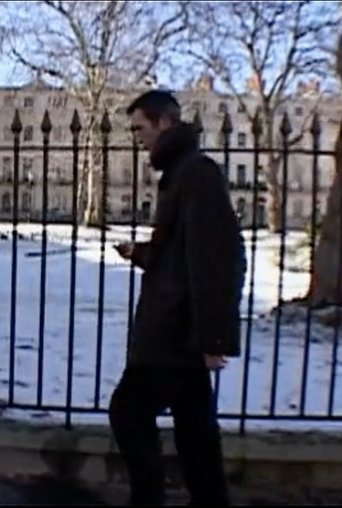
Francis Alÿs is filmed by his collaborator Rafael Ortega walking along Fitzroy Square, drumming out rhythms by dragging a wooden stick on the iron railings.
Fitzroy Square
2004
 NR
2005, 00:03:07
Looking Up
2005
Film credits
2010s · 2 titles
 NR
"Mixing water from the Red Sea with water from the Black Sea". Trabzon, Turkey-Aqaba, Jordan, 2010.
Watercolor
2011
 6.0
One of Francis Alÿs’ series of performative videos that politicize absurd or seemingly futile gestures, Paradox of Praxis 5 documents the artist’s nocturnal perambulations through Juárez as he kicks a ball of fire along the city’s desolate streets. Transcending metaphor, the eerie mobile conflagration traces out an imaginary map of a devastated city.
Paradox of Praxis 5
2015
2000s · 3 titles
 NR
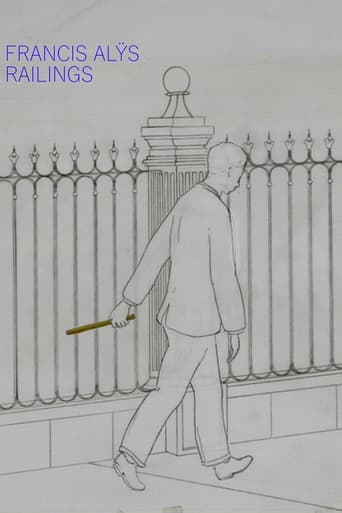
This video performance showcases two works by the artist. In the first, he walks through the streets of London, trailing a wooden drumstick along a series of metal railings, producing a percussive, sometimes bell-like noise. The camera follows behind, focusing on the stick as it strikes the railings. Occasionally, it cuts to wide-angle shots, capturing the awkward and oddly humorous presence of other people. In the second work, titled "Samples II" Alÿs appears even rawer, minimal and radical. He walks around London with a drumstick in hand, creating sounds by playing the metal fences beside him, without a melody. These works are a playful example of one of Alÿs’s ‘interventions’ in the city.
Railings
2004
 NR
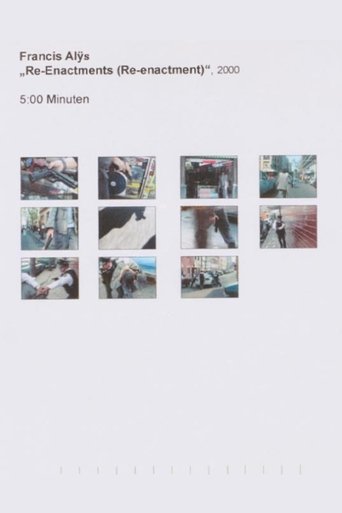
For this work Alÿs purchased a gun in Mexico City then walked through the city streets with the weapon in his hand. After eleven minutes he was arrested by the police. The following day he repeated the action, this time in cooperation with the police. By presenting a record of this dramatic action alongside footage of its reenactment, Alÿs blurs the boundaries between documentation and fiction. Questioning the concept of authenticity, this work demonstrates “how media can distort and dramatize the immediate reality of a moment,” the artist has said. Gallery label from Francis Alÿs: A Story of Deception, May 8–August 1, 2011.
Re-enactment
2000
 NR
In The Green Line, for which the axiom was ‘sometimes the political is poetic, sometimes the poetic is political’, Alÿs walks holding a punctured can of dribbling green paint along the contested width of the so-called Green Line established between Israel and its neighbours following the 1948 Arab–Israeli War. In formal terms, The Green Line is a reenactment of an earlier work, The Leak (1996), in which the artist took a can dribbling blue paint for a walk and installed the empty container in the gallery. By recontextualising The Leak in geopolitical terms, Alÿs relocates the tensions in the work from those formal ideas of action and painting to questions of maps and territories and who has the right to live where.
The Green Line
2004
1990s · 3 titles
NRThe video shows the artist walking in circles around the flagpole (“Madre Patria”) in Zócalo, Mexico City’s monumental central square, which is flanked by government institutions. This work relates to a storied incident that took place during the Mexican government’s brutal oppression of the 1968 student uprising in Mexico City.
Patriotic Tales
1997
 NR
For the 1999 Venice Biennale, Alÿs created an unofficial performance for the occasion, titled Duett. The piece begins with Alÿs entering Venice by train while fellow Belgian artist Honoré d’O landed at the airport, and each man is carrying one half of a tuba. After drifting through the labyrinth of streets, they eventually met three days later and reassembled the musical instrument. The work is emblematic of Alÿs’s exploration of estranged or misplaced halves striving for reconciliation.
Duett
1999
 NR
For more than nine hours, Francis Alÿs pushes a block of ice through the streets of Mexico City until it completely melts.
Paradox of Praxis 1 (Sometimes Making Something Leads to Nothing)
1997
Undated · 2 titles
 NR
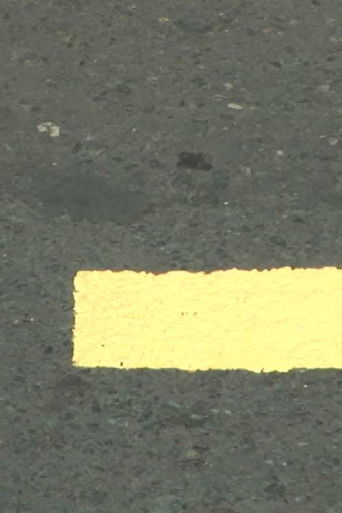
From the 3rd to the 5th of November 2008, 60 median strips erased by the passage of time were repainted in the former Panama Canal Zone.
Painting/Retoque
—
 NR
The Belgian-born and Mexican-based conceptual artist Francis Alÿs arrived in Iraq in October 2016 to document the displacements caused by the Mosul offensive against ISIS.
Color Matching
—
Behind the camera
8.0The Nightwatch documents an action realised by Alÿs in 2004 in which he released a fox into London’s National Portrait Gallery in the middle of the night and used the museum’s CCTV system to follow its movements. The institution was chosen because unlike other institutions it does not conceal its CCTV cameras.
The Nightwatch
2004
NRFor an indeterminate period of time, the magnetized metal collector takes a daily walk through the streets and gradually builds up a coat mad of any metallic residue lying in its path. This process goes on until the collector is completely covered by its trophies.
The Collector
2006
NRNo synopsis available yet.
Siren
2023
NRThe video shows the artist walking in circles around the flagpole (“Madre Patria”) in Zócalo, Mexico City’s monumental central square, which is flanked by government institutions. This work relates to a storied incident that took place during the Mexican government’s brutal oppression of the 1968 student uprising in Mexico City.
Patriotic Tales
1997
NRFrancis Alÿs is filmed by his collaborator Rafael Ortega walking along Fitzroy Square, drumming out rhythms by dragging a wooden stick on the iron railings.
Fitzroy Square
2004
NR2005, 00:03:07
Looking Up
2005
Lamma Island, Hong Kong, 2020.
Prohibited Steps
—
NRFrom the 3rd to the 5th of November 2008, 60 median strips erased by the passage of time were repainted in the former Panama Canal Zone.
Painting/Retoque
—
 NR
A traditional animation, hand-drawn in 500+ frames (which are also on display as part of the installation). The animation consists solely of a shoe shine: hands move a length of cloth around and across a shoe, syncopated with a minimalistic melody and lyrics written by the artist. Its swaying, repetitive quality draws the audience into a simple and elegant comparison of artistic labor, in the form of drawing, to the marginalized service economy of a global city.
Bolero (Shoe Shine Blues), 1996-2007
2008
NRThis video performance showcases two works by the artist. In the first, he walks through the streets of London, trailing a wooden drumstick along a series of metal railings, producing a percussive, sometimes bell-like noise. The camera follows behind, focusing on the stick as it strikes the railings. Occasionally, it cuts to wide-angle shots, capturing the awkward and oddly humorous presence of other people. In the second work, titled "Samples II" Alÿs appears even rawer, minimal and radical. He walks around London with a drumstick in hand, creating sounds by playing the metal fences beside him, without a melody. These works are a playful example of one of Alÿs’s ‘interventions’ in the city.
Railings
2004
 NR
No synopsis available yet.
Semáforos
1995
 1.0
For the last decade Alÿs has made repeated trips to the dusty highlands south of Mexico City to chase the tornadoes that frequently occur in that region at the end of the dry season. Tornado unfolds in three movements: waiting for the storms, pursuing them, and catching or missing them. Depicting a one-on-one challenge of the power of nature, the work is a recognition of human persistence, emphasizing the necessity of pursuing ideals however unattainable or absurd they may seem. It is also a reflection on the present chaotic state of Mexico and a study of the search for a moment of order within it; scientifically speaking, tornadoes are instances of order emerging from chaos.
Tornado
2010
 5.0
During the 5th Havana Biennial, artist Francis Alys put on his magnetic shoes and took daily walks through the streets of the city, collecting scraps of metal lying in his path.
Zapatos Magnéticos
1994
 NR
The game is filmed from above in a single take, emphasizing the inexorable process of subtraction. Six children place five chairs in a row, facing in alternate directions. When the music starts, the players skip one behind the other around the chairs. When the music stops, everyone scrambles to occupy the nearest chair and one person is left standing. The loser carries a chair away, stomping out of shot to the left. The music starts again, and so it goes on until the winner claims the last chair. Then there is only an empty space.
Children’s Game #12: Musical Chairs
2012
 NR
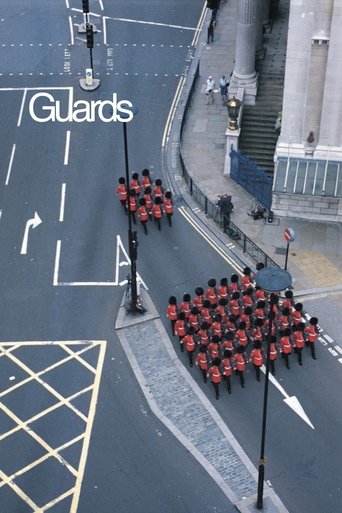
64 Coldstream guards walk separately in London entering through different streets and unaware of one another’s route. Upon meeting, they fall into step and match together, looking or more guards to join up with.
Guards
—
NRFor this work Alÿs purchased a gun in Mexico City then walked through the city streets with the weapon in his hand. After eleven minutes he was arrested by the police. The following day he repeated the action, this time in cooperation with the police. By presenting a record of this dramatic action alongside footage of its reenactment, Alÿs blurs the boundaries between documentation and fiction. Questioning the concept of authenticity, this work demonstrates “how media can distort and dramatize the immediate reality of a moment,” the artist has said. Gallery label from Francis Alÿs: A Story of Deception, May 8–August 1, 2011.
Re-enactment
2000
NR"Mixing water from the Red Sea with water from the Black Sea". Trabzon, Turkey-Aqaba, Jordan, 2010.
Watercolor
2011
 NR
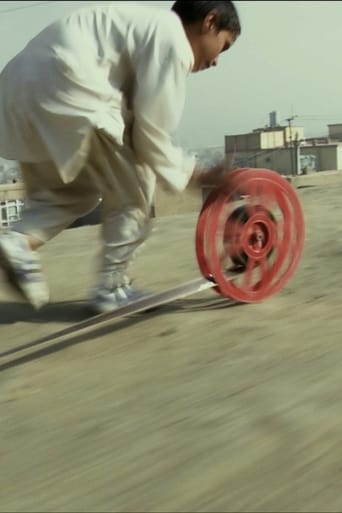
The cameras follow a reel of film as it unrolls through the old part of Kabul—pushed by two children, uphill and downhill, like a hoop.
Reel/Unreel
2012
 NR
In August 2017, during the final phase of the Fatah (Conquest) Operation, the Iraqi Army pushed Islamic State combatants back from the east bank of the Tigris River in Mosul. With the support of Baghdad’s Ruya Foundation, Francis Alÿs had been working with the inhabitants of the border region between Iraq and Syria, embedded with the armed forces fighting the Islamist militias. On the west bank of the Tigris, which had just been liberated from Daesh control, Alÿs documented a peculiar street game that he had heard of on a previous trip: a soccer game played without a ball, but with great skill, imagination and resistance by a group of young people, in defiance of the barbarous impositions of the Islamic State, an expression of passion and creativity that these young people were more than willing to reenact in front of the camera.
Children’s Game #19: Haram Football
2017
6.0One of Francis Alÿs’ series of performative videos that politicize absurd or seemingly futile gestures, Paradox of Praxis 5 documents the artist’s nocturnal perambulations through Juárez as he kicks a ball of fire along the city’s desolate streets. Transcending metaphor, the eerie mobile conflagration traces out an imaginary map of a devastated city.
Paradox of Praxis 5
2015
 NR
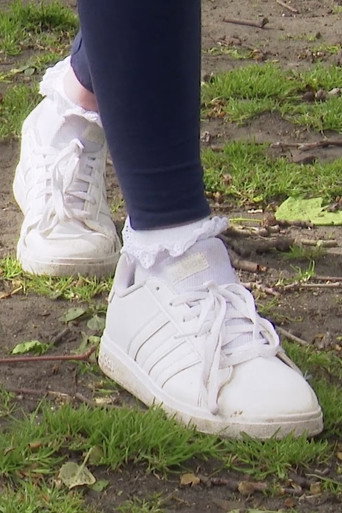
Grandma’s Footsteps in Britain, Red light, green light in North America, Thunder, weather, lightning in Austria, One, two, three, ciggy forty-three in Argentina, Frozen in Mexico, Statues in Greece – all refer to a game of stealth and balance popular around the world. While some versions rely on turning around at unpredictable intervals, these London kids play it with the regularly timed cry of “One, two, three, freeze!”. The caller takes her time assessing everyone’s immobility, which ensures further wobbles. But she can only expel the most unstable, and the forwards progress won’t be stopped.
Children’s Game #45: 1, 2, 3, Freeze!
2024
NRFor the 1999 Venice Biennale, Alÿs created an unofficial performance for the occasion, titled Duett. The piece begins with Alÿs entering Venice by train while fellow Belgian artist Honoré d’O landed at the airport, and each man is carrying one half of a tuba. After drifting through the labyrinth of streets, they eventually met three days later and reassembled the musical instrument. The work is emblematic of Alÿs’s exploration of estranged or misplaced halves striving for reconciliation.
Duett
1999
 NR
As is well known, ‘gringo’ is the derogatory term Mexicans use to refer to NorthAmerican citizens. Shot in a central province of Mexico, Alÿs’s video portrays the confrontation between a group of dogs protecting their master’s home and an intruder (the cameraman, invisible to the work’s spectators). In this fiction of sorts, the camera takes an active role in the unfolding of the narrative. By examining the way in which its oppressive gaze can be a form of weaponry as much as a shield, it draws attention to how videocameras have become an epitome of power. Acting ‘like a dog among dogs’, Alÿs deliberately set the camera against the animals knowing that dogs loathe direct eye contact. Throughout the film the camera manages to keep the dogs at bay, sometimes providing a physical armour, sometimes actively entering into the game of menace and recognition.
El Gringo
2003
 NR
No synopsis available yet.
Children’s Game #24: Pandemic Games
2020
 NR
Over the city of Lubumbashi looms the mampala or slag heap of the Étoile du Congo cobalt mine, its lower slopes today sifted by the clandestins, lithium hunters who risk their lives to feed our global battery market. The film rests on dramatic contrasts – tiny bright figures against the expanse of darkness; a child who can barely see over the colossal tire he fights to push uphill. Then the adrenaline rush of rolling down inside it! Yet the song the kids invented “pushing, pushing” to solve post-industrial problems, gives faith in these young carriers of D.R. Congo’s future.
Children’s Game #29: La roue
2021
 NR
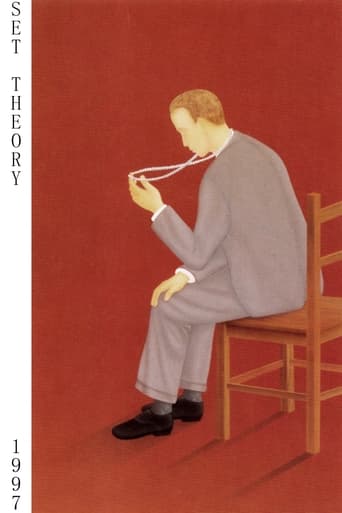
Francis Alÿs has his own drawing painted by several different semi-professional painters.
Set Theory
—
 NR
The castle must be positioned just far enough from the sea to be completed before the tide reaches it. As the moat is dug by busy spades, the vacated sand forms a growing pile in the middle. Sea water starts to rise into the moat from below. As the waves break gently, closer and closer, the children dig faster to fortify the outer rampart with sodden sand. Even as the defences are being flooded, they work on shaping and firming the castle with hands and feet. The tide soon overwhelms the mini world and smooths the whole thing flat, leaving the children standing ankle-deep in ebb and flow.
Children’s Game #6: Sandcastles
2009
 NR
A piñata is a papier-mâché figure stuffed with sweets. Common at birthdays in urban patios, here we find it in a field, where a garish Superman dangles between tall poles on a rope jerked by an adult, to make hitting harder. Each player is blindfolded and spun around several times before attempting to hit the piñata with a long stick. The kids’ wild swinging is directed by the shouts of friends, while the allotted time of each turn is counted down in a singsong about finding and losing one’s way. Fierce blows are dealt with varying accuracy until the piñata is fully smashed open and its sweets shower to the ground, leaped on by all the kids at once. The hollow, punctured figure is triumphantly dismembered.
Children’s Game #13: Piñata
2012
NRThe Belgian-born and Mexican-based conceptual artist Francis Alÿs arrived in Iraq in October 2016 to document the displacements caused by the Mosul offensive against ISIS.
Color Matching
—
 NR
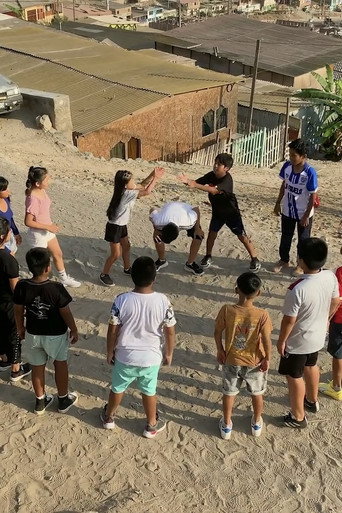
The game “Mosquito of Pachacútec” refers to the historical metaphor of how the Inca Empire was challenged in its territorial conquests by a tiny adversary: the mosquito. These seemingly insignificant insects hindered the expansion of the Inca Pachacútec empire in the mid-15th century, particularly in coastal areas, where malaria-carrying mosquitoes formed a natural barrier for the Inca armies. The players form a circle. One player throws an imaginary mosquito into the air, shouting, “The Pachacútec mosquito is going this way!” The following players try to kill the mosquito by clapping their hands in the air. After a couple of rounds, another imaginary mosquito is released, then a third, until the chain breaks and the round collapses in a fit of laughter.
Children’s Game #43: Mosquito de Pachacútec
2024
 NR
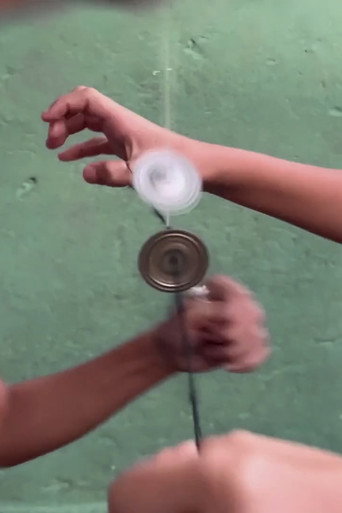
Ordinary bottle tops, once flattened, threaded and tensed for spinning, become as sharp as gladiator swords. It’s edge against thrumming edge as the jousters try to slice their opponent’s string by means of feints, angles, and jabs. The players fight in such close proximity that the emotion of each move is magnified in their faces, as if to compensate for the necessary restraint of thrusts and parries – take that, oh no, how about this, oops close one… gotcha!
Children’s Game #41: Chapitas
2023
Alÿs’s motto for When Faith Moves Mountains is “Maximum effort, minimum result.” For this epic project the artist invited five hundred volunteers to walk up a sand dune on the outskirts of Lima, Peru, shoveling in unison, thus displacing the dune by a few inches. Demonstrating a ridiculous disproportion between an effort and its effect, the work is a metaphor for Latin American society, in which minimal reforms are achieved through massive collective efforts. Participants in the project gave their time for free, reversing conservative economic principles of efficiency and production. Embracing rumor, urban myth, and oral history, Alÿs aims to make works that continue beyond the duration of the event itself, through stories disseminated by word of mouth.
When Faith Moves Mountains
2002
NRFor more than nine hours, Francis Alÿs pushes a block of ice through the streets of Mexico City until it completely melts.
Paradox of Praxis 1 (Sometimes Making Something Leads to Nothing)
1997
 NR
Close-up on shiny boots, knotted elastic, cobbles. Within the confines of a courtyard two demure little girls are playing a game of confinement, entrapment, escape. An elastic band has been stretched into a rectangle around four points –the legs of one girl and of a chair. At first the rectangle is positioned close to the ground. Silent with concentration, the girls take turns bracing the elastic and performing a prescribed sequence of jumps on and around the tensed bands. Ankles are entangled and then jump free. As the elastic rises higher, more and more of the body is involved in skilful contortions and athletic, perilous choreography. There’s no ultimate winning, just getting better at the dance.
Children’s Game #4: Elastic
2008
 NR
A guitar, a bacalao and a teddy bear dangle at the top of a wooden pole. The mast is slickened with grease. A group of teenagers gather. Strength and teamwork will be required, as well as some patience. After a couple of attempts at solitary climbing, the participants join forces and use their bodies to build a tower; a hand pushes down on a shoulder, a foot on a head, but all eyes are focused on the top and on snatching a prize.
Children’s Game #49: Pau de Sebo
2024
Presented at the Iraqi Pavilion at the 57th Venice Biennale.
Untitled
2017
 6.5
The children of a mountain village near Mosul re-enact a century of Iraqi history, from the secret Sykes-Picot agreement in 1916 to the realm of terror imposed by the Islamic State in 2016. The children revisit their past to understand their present.
Sandlines, the Story of History
2020
6.5The children of a mountain village near Mosul re-enact a century of Iraqi history, from the secret Sykes-Picot agreement in 1916 to the realm of terror imposed by the Islamic State in 2016. The children revisit their past to understand their present.
Sandlines, the Story of History
2020