
Acting
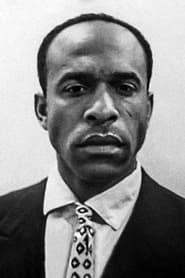
Frantz Fanon
Born — Died
1925-07-20 — 1961-12-06
Place of birth
Fort-de-France, Martinique, France
Known for
Acting
Credits
15 titles
Known for
 8.7
8.7The history of decolonization from the point of view of colonized peoples, an epic story that still resonates and reverberates to this day.
Decolonisation
2020
 9.5
9.5Upon his death, a young African director, Abramo Malonga, bequeathed his first and last unfinished film to his former teacher, the Italian director Fausto Morelli. Morelli, who after seeing the work, is confronted with a confusing, complex and, in part, incomprehensible work. Helped by the young widow of Abramo Malonga and by the notes left by his deceased friend, and again by his personal memories, the Italian director attempts to reconstruct and complete the film. Fausto's work progresses with difficulty, not only because of the problems the film poses for him, but because of the problems that arise in his daily life. After a long crisis, after which he returns to Pisa with his former party companions and abandons himself to love and his own solitude, Fausto takes up the work of his African friend, closing it with a final invention, in which , with a bold metaphor, has refigured the human condition of our time.
The Damned Of The Earth
1969
 7.2
7.2Explores the life and work of the psychoanalytic theorist and activist Frantz Fanon who was born in Martinique, educated in Paris and worked in Algeria. Examines Fanon's theories of identity and race, and traces his involvement in the anti-colonial struggle in Algeria and throughout the world.
Frantz Fanon: Black Skin, White Mask
1996
 6.6
6.6Frantz Fanon, a French psychiatrist from Martinique, has just been appointed head of department at the psychiatric hospital in Blida, Algeria. His methods contrast with those of the other doctors in a context of colonization. A biopic in the heart of the Algerian war where a fight is waged in the name of Humanity.
Fanon
2025
 NR
NRIn five parts, this documentary tells the story of the colonisation of the French Overseas Territories. Slave descendants, coloniser descendants, historians, admirals, rebellious writers and politicians recount a lasting past that keeps on igniting the economic and social relations of these territories even to this day.
Contre-histoire de la France d'outre-mer
2013
 NR
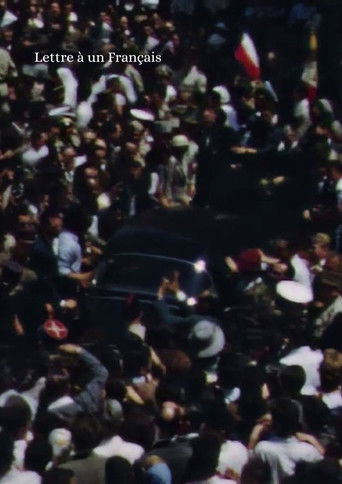
NRNo synopsis available yet.
Lettre à un Français
2025
Film credits
2020s · 4 titles
6.6Frantz Fanon, a French psychiatrist from Martinique, has just been appointed head of department at the psychiatric hospital in Blida, Algeria. His methods contrast with those of the other doctors in a context of colonization. A biopic in the heart of the Algerian war where a fight is waged in the name of Humanity.
Fanon
2025
 10.0
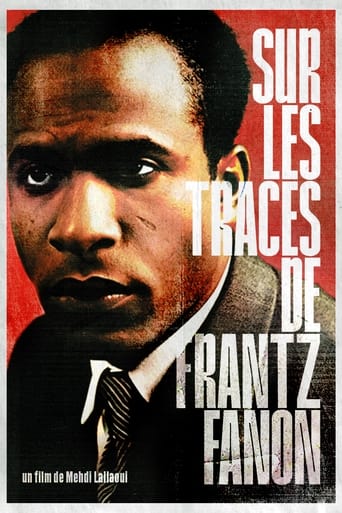
10.0Who was Frantz Fanon, the author of Wretched of the Earth and Black Skin, White Masks, this Pan-African thinker and psychiatrist engaged in anti-colonialist struggles? Born in Martinique, Frantz Fanon was not yet 20 years old when he landed, weapons in hand, on the beaches of Provence in August 1944 with thousands of soldiers from "Free France", most of whom had come from Africa, to free the country from Nazi occupation. He became a psychiatrist and ten years later joined the Algerians in their fight for independence. Died at the age of 36, he left behind a major work on the relationships of domination between the colonized and the colonizers, on the roots of racism and the emergence of a thought of a Third World in search of freedom. 60 years after his death, the film follows in the footsteps of Frantz Fanon, alongside those who knew him, to rediscover this exceptional man.
In the Footsteps of Frantz Fanon
2021
 8.0
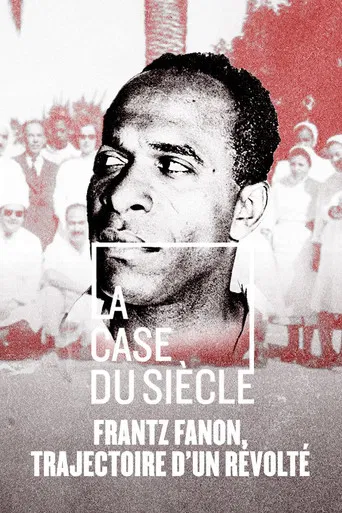
8.0Frantz Fanon alone embodies all the issues of French colonial history. Martinican resistance fighter, he enlisted, like millions of colonial soldiers, in the Free Army out of loyalty to France and the idea of freedom that it embodies for him. A writer, he participated in the bubbling life of Saint-Germain with Césaire, Senghor and Sartre, debating tirelessly on the destiny of colonized peoples. As a doctor, he revolutionized the practice of psychiatry, seeking in the relations of domination of colonial societies the foundations of the pathologies of his patients in Blida. Activist, he brings together through his action and his history of him, the anger of peoples crushed by centuries of colonial oppression. But beyond this exceptional journey which makes sensitive the permanence of French colonialism in the Lesser Antilles at the gates of the Algerian desert, he leaves an incomparable body of work which has made him today one of the most studied French authors across the Atlantic.
Frantz Fanon, trajectoire d'un révolté
2021
 6.0
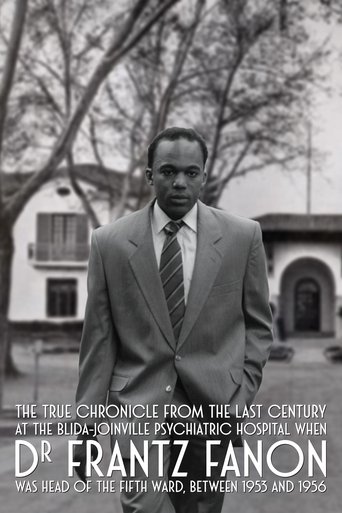
6.01953, colonized Algeria. Fanon, a young black psychiatrist is appointed head doctor at the Blida-Joinville Hospital. He was putting his theories of ‘Institutional Psychotherapy’ into practice in opposition to the racist theories of the Algies School of Psychiatry, while a war broke out in his own wards.
True Chronicles of the Blida Joinville Psychiatric Hospital in the Last Century, when Dr Frantz Fanon Was Head of the Fifth Ward between 1953 and 1956
2025
2000s · 2 titles
 10.0
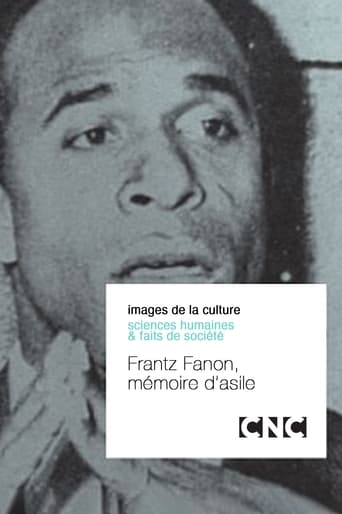
10.0Using archive material and present-day accounts, the recalls the life of the Afro-Caribbean psychiatrist, Frantz Fanon. In 1953, at the age of twenty eigh, Fanon was appointed head doctor at the psychiatric hospital in Blida-Joinville, a few kilometres from Algiers. As amedical student in Paris, he had been appalled by the living conditions of the Algerian immigrants and gave over the rest of his brief life to analysing the alienation of the black man, of colonised people and man in general. The forcefulness of his writing - as in Black Skin, White Masks and The Wretched of the Earth - and the pertinence of his reasoning still resonate strongly into today's world.
Frantz Fanon, mémoire d'asile
2002
 10.0
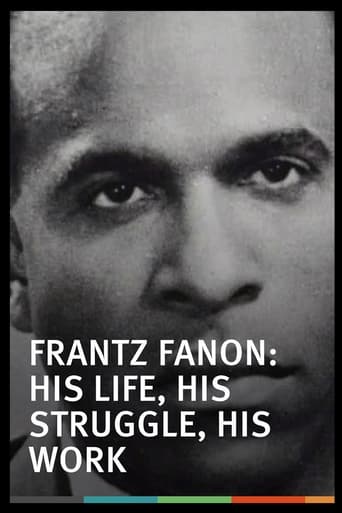
10.0It is the evocation of a life as brief as it is dense. An encounter with a dazzling thought, that of Frantz Fanon, a psychiatrist of West Indian origin, who will reflect on the alienation of black people. It is the evocation of a man of reflection who refuses to close his eyes, of the man of action who devoted himself body and soul to the liberation struggle of the Algerian people and who will become, through his political commitment, his fight, and his writings, one of the figures of the anti-colonialist struggle. Before being killed at the age of 36 by leukemia, on December 6, 1961. His body was buried by Chadli Bendjedid, who later became Algerian president, in Algeria, at the Chouhadas cemetery (cemetery of war martyrs ). With him, three of his works are buried: “Black Skin, White Masks”, “L’An V De La Révolution Algérien” and “The Wretched of the Earth”.
Frantz Fanon: His Life, His Struggle, His Work
2001
1970s · 1 titles
Series credits
Behind the camera
9.5Upon his death, a young African director, Abramo Malonga, bequeathed his first and last unfinished film to his former teacher, the Italian director Fausto Morelli. Morelli, who after seeing the work, is confronted with a confusing, complex and, in part, incomprehensible work. Helped by the young widow of Abramo Malonga and by the notes left by his deceased friend, and again by his personal memories, the Italian director attempts to reconstruct and complete the film. Fausto's work progresses with difficulty, not only because of the problems the film poses for him, but because of the problems that arise in his daily life. After a long crisis, after which he returns to Pisa with his former party companions and abandons himself to love and his own solitude, Fausto takes up the work of his African friend, closing it with a final invention, in which , with a bold metaphor, has refigured the human condition of our time.
The Damned Of The Earth
1969
NRNo synopsis available yet.
Lettre à un Français
2025
 9.0
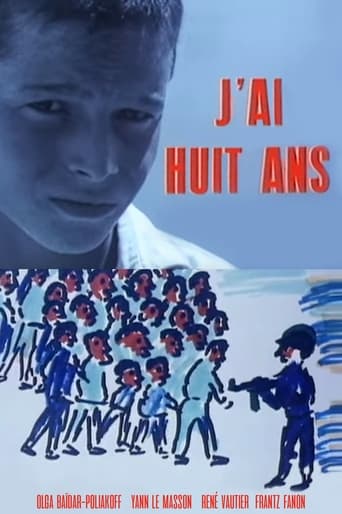
9.0With my wife, Olga Poliakoff, we made "I'm Eight Years Old" based on an idea by René Vautier. Using drawings by Algerian children who were refugees in Tunisia, the film immerses the viewer in the traumatized world of these children, horrifically linking the word "France" with words like "kill," "burn," and "torture." The live-action footage was shot in Tunisia by René Vautier and myself. A second set of drawings was compiled, and the children's testimonies were recorded by Olga at the Algerian-Tunisian border. The entire film was edited in collaboration with Jacqueline Meppiel. The first screening took place in Paris on February 10, 1962, without any precautions or authorization, for about fifty people. Sponsored by the Maurice Audin Committee, the film then circulated clandestinely throughout France in dozens of copies and was seen by tens of thousands of people while the OAS was carrying out bombings in Paris and Algiers – Yann Le Masson
J'ai Huit Ans
1962
 10.0
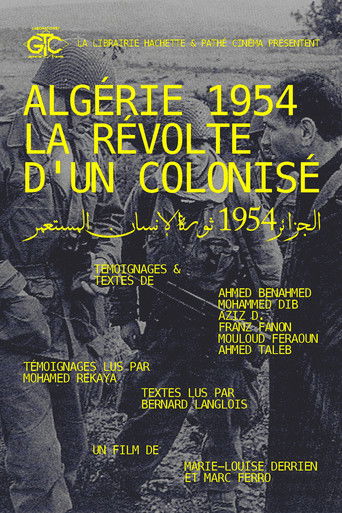
10.0This film presents the point of view of an Arab from Algeria who rebels against colonization. He analyzes the process of awareness, the transition to revolt, to armed insurrection. Algeria and the settlers are seen through this lens and not the way a Frenchman saw the country. He gives voice to the Arabs at a time when this word was not heard: sometimes it was not even produced, at least publicly. The testimonies are based on real propositions, most of them were made to the author during his stay in Algeria from 1948 to 1956, then in 1958 and 1959. The comments are borrowed from the texts of Arab theorists of the revolution Algerian. This film thus completely evacuates the point of view of those who are not insurgents; he does not give the opinion of the colonists. It is the direct expression of what was the revolt of a colonized person: it thus constitutes the very type of the historical document.
Algeria 1954, The Revolt Of A Colonized
1974