
Known for
![Streetscapes [Dialogue] poster](https://image.tmdb.org/t/p/w342/lbaDCCZJ6xwvNLO5qFDBmjnjaOH.jpg) 5.8
5.8A film director confides in his interlocutor. He talks about the working process, about creative blocks, about artistic crises and expressive forces. At some point, the idea takes hold that this conversation could be turned into a film. And this is the very film we’re watching the two of them in.
Streetscapes [Dialogue]
2017
 2.0
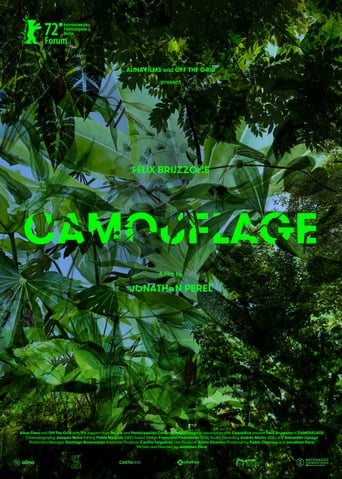
2.0In Camouflage, writer Félix Bruzzone embodies a runner who has an obsession with Campo de Mayo, the biggest military unit in Argentina. It is also the place where his mother disappeared in 1976 and the main clandestine center of detention, torture and extermination during the last dictatorship. The film will follow Félix as he finds characters that allow him to enter and explore this place so loaded with history.
Camouflage
2022
 5.7
5.7Images of Argentinian companies and factories in the first light of day, seen from the inside of a car, while the director reads out documents in voiceover that reveals the collusion of the same concerns in the military dictatorship’s terror.
Corporate Accountability
2020
 NR
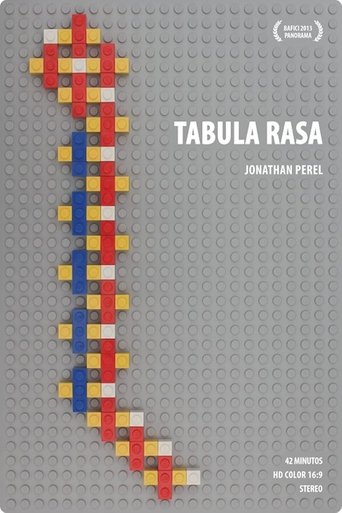
NRArchitectural plans, graphics of abstract forms that gradually become recognizable images, photographs of facades, descriptive texts. Perel returns to the site where the Clandestine Detention, Torture, and Extermination Center (ESMA) once operated, but this time his approach is different. Not only because he enters from a different physical location than the one that represents his entry into the social imaginary, but also because his approach aims to contemplate, no longer the construction of a new place, but the destruction of space. This annihilation, Perel seems to be telling us, brings down much more than columns, cement, and metal beams.
Tabula Rasa
2013
 NR
NRIn and around the Escuela de Mecánica de la Armada (ESMA), the Navy Mechanics School, a former clandestine centre for detention, torture and extermination in Buenos Aires from 1976 to 1983.
The Site
2010
The attempt to accompany the creative process (with the inevitable difficulties and silences) of five women-dancers-choreographers, in their experience of creating a work of dance theater.
5 (five)
2008
Film credits
2020s · 2 titles
5.7Images of Argentinian companies and factories in the first light of day, seen from the inside of a car, while the director reads out documents in voiceover that reveals the collusion of the same concerns in the military dictatorship’s terror.
Corporate Accountability
2020
 NR
NRAn archaeologist and a weapons designer, who knew each other in a previous life as a filmmaker and a psychoanalyst, meet at an excavation site in the Negev desert and begin a conversation about love and war, which they continue in the Israeli city of Be’er Sheva. A series of encounters with alternating actors in different roles ensues, which leads the viewer through the cities of Athens, Berlin, Hong Kong and São Paulo. Among those appearing are: an old artist who meets his younger self; a mother who lives with her two grown-up sons, a priest and a policeman; a Chinese and a Japanese woman; a curator and a cosmologist.
The Last City
2021
Behind the camera
2.0In Camouflage, writer Félix Bruzzone embodies a runner who has an obsession with Campo de Mayo, the biggest military unit in Argentina. It is also the place where his mother disappeared in 1976 and the main clandestine center of detention, torture and extermination during the last dictatorship. The film will follow Félix as he finds characters that allow him to enter and explore this place so loaded with history.
Camouflage
2022
2.0In Camouflage, writer Félix Bruzzone embodies a runner who has an obsession with Campo de Mayo, the biggest military unit in Argentina. It is also the place where his mother disappeared in 1976 and the main clandestine center of detention, torture and extermination during the last dictatorship. The film will follow Félix as he finds characters that allow him to enter and explore this place so loaded with history.
Camouflage
2022
5.7Images of Argentinian companies and factories in the first light of day, seen from the inside of a car, while the director reads out documents in voiceover that reveals the collusion of the same concerns in the military dictatorship’s terror.
Corporate Accountability
2020
5.7Images of Argentinian companies and factories in the first light of day, seen from the inside of a car, while the director reads out documents in voiceover that reveals the collusion of the same concerns in the military dictatorship’s terror.
Corporate Accountability
2020
NRArchitectural plans, graphics of abstract forms that gradually become recognizable images, photographs of facades, descriptive texts. Perel returns to the site where the Clandestine Detention, Torture, and Extermination Center (ESMA) once operated, but this time his approach is different. Not only because he enters from a different physical location than the one that represents his entry into the social imaginary, but also because his approach aims to contemplate, no longer the construction of a new place, but the destruction of space. This annihilation, Perel seems to be telling us, brings down much more than columns, cement, and metal beams.
Tabula Rasa
2013
NRArchitectural plans, graphics of abstract forms that gradually become recognizable images, photographs of facades, descriptive texts. Perel returns to the site where the Clandestine Detention, Torture, and Extermination Center (ESMA) once operated, but this time his approach is different. Not only because he enters from a different physical location than the one that represents his entry into the social imaginary, but also because his approach aims to contemplate, no longer the construction of a new place, but the destruction of space. This annihilation, Perel seems to be telling us, brings down much more than columns, cement, and metal beams.
Tabula Rasa
2013
NRIn and around the Escuela de Mecánica de la Armada (ESMA), the Navy Mechanics School, a former clandestine centre for detention, torture and extermination in Buenos Aires from 1976 to 1983.
The Site
2010
The attempt to accompany the creative process (with the inevitable difficulties and silences) of five women-dancers-choreographers, in their experience of creating a work of dance theater.
5 (five)
2008
 NR
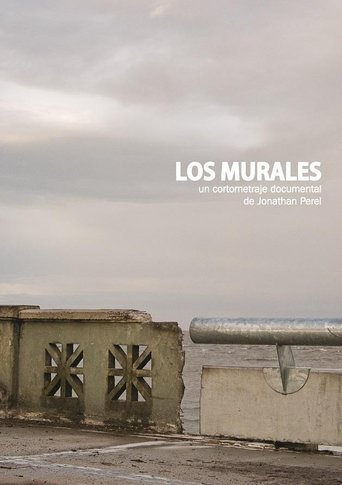
NRGraffiti in the former clandestine centres for detention, torture and extermination, El Olimpo and Automotores Orletti, in Buenos Aires, Argentina.
The Murals
2011
 NR
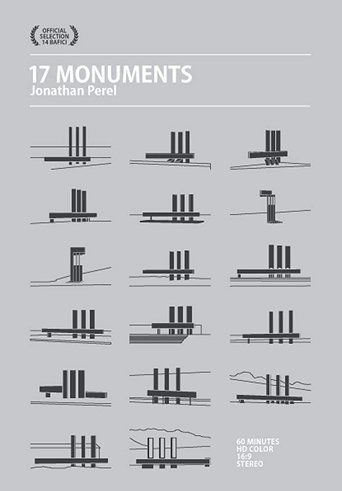
NRSeventeen tripod-bound shots of fixed length observe the diverse and disparate settings in which 17 monuments, each bearing the words 'Memory', 'Truth' and 'Justice', were built by law to mark locations used as detention and torture centres during Argentina's military dictatorship between 1976 and 1983.
17 Monuments
2012
 6.0
6.0From toponymy, a branch of linguistics, to politics, the links can be quite unexpected. These are which are sought to be revealed in the new fi lm by Jonathan Perel who uses his filmwork as a tool to explore and accurately document the marks left by previous dictators of Argentina. We are in the province of Tucuman, in the north of Argentina, an emblematic region where the fi rst Act of Independence in South America was signed in 1816 and where the “Operation Independence” took place in 1974, during which the guerillas’ insurgence was violently repressed.
Toponymy
2015
6.0From toponymy, a branch of linguistics, to politics, the links can be quite unexpected. These are which are sought to be revealed in the new fi lm by Jonathan Perel who uses his filmwork as a tool to explore and accurately document the marks left by previous dictators of Argentina. We are in the province of Tucuman, in the north of Argentina, an emblematic region where the fi rst Act of Independence in South America was signed in 1816 and where the “Operation Independence” took place in 1974, during which the guerillas’ insurgence was violently repressed.
Toponymy
2015
No synopsis available yet.
Las aguas del olvido
2013
Adolfo Scilingo was the only military officer to confess the crimes of the dictatorship that ruled Argentina from 1976 to 1983. Among the genocide practices described were the death flights -- the dropping of tortured living prisoners into the Río de la Plata or the Atlantic Ocean. Scilingo specifies the model that was used in the flights he participated in: an Electra. Of the eight Electras belonging to the Argentine Navy, only the three bought in 1973 could have been used in the flights that Scilingo describes. Those planes are at present in Argentina. This film searches cartographically the traces of those planes.
5-T-2 Ushuaia
2016