
Directing
Shûsaku Arakawa
Born 1936-07-06 · Nagoya, Japan
Arakawa (Shūsaku Arakawa; b. 1936, Nagoya, Aichi Prefecture, Japan – d. 2010, New York) was an artist and architect who had a personal and artistic partnership with Madeline Gins that spanned more than four decades. He was one of the founding members of the Japanese avant-garde art collective Neo Dadaism Organizers and exhibited at the Yomiuri Independent exhibition from 1958 to 1961, an annual watershed event for postwar Japanese art. Arakawa arrived in New York in the end of 1961 and quickly rose to fame as one of the earliest practitioners of the international conceptual art movement of the 1960s. He represented Japan in XXXV Venice Biennale (1970) and was included in Documenta IV (1968) and Documenta VI (1977). His work has been shown extensively around the world and is held by numerous museum collections world-wide, including the Metropolitan Museum of Art, New York; Museum of Modern Art, New York; Centre Georges Pompidou, Paris; and the National Museum of Modern Art, Tokyo.
Acting credits
 NR
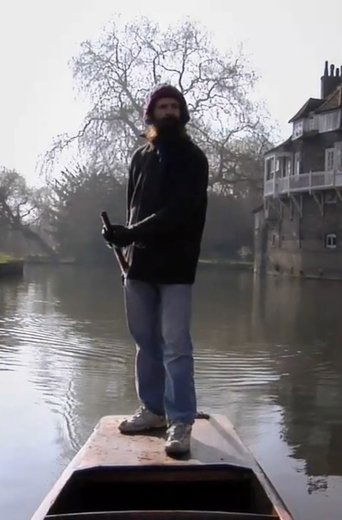
NRLife Extended continues Bigert & Bergström’s exploration of the human endeavor to control life and death. In the film, we meet the gerontologist who believes we will be immortal within a near future, the architects who constructs spaces to slow down the aging process, the monk who runs for 1,000 days in order to strengthen his spirit for its immortal journey, the street kids who lives in the moment, and many more. “Today aging is subject to control,” as one biochemist puts it. And the speed with which this biotechnological development is moving indicates that coming generations will live very long lives. Opposing the static image of the stairway of life, the film is constructed as a relay race where people move towards the viewer. Initiated as a work of art, the film envisions a contemporary memento mori for death itself, when death has become nothing but a memory.
Life Extended
2009
 NR
NRAn interview with artist Shūsaku Arakawa.
Art, Life and Opinions: Shūsaku Arakawa
—
The mental crisis of an architect whose reflections on his commission to build a prison lead to the realization that the modern Western world is a single prison.
N.N.
1969
 NR
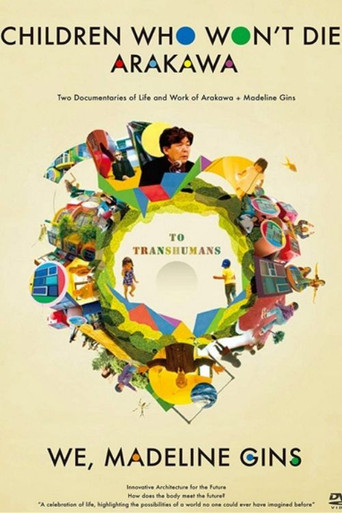
NRArakawa has thrown big ripples all over the world with strange works such as the theme park "Site of Reversible Destiny Yoro", the house for not dying "Mitaka Tenmei Reversible House", and the huge cylindrical building "Nagi Ryuanji". Shusaku died suddenly in New York on May 19, 2010 at 0:35 am. Arakawa talks about the "Mitaka Tenmei Reversible House" he built during his lifetime. "Living here brings out the potential of the body and humans will not die."
Children Who Won’t Die
2013
Behind the camera
 4.2
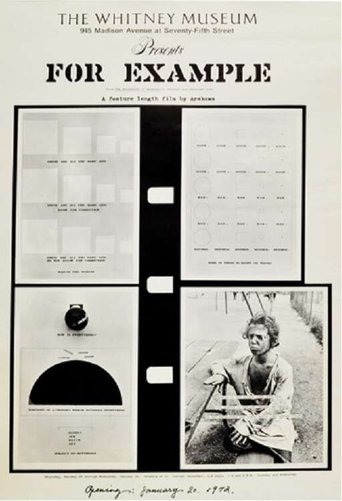
4.2Experimental documentary film, set in the then-present day, about an impoverished, lost boy, living alone in the Bowery.
For Example: A Critique of Never
1971
4.2Experimental documentary film, set in the then-present day, about an impoverished, lost boy, living alone in the Bowery.
For Example: A Critique of Never
1971
 7.7
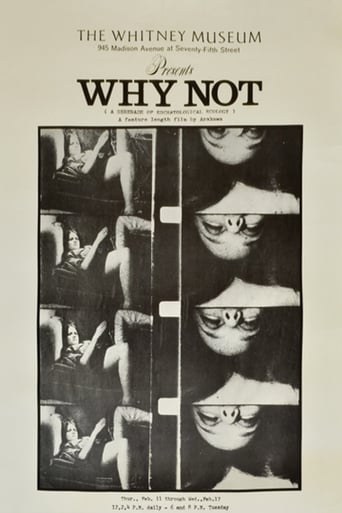
7.7Why Not is hypnotic, compulsive and claustrophobic. It is bathed in a cold, pervasive eroticism, which, oblique and displaced at first, finally becomes explicit in one of the most bizarre masturbation sequences ever filmed. For almost two hours, we observe a young, strikingly pretty girl, nude most of the time and alone in an apartment, engaged in a sonambulistic and sensuous attempt at coming to terms with herself.
Why Not: A Serenade of Eschatological Ecology
1970
7.7Why Not is hypnotic, compulsive and claustrophobic. It is bathed in a cold, pervasive eroticism, which, oblique and displaced at first, finally becomes explicit in one of the most bizarre masturbation sequences ever filmed. For almost two hours, we observe a young, strikingly pretty girl, nude most of the time and alone in an apartment, engaged in a sonambulistic and sensuous attempt at coming to terms with herself.
Why Not: A Serenade of Eschatological Ecology
1970