
Directing
Fritz Freisler
Born — Died
1881-01-21 — 1955-07-02
Known for
Directing
Credits
23 titles
Known for
No synopsis available yet.
Die Hindernisehe
1919
 NR
In Vienna, the director of a sanatorium is telling writer Kristinus the story of a strange case. The very rich and dandy-esque Baron von Stroom had fallen in love with an actress but could not conquer her. One day he acquired a Chinese clay figure of a Mandarin, a talisman whose possessor is said to be able to seduce any woman he desires. As promised, all women's hearts fall to Baron von Stroom. The first is the actress, followed by the wife of the railway king, and then a Princess. Every time the Baron calls out “Man-da-riiiin”, the statue becomes alive ready to make another woman fall in love with his master. But von Stroom soon begins to feel nostalgic for the times when he would conquer the women he desired. However, his attempts to seduce women without the help of his ghostly servant become utterly unsuccessful. Unable to get rid of his devilish servant... Produced one year before The Cabinet of Dr. Caligari, The Mandarin is a predecessor of German expressionism.
The Mandarin
1918
No synopsis available yet.
Dorine und der Zufall
1928
The inhabitants of Vienna line the streets to salute the soldiers who go to the war. The butcher and widower Franz Xaver Wamperl succeeds to enroll himself in the army, and so does his son Ferdl, who becomes a platoon leader. Ferdl is a womanizer, who at the same time has three fiancées in Vienna: Franzi, Resl and Poldi. All three girls remain faithful to him, when he's away at the front, and all of them send passionate love-letters to him. On May Day both Ferdl and his father Franz are back in Vienna on a short leave. They are sitting in an open-air café with another soldier, when suddenly Poldi and Franzi turn up at the same time. When the two women find out that Ferdl has a romance with both of them, they start to weep and quarrel. Ferdl tries to escape, but land in a fight between Franzi and Resl.
Vienna in War
1916
 7.0
Anita Berber and Sebastian Droste performed their macabre dances of vice, horror and ecstasy. Saturated with an air of morbidity and decadence; death, dreams, torture, sex and sensuality.
Tänze des Grauens, des Lasters und der Ekstase
1923
 7.0
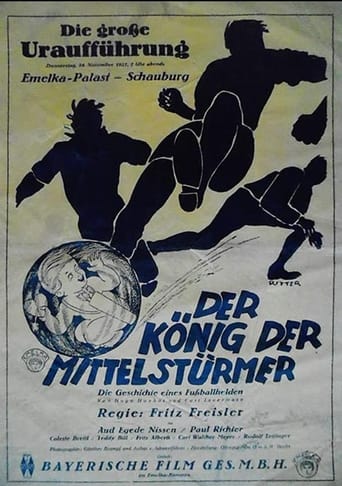
König der Mittelstürmer / King of the Centre Forwards refers with the name of its hero to the German soccer legend of the twenties: Tull Harder, star of the Hamburger Sport Verein (HSV). But the story itself is completely fictitious: The son of a trade company's director falls in love with the daughter of a big American oil magnat. But she suspects him to be only interested in her money. So she buys his father's company to take revenge on him. The son's true love is soccer, and from the very first moment the soccer fever is present throughout the film. It starts with pictures of a soccer game and even an apple or a crumpled up paper must serve as substitute for a ball. Whereas Die elf Teufel promotes soccer as "the sport of the century", König der Mittelstürmer shows the hero's father who still has to be convinced from its importance. He hates soccer and blames everybody to be "soccer crazy".
King of the Centre Forwards
1927
Behind the camera
No synopsis available yet.
Die Hindernisehe
1919
NRIn Vienna, the director of a sanatorium is telling writer Kristinus the story of a strange case. The very rich and dandy-esque Baron von Stroom had fallen in love with an actress but could not conquer her. One day he acquired a Chinese clay figure of a Mandarin, a talisman whose possessor is said to be able to seduce any woman he desires. As promised, all women's hearts fall to Baron von Stroom. The first is the actress, followed by the wife of the railway king, and then a Princess. Every time the Baron calls out “Man-da-riiiin”, the statue becomes alive ready to make another woman fall in love with his master. But von Stroom soon begins to feel nostalgic for the times when he would conquer the women he desired. However, his attempts to seduce women without the help of his ghostly servant become utterly unsuccessful. Unable to get rid of his devilish servant... Produced one year before The Cabinet of Dr. Caligari, The Mandarin is a predecessor of German expressionism.
The Mandarin
1918
No synopsis available yet.
Dorine und der Zufall
1928
No synopsis available yet.
Dorine und der Zufall
1928
The inhabitants of Vienna line the streets to salute the soldiers who go to the war. The butcher and widower Franz Xaver Wamperl succeeds to enroll himself in the army, and so does his son Ferdl, who becomes a platoon leader. Ferdl is a womanizer, who at the same time has three fiancées in Vienna: Franzi, Resl and Poldi. All three girls remain faithful to him, when he's away at the front, and all of them send passionate love-letters to him. On May Day both Ferdl and his father Franz are back in Vienna on a short leave. They are sitting in an open-air café with another soldier, when suddenly Poldi and Franzi turn up at the same time. When the two women find out that Ferdl has a romance with both of them, they start to weep and quarrel. Ferdl tries to escape, but land in a fight between Franzi and Resl.
Vienna in War
1916
7.0Anita Berber and Sebastian Droste performed their macabre dances of vice, horror and ecstasy. Saturated with an air of morbidity and decadence; death, dreams, torture, sex and sensuality.
Tänze des Grauens, des Lasters und der Ekstase
1923
7.0König der Mittelstürmer / King of the Centre Forwards refers with the name of its hero to the German soccer legend of the twenties: Tull Harder, star of the Hamburger Sport Verein (HSV). But the story itself is completely fictitious: The son of a trade company's director falls in love with the daughter of a big American oil magnat. But she suspects him to be only interested in her money. So she buys his father's company to take revenge on him. The son's true love is soccer, and from the very first moment the soccer fever is present throughout the film. It starts with pictures of a soccer game and even an apple or a crumpled up paper must serve as substitute for a ball. Whereas Die elf Teufel promotes soccer as "the sport of the century", König der Mittelstürmer shows the hero's father who still has to be convinced from its importance. He hates soccer and blames everybody to be "soccer crazy".
King of the Centre Forwards
1927
 NR
No synopsis available yet.
Die Jagd nach dem Glück
1920
NRNo synopsis available yet.
Die Jagd nach dem Glück
1920
No synopsis available yet.
Der Henker von Sankt Marien
1920
No synopsis available yet.
Der Henker von Sankt Marien
1920
A professor discovers a way to separate the soul from the body.
Her Other Self
1918
 8.0
"Lights of the Abyss". Anita Berber enchants men and women as the seductive goddess Astarte.
Irrlichter der Tiefe
1923
No synopsis available yet.
Bitte ein Autogramm!
1934
A man tries desperately to make a phone call.
Be Brief!
1932
No synopsis available yet.
Hoheit tanzt Walzer
1926
No synopsis available yet.
Hoheit tanzt Walzer
1926
 NR
Austria during the final days of the Habsburg Empire. On a stormy night, an unconscious, heavily pregnant woman is found in the woods of Maxhausen. She is quickly taken to a forest cabin, where she gives birth to her baby shortly thereafter. She dies soon after. The woman was carrying a considerable amount of cash. The newborn is baptized Eva and placed in the care of the Maxhausen estate manager. Eva is six years old when the Archduchess moves into the castle with her children—a boy, Peperl, and a girl, Poldi. The two high-born children quickly become friends with Eva. World War I breaks out in 1914, bringing with it the primal catastrophe of the European continent.
Die 3 Niemandskinder
1927
NRAustria during the final days of the Habsburg Empire. On a stormy night, an unconscious, heavily pregnant woman is found in the woods of Maxhausen. She is quickly taken to a forest cabin, where she gives birth to her baby shortly thereafter. She dies soon after. The woman was carrying a considerable amount of cash. The newborn is baptized Eva and placed in the care of the Maxhausen estate manager. Eva is six years old when the Archduchess moves into the castle with her children—a boy, Peperl, and a girl, Poldi. The two high-born children quickly become friends with Eva. World War I breaks out in 1914, bringing with it the primal catastrophe of the European continent.
Die 3 Niemandskinder
1927
No synopsis available yet.
Liebesgeschichten
1925
 NR
An anthology of early German cinematic shorts 1908-1918
Cinema Pioneers
2009