

Directing
Siegfried A. Fruhauf
Born
1976-01-01 (50)
Place of birth
Grieskirchen District, Austria
Known for
Directing
Credits
40 titles
Born in Grieskirchen (Upper Austria) in 1976 and grown up in the small village of Heiligenberg (Upper Austria). 1991 – 1994 Training as commercial manager. Studied experimental visual design at the University of Artistic and Industrial Design in Linz where he first came into contact with the Austrian Film Avantgarde. From 1995 to 2010 he lived and worked in Linz and Heiligenberg. 2002 Supporting Award for Filmart by the Austrian Federal Chancellery. Since 2001 organization of film and art events. Since 2009 lecturere at the University of Artistic and Industrial Design, Linz. Numerous works and shows in the area of film, video and fotography. Participation in various important international f…
Known for
 5.0
Twenty-eight well-known filmmakers living and working in Austria were invited by WIENER MOZARTJAHR 2006, to produce associative miniatures on Mozart. Requirement: they had to be one-minute artistic short films. The directors come from a whole range of different backgrounds, ranging from animated, experimental and short film to documentaries and feature films. The result is a multi-facetted sampler of diverse formal and contextual positions with regard to Mozart’s person and his influence on today’s society, art and culture. The contributions run the gamut from experimental-conceptual statements through socio-critical and documentary observations to pithy short feature films.
The Mozart Minute
2006
 NR
The dynamic performance of drummer Jörg Mikula serves as the trigger for a new work by Siegfried Fruhauf that explores the reciprocal relationship between the two time-based media of film and music in a wild way. WHERE DO WE GO reveals itself to be a synesthetic experiment rendering sight as rhythmical and the visual edit as musical. The filmmaker painstakingly animates brief phases of movement recorded with a Lomography Supersampler* to create a visual series of trains, tracks, bridges and nature that are re-constellated and brought together in a multiple split-screen projection.
Where Do We Go
2018
 NR
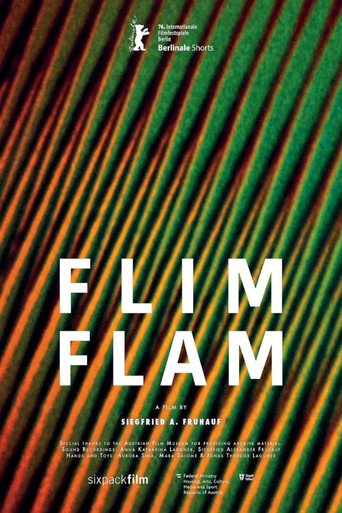
A visual and acoustic reflection about perception, deception, truth and the medium of film itself. Between visibility, irritation, structure and dissolution, a space arises for one’s own vision. An experimental film that wants to be experienced.
Flim Flam
2026
 NR
Rattling, diamond shaped refractions of light: a projector? fluorescent tubes? It turns out to be more like a "human machine" the filmmaker is dissecting with a fine surgical blade. And so commences an imagined dolly shot into the bloodless, post-humanoid body, travelling into an abstract space that occasionally seems to become concrete of its own accord before dissolving back into glistening streaks and ultimately, wide expanses: a cinematic worm hole leading behind the images, where the sluggish human eye is and must be subject to a trick of light arrangements.
Thorax
2020
 NR
How simple is it to make what is happening look suspicious, when harmless shapes are transformed in the bustle of image compression artefacts into dark shadows and a disco light palm becomes an association with explosions? It starts with red, signaling a reason for caution, and it ends in only three minutes as film noir.
SPOT - an Attwenger Trilogy
2015
Etüde draws on early avant-garde film theories and practices, on the utopia of the absolute film: hearing pictures, seeing music. With the technique of hand-drawn sound, the film medium becomes the instrument, something playable. Fruhauf allows us to take part in this process, gets the sound creaking and places a hand in the picture as a subject – where it increasingly threatens to rebel against its forced role.
Etüde
2011
Behind the camera
5.0Twenty-eight well-known filmmakers living and working in Austria were invited by WIENER MOZARTJAHR 2006, to produce associative miniatures on Mozart. Requirement: they had to be one-minute artistic short films. The directors come from a whole range of different backgrounds, ranging from animated, experimental and short film to documentaries and feature films. The result is a multi-facetted sampler of diverse formal and contextual positions with regard to Mozart’s person and his influence on today’s society, art and culture. The contributions run the gamut from experimental-conceptual statements through socio-critical and documentary observations to pithy short feature films.
The Mozart Minute
2006
NRThe dynamic performance of drummer Jörg Mikula serves as the trigger for a new work by Siegfried Fruhauf that explores the reciprocal relationship between the two time-based media of film and music in a wild way. WHERE DO WE GO reveals itself to be a synesthetic experiment rendering sight as rhythmical and the visual edit as musical. The filmmaker painstakingly animates brief phases of movement recorded with a Lomography Supersampler* to create a visual series of trains, tracks, bridges and nature that are re-constellated and brought together in a multiple split-screen projection.
Where Do We Go
2018
NRA visual and acoustic reflection about perception, deception, truth and the medium of film itself. Between visibility, irritation, structure and dissolution, a space arises for one’s own vision. An experimental film that wants to be experienced.
Flim Flam
2026
NRRattling, diamond shaped refractions of light: a projector? fluorescent tubes? It turns out to be more like a "human machine" the filmmaker is dissecting with a fine surgical blade. And so commences an imagined dolly shot into the bloodless, post-humanoid body, travelling into an abstract space that occasionally seems to become concrete of its own accord before dissolving back into glistening streaks and ultimately, wide expanses: a cinematic worm hole leading behind the images, where the sluggish human eye is and must be subject to a trick of light arrangements.
Thorax
2020
NRHow simple is it to make what is happening look suspicious, when harmless shapes are transformed in the bustle of image compression artefacts into dark shadows and a disco light palm becomes an association with explosions? It starts with red, signaling a reason for caution, and it ends in only three minutes as film noir.
SPOT - an Attwenger Trilogy
2015
Etüde draws on early avant-garde film theories and practices, on the utopia of the absolute film: hearing pictures, seeing music. With the technique of hand-drawn sound, the film medium becomes the instrument, something playable. Fruhauf allows us to take part in this process, gets the sound creaking and places a hand in the picture as a subject – where it increasingly threatens to rebel against its forced role.
Etüde
2011
 9.0
"Mountain Trip is a cinematic myriorama constructed of hundreds of Austrian postcards, which reflect a country's hackneyed trappings as no other medium can." (Siegfried A. Fruhauf)
Mountain Trip
1999
Short film by Siegfried A. Fruhauf
Mozart Dissolution
2006
Ground Control is a rough video miniature. It begins with the simplest and most fundamental thing the electronic moving-image machine has to offer: the uncontrolled beam of electrons directed across a photoelectric layer of cesium oxide lining a Braun tube, or snow. Recording this chaos involves a fascination that existed during the early days of film: the repeatability of a unique event. A visual sequence which has never before existed and will never happen again becomes reproducible, thereby losing the status of the chaotic. This idea, a result of the desire to control an uncontrollable world, is the beginning of the chain of associations in this video, which randomly acting ants push their way into. The image of them crawling is manipulated in the reproduced images, distortion of their movement is forced upon them. The insects become monsters when, after being locked into the frame, they suddenly burst into the (snow)storm as a sequence of individuals.
Ground Control
2008
 7.7
Exposed uses short scene from a feature film – a man observes a dancing woman through a keyhole – as the raw material. Solely fragments of this tableau are visible to the viewer, and Fruhauf "re-exposes" the scene by passing the perforations of a strip of film in front of the projector so that they resemble a moving sieve. While the moving stencil allows us to see no more than portions of the scene, the narration's "peeping tom" motif is repeated in our own perception. Sight can no longer be taken for granted and therefore increases in fascination. Fruhauf also breaks up the intended movement of the found footage on the temporal level. The apparent irregularity of the fields of light scanning over the strip of film is juxtaposed with a metronomically precise rhythm which segments the scene. Successive shots often vary to no more than a minimal degree. Similar to a record album with a crack, the progression shifts in minute but regular ways.
Exposed
2001
 NR
In his GRAAS video, Siegfried A. Fruhauf begins a hypnotic odyssey based on the musical work of the same name by Attwenger. A forest grows abruptly in front of us, the tree trunks carving caesuras into the image and - like all the other components of the video - tend to block our view.
Graas
2006
 NR
Looking at the camera demonstrates the awareness that there is someone looking back before taking pictures.
Bled
2007
 NR
The title of this miniature heralds a series of tensions for which Siegfried A. Fruhauf has found a new form: "Still Dissolution" measures the relationship between photography and film, standstill and motion, formation and dissolution, now and then, and material reality and illusion, and does so in an interplay of analogue and digital visual technologies.
Still Dissolution
2013
 7.0
The raw material used in Blow-Up comprises two shots from an old educational film about first aid: a man demonstrates mouth-to-mouth resuscitation on a life-size dummy; the dummy's chest rises and falls. Fruhauf introduces this scene into his own métier, turning the "blow-up" metaphor into an image with a false bottom. With the aid of a digital photocopier, the strip of film was reduced in size to a narrow ribbon, and Blow-up shows this transformation in reverse.
Blow-Up
2000
Short film from 2001.
Wood Land & Power Pole (Deconstruction)
2001
No synopsis available yet.
Water and Clearing
2020
 NR
It’s all the rage to evoke spectacular ‘immersive’ cinema today, but nothing matches the immersion effect of a Siegfried A. Fruhauf film. Agglomerating the textures of cave surfaces with the material traces of filmic processes, Cave Painting offers a trippy visual and sonic journey for the senses that evokes an avant-garde, grunge version of the psychedelia in Stanley Kubrick’s 2001: A Space Oydssey. Don’t blink, or you’ll miss something good. As always, Fruhauf conjures a new world.
Cave Painting
2023
 NR
The curtain is emblematic of cinema: a veil of illusion that never completely closes but continuously opens.
Dissolution Prologue (Extended Version)
2021
NRThe curtain is emblematic of cinema: a veil of illusion that never completely closes but continuously opens.
Dissolution Prologue (Extended Version)
2021
 2.0
This movie consists of 100 frames. The length of 100 frames an analog 35 mm film is 6.25 feet = 1.91 meter. Keep other people at this comfortable distance. COVID-19 is bad! Stay safe!
Distance Film
2020
Short film from 2018.
Siemens Star
2018
 8.0
Structural Filmwaste. Dissolution 2 is the continuation of investigations into the fragmentation of time and images through video. It also represents an attempt to reveal the material nature of this vehicle of illusions. Depictions of a film strip (with sprocket holes, frame lines, splices, etc.) were reduced to horizontal and vertical lines with a resolution comparable to that of video. The image itself comprises two different temporal structures which are interlaced in the alternation between the half images.
Structural Filmwaste. Dissolution 1
2003
 NR
Free fall experiences are of extreme interest to me as a filmmaker due to altered visual perceptual parameters. The more or less uncontrolled dynamics of a falling camera generate unexpected views of our familiar environment. In my one-minute video, I tried to compose shots of cameras being thrown into the air into a fast-paced free-fall ballet. Conventional ways of looking at the use of architecture are broken up and well-known horizons are eliminated. A new perspective unfolds in the energy of these camera movements.
Thrown
2018
All that film is can be reduced to two elements: light and (proportionately structured) movement. And there are many possible answers to the question of what light and proportionate movement are. In REALTIME, Siegfried Fruhauf has decided on the most simple one, summing it up in the most symbolically unequivocal and, literally, most illuminating way: the sun. The light of the sun is the only type of lighting used to illuminate the movie screen in REALTIME. And the sunrise, filmed in real time, is the only discernible motion – which makes us realize that all motion, in film and in the cosmos, is temporal.
Realtime
2002
 NR
Schwere Augen will play very directly upon sight as a sense involving distance, choosing the gaze as its central motif. The eye is like a keyhole with a view to the subjects interior, to the complex and abysmal activities of the psyche. Schwere Augen does not intend to deliver an analytic expose, but rather attempts an aesthetic approach to the distant scopic sense. A declaration of love to the pleasure of looking - a small, romantic movie. The footage of HEAVY EYES (Schwere Augen) evolved over the course of many copy generations and a number of different motion picture formats. From 16 mm found footage to DV-Cam to VHS, from VHS through a wide variety of digital file codecs, all the way to the striking of a 35 mm film print. Unfortunately, 35 mm film projection rarel. The transition to video has created an entirely different experience. Though nothing has significantly changed in terms of content, HEAVY EYES has become a new work.
Heavy Eyes
2011
NRSchwere Augen will play very directly upon sight as a sense involving distance, choosing the gaze as its central motif. The eye is like a keyhole with a view to the subjects interior, to the complex and abysmal activities of the psyche. Schwere Augen does not intend to deliver an analytic expose, but rather attempts an aesthetic approach to the distant scopic sense. A declaration of love to the pleasure of looking - a small, romantic movie. The footage of HEAVY EYES (Schwere Augen) evolved over the course of many copy generations and a number of different motion picture formats. From 16 mm found footage to DV-Cam to VHS, from VHS through a wide variety of digital file codecs, all the way to the striking of a 35 mm film print. Unfortunately, 35 mm film projection rarel. The transition to video has created an entirely different experience. Though nothing has significantly changed in terms of content, HEAVY EYES has become a new work.
Heavy Eyes
2011
 NR
While white particles shimmer against a black backdrop, we listen to a rising ambient soundtrack, which determines the dynamics of their movement, their transformations, and also of nascent concrete motifs. The inspiration for this organic, yet also coolly detached, abstract film was the full moon reflected on the surface of the water. (Viktor Palák, KVIFF)
Mare Imbrium
2024
 NR
It was supposed to be just a review of a cinematic apparatus, but it has turned into a storm.
Camera Test
2022
 NR
For the exhibition VILLA KARBACH (part of European Capital of Culture Bad Ischl Salzkammergut 2024, Austria), Siegfried A. Fruhauf (AT) developed the installation “Alpenglühen Karbach” (2024) based on rethinking cinema in new and endless ways. The Austrian artist tries to bring the sun underground and stage the sunrise in a tunnel.
Alpenglühen Karbach
2024
Thirty-six individual photographic images of an abandoned house are layered on 35mm film. The rhythmic, minimalist soundtrack enhances the play of spatial perception.
Exterior Extended
2013
 NR
whoosh yeah super very unique aesthetic riddim riddim travel time flying by love it!!! a straight up fine fruhaufattwenger affair.
Real
2021
 NR
Rushing electronic sound accompanied by flickering, flickering black-and-white lines; abstract configurations that move to the rhythm of the sound, faster and faster, then slower again. Hypnotic and intoxicating, they create an ecstatic cinematic event in the style of Fruhauf.
This Arrow Points
2025
 NR
The abstruse title "Wk=mMv2/2" is the physical equation for a molecule's kinetic energy, and it refers to the images shown in the film: They were created by zooming at coincidentally photographed individuals on postcards. As a result of the extreme enlargement, the grid of the cards' printing is made clearly visible and the figures, many of which are only a few millimeters high in the original, are greatly abstracted.
Wk=mMv2/2
2006
 8.0
"La Sortie ironizes one of cinema's original motifs: Under Fruhauf's expert hands, just as in the people's real history, the workers will never manage to leave the factory; instead of escaping into off-screen space, as in the initial three stagings by the Lumière brothers, their movements from foreground to background and simultaneously from left to right and right to left form a plastic cross which refers to the death of manual labor in factories, the figurative erasure of its working class, and the death of cinema. In other words, after the harmonious mise-en-scène of the Lumières who invented an appeased everyday comes a critical elegy." (Nicole Brenez)
La sortie
1999
 NR
Experimental short film.
Structural Filmwaste. Dissolution 2
2003
 NR
Crying infant and the metaphorical resolution in a digital order in the binary code of 0 and 1.
Pixel Baby
2008
Movements of industrial meat processing machines cast in cinematic structures. Bloodless cinema. Heartbeat of the apparatus.
Ballet Anemic
2023
 6.8
SUN – which is not necessarily typical for the genre – consists of nothing more than a dozen static shots with little or no movement. The main subject of both the video and the song's lyrics are identical. But this is not immediately obvious: In a slow reverse zoom the white glare filling the picture is gradually revealed to be the sun's ball of light surrounded by a green-ish yellow blaze.
Sun
2003