
Known for
 6.5
No synopsis available yet.
Massage Parlor Wife
1975
Made with Shanti Project of San Francisco, with a grant from the US Department of Health, Education, and Welfare. An in-depth sharing of the counselling process between psychologist Dr. Charles Garfield and three women who are dying of cancer. "Beautifully and sensitively done. Very beneficial to our training program." - Barb Taruscio, Bon Secours Hospital, Grosse Point, Michigan
Three Lives: Counselling the Terminally Ill
1976
"Makes Testament look like Singing in the Rain." - Tom Luddy The documented story of an American family in tragedy. Extremely sad, vulnerable, and moving - maybe more so than a film should be. Awards: Academy Award Nominating Committee Certificate of Special Merit; Blue Ribbon, American Film Festival; CINE Golden Eagle. Exhibition: Telluride Film Festival; portions screened on CBS National News.
Erika: Not in Vain
1983
 NR
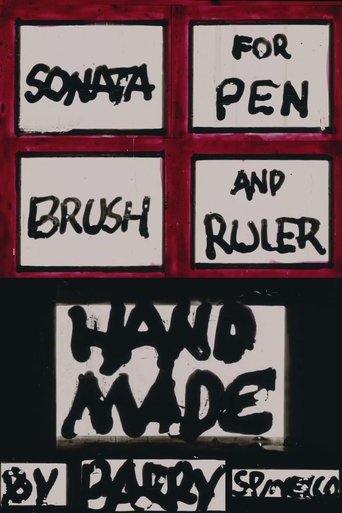
From 1967-71 Barry Spinello made films without camera or tape recorder by hand drawing both sound and picture directly onto clear 16mm leader. His interest and education (at Columbia) was in music, painting, and poetry. His effort was to merge these three: “to squeeze sound and picture out of the same tube – to weave a cloth with warp as sound, woof as picture, and meaning the fabric itself."
Sonata for Pen, Brush, and Ruler
1968
 NR
Black and white with some color hand-applied to each print, hand-painted image, hand-painted sound.
Soundtrack
1969
 NR
The "theme," a seven-second loop-painting (actually closer to eight), is repeated seven times in succession before the title appears. Then, using an optical printer, the variations start. After each variation the original theme is repeated once. The variations involve step-printing, repetitions and optical manipulations. They very closely follow the original theme.
Variations on a Seven Second Loop-Painting
1970
Behind the camera
6.5No synopsis available yet.
Massage Parlor Wife
1975
6.5No synopsis available yet.
Massage Parlor Wife
1975
6.5No synopsis available yet.
Massage Parlor Wife
1975
Made with Shanti Project of San Francisco, with a grant from the US Department of Health, Education, and Welfare. An in-depth sharing of the counselling process between psychologist Dr. Charles Garfield and three women who are dying of cancer. "Beautifully and sensitively done. Very beneficial to our training program." - Barb Taruscio, Bon Secours Hospital, Grosse Point, Michigan
Three Lives: Counselling the Terminally Ill
1976
"Makes Testament look like Singing in the Rain." - Tom Luddy The documented story of an American family in tragedy. Extremely sad, vulnerable, and moving - maybe more so than a film should be. Awards: Academy Award Nominating Committee Certificate of Special Merit; Blue Ribbon, American Film Festival; CINE Golden Eagle. Exhibition: Telluride Film Festival; portions screened on CBS National News.
Erika: Not in Vain
1983
NRFrom 1967-71 Barry Spinello made films without camera or tape recorder by hand drawing both sound and picture directly onto clear 16mm leader. His interest and education (at Columbia) was in music, painting, and poetry. His effort was to merge these three: “to squeeze sound and picture out of the same tube – to weave a cloth with warp as sound, woof as picture, and meaning the fabric itself."
Sonata for Pen, Brush, and Ruler
1968
NRBlack and white with some color hand-applied to each print, hand-painted image, hand-painted sound.
Soundtrack
1969
NRThe "theme," a seven-second loop-painting (actually closer to eight), is repeated seven times in succession before the title appears. Then, using an optical printer, the variations start. After each variation the original theme is repeated once. The variations involve step-printing, repetitions and optical manipulations. They very closely follow the original theme.
Variations on a Seven Second Loop-Painting
1970
 6.8
A Day in the Life of Bonnie Consolo is a 1975 short documentary directed by Barry J. Spinello which presents the daily challenges faced by Bonnie Consolo, an armless woman, and her determination to overcome them. The film shows her driving, cooking, and shopping like anybody else. The film was nominated for an Oscar for Best Live Action Short Film.
A Day in the Life of Bonnie Consolo
1975
 NR
A "didactic" and "educational film" (distributed by Grove Press until they went out of the film business), FILM GRAPHICS uses clips from Buñuel and Eisenstein, along with animated overlay, to illustrate basic principles of classic film editing. Good for film editing and film study classes. Made with Paul Aratow, who went on to produce Sheena Queen of the Jungle.
Film Graphics: Abstract Aspects of Editing
1972
"In BROKEN SOLDIERS Spinello tells the story of a young boy who receives a toy soldier from his brother, just returning home from the battlefield in World War II. When the toy breaks, the boy puts it into a paper boat and floats it down the river. The boat docks, and as the soldier leaves the boat to meet a company of compatriots the fantasy begins: a battle with rough, tough, icky garden snails. The soldiers are beautiful: a bugler, a messenger, a gunner cleaning his weapon, a cook with his hand in a pot. The snails mount an offensive on the fort. It's a scene you may have missed in Patton, but can see tonight on PBS." - David Kleinberg, San Francisco Examiner and Chronicle
Broken Soldiers
1973
Neil (Barry Spinello) turns to the camera and says: "Film everything for the next 24 hours, 'cause I've come to a strong, positive decision - namely, to commit suicide." We then see the last 24 hours of Neil's life: his mother rushed in from NY; an ex-girlfriend; a current girlfriend; a former film professor. We see Neil direct the film from inside the film, and only learn that it is a total fiction as the final credits roll. "For all its excesses ... the film works. It keeps you not only enthralled for an hour, but also entirely involved. Appalled, fearful, saddened, horrified, one finds it impossible not to want to intervene, to interject one's own sensitivity and humanity into the process and guide it to a different finale. RUSHES is an excellent film for a preliminary to a discussion on suicide." - Ruth Backes, "The Filmshelf," New England Journal of Human Services
Rushes
1979
 NR
This film is my bridge from filmpainting to live-action filmmaking. A grant from a former teacher, through the National Counsel of Churches, enabled me to purchase camera, tape recorder, and editing equipment. DAYLIGHT combines filmpainting and live-action techniques. It took two years to make and starts with the words: "And so the journey ends." Although some people at the time called it a very moving film, I haven't looked at it in 20 years.
Daylight
1972
Sound and picture are constructed frame by frame in After Effects with T.S. Elliot and Gertrude Stein arguing while trapped in a Jackson Pollock painting.
Towards
2013
 NR
Abstract animation.
Colored Relations
1970
 NR
In SIX LOOP-PAINTINGS, as in SOUNDTRACK, sound and image are hand applied directly on to 16mm clear leader. The image at a given instant is repeated both on the image track and soundtrack, so that the viewer is visualizing the image he is hearing. However, unlike SOUNDTRACK, the images and sounds in SIX LOOP-PAINTINGS are not painted; they are made by cutting to size and pasting acetate self-adhesive patterns (Micotape and Zipatone) directly onto the clear film. Each pattern yields a distinct sound. Patterns of lines yield square wave sounds; patterns of dots yield sine wave sounds; patterns of diamonds yield sawtooth wave sounds, etc. The finer the pattern, the higher pitched the tone. The further spaced the pattern, the deeper the tone.
Six Loop Paintings
1970