

Sound
Iannis Xenakis
Born — Died
1922-05-29 — 2001-02-04
Place of birth
Brăila, Romania
Known for
Sound
Credits
14 titles
Giannis Klearchou Xenakis (also spelled for professional purposes as Yannis or Iannis Xenakis; Greek: Γιάννης "Ιωάννης" Κλέαρχου Ξενάκης; 29 May 1922 – 4 February 2001) was a Romanian-born Greek-French avant-garde composer, music theorist, architect, performance director and engineer. After 1947, he fled Greece, becoming a naturalised citizen of France eighteen years later. Xenakis pioneered the use of mathematical models in music such as applications of set theory, stochastic processes and game theory and was also an important influence on the development of electronic and computer music. He integrated music with architecture, designing music for pre-existing spaces, and designing spaces t…
Known for
No synopsis available yet.
Samedi soir
1971
No synopsis available yet.
Bio’s Bahnhof
1978
No synopsis available yet.
Nadir
1993
 NR
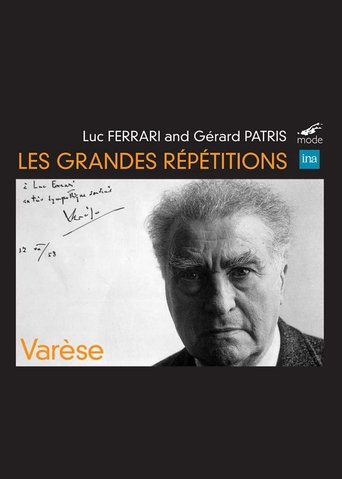
NREdgard Varèse died on 6 November 1965, a few days before the filming of the rehearsal of his work "Déserts" which he had to attend.
The Great Rehearsals: Homage to Edgard Varèse
1966
 NR
NR"A renowned composer and organist, Olivier Messiaen was also a great teacher. Michel Fano, who took his composition class at the Paris Conservatory, films some of the privileged moments of his teaching. This film, co-directed with Denise Tual, also shows Messiaen as a devotee, an ornithologist, and a synaesthete, evoking the fundamental concepts of his inspiration with an often sparkling ease (the musician imitating certain bird songs in a manner reminiscent of Rouch recreating the cries of wizards for certain films). In this way, the film boldly collides sequences with visual or sound correspondences, the directors succeeding in dragging us into the world of mystery and dreams dear to the musician." (François Waledisch)
Olivier Messiaen and the Birds
1973
A conversation between Morton Feldman and lannis Xenakis which took place on Friday, July 4, 1986 at De Kloveniersdoelen, Middelburg, The Netherlands. The conversation was part of a five day master-class given by Morton Feldman during the Festival Nieuwe Muziek, June 19–July 6, 1986. Morton Feldman’s Trio (1980) was performed by Aki Takahashi, piano, Mifune Tsuji, violin and Tadashi Tanaka, violoncello on Thursday, July 3, 1986 at De Kloveniersdoelen, Middelburg.
Morton Feldman and lannis Xenakis, A Conversation
1986
Film credits
2000s · 2 titles
 NR
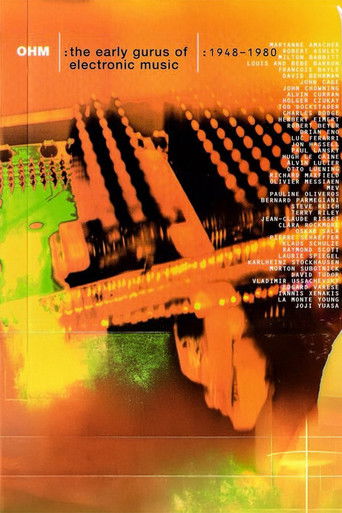
NRDrawing on rare performances, interviews, animations, and experimental film, this documentary surveys the formative years of electronic music from 1948 to 1980. Featuring pioneering composers and inventors—including Milton Babbitt and Leon Theremin—the film explores the experimental technologies, academic laboratories, and creative struggles that shaped the early evolution of electronic sound.
OHM+: The Early Gurus Of Electronic Music : 1948–1980
2005
 3.5
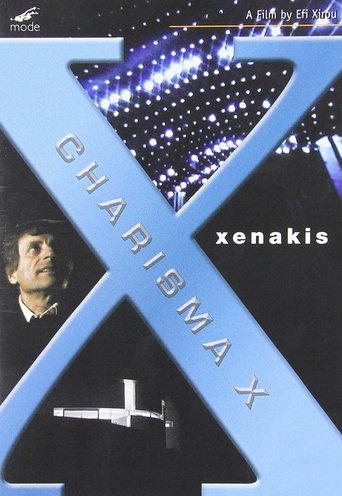
3.5This is a documentary film on the life and work of the composer Iannis Xenakis, the “architect of sound”, whose visionary work reconciles art with science. The film develops in such a way to show how Xenakis’ philosophy, architectural experience, mathematics and political background morph into music and how physical phenomena are transformed into musical expression.
Charisma X: Iannis Xenakis
2009
1990s · 3 titles
No synopsis available yet.
Nadir
1993
 8.0
8.0For the past ten years Zappa in composing has turned away from Rock and Roll music - for which he first became famous - and has been working on new, contemporary, orchestral electronic music; in solitude and beyond any commercial conventions or commitments. It is the first time that Zappa has allowed a film crew to study him during compositional work, actually filming the first moments of a new compositional process. By contrast, in a staged interview Zappa gives comments on music. This film seeks to reveal the sensetivities of Zappa's personality and character also beyond narrative content.
Frank Zappa: Peefeeyatko
1991
 6.0
6.0BBC TV documentary
Something Rich and Strange: The Life and Music of Iannis Xenakis
1991
1970s · 2 titles
NR"A renowned composer and organist, Olivier Messiaen was also a great teacher. Michel Fano, who took his composition class at the Paris Conservatory, films some of the privileged moments of his teaching. This film, co-directed with Denise Tual, also shows Messiaen as a devotee, an ornithologist, and a synaesthete, evoking the fundamental concepts of his inspiration with an often sparkling ease (the musician imitating certain bird songs in a manner reminiscent of Rouch recreating the cries of wizards for certain films). In this way, the film boldly collides sequences with visual or sound correspondences, the directors succeeding in dragging us into the world of mystery and dreams dear to the musician." (François Waledisch)
Olivier Messiaen and the Birds
1973
 NR
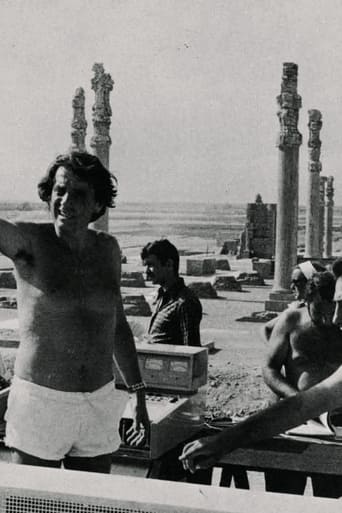
NRThe creation of Iannis Xenakis’ « Persephassa » at the Shiraz-Persepolis Art Festival. There are only a few archives left of this piece, for its ring-like disposition around the audience made it difficult for people to record it or take pictures of it. When it was created in Persepolis, each percussionist was settled on the stump of a column of the Palace of Darius. The distance between them could go as far as 164 feet (50 metres).
Du 5éme des Arts de Shiraz
1971
Series credits
Behind the camera
In Gibellina, in deep Sicily, the sumptuous staging, by Yannis Kokkos, of Oresteïa by Iannis Xenakis, after Aeschylus.
La geste gibelline
1988
 8.0
8.0Mycenae-Alpha is an electroacoustic work that Xenakis composed in 1978 as part of an installation of lights, movement and music that took place at Mycenae Acropolis in Greece. The massive multimedia performances Xenakis called polytopes Mycenae-Alpha is also the first work to be composed entirely on the UPIC system. The UPIC is a tool for the graphic composition of electroacoustic music which was first developed in the late 1970s by Xenakis and his staff at the Center for Studies in Mathematical and Automated Music in Paris.
Polytope (Mycenes Alpha) 1978
1980