
Directing
Joan Jonas
Born
1936-01-01 (90)
Place of birth
New York, New York, U.S.A.
Known for
Directing
Credits
45 titles
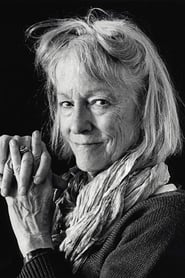
Joan Jonas is an American visual artist and a pioneer of video and performance art who is one of the most important female artists to emerge in the late 1960s and early 1970s.[1] Jonas' projects and experiments provided the foundation on which much video performance art would be based. Her influences also extended to conceptual art, theatre, performance art and other visual media. She lives and works in New York and Nova Scotia, Canada. From Wikipedia.
Known for
 4.6
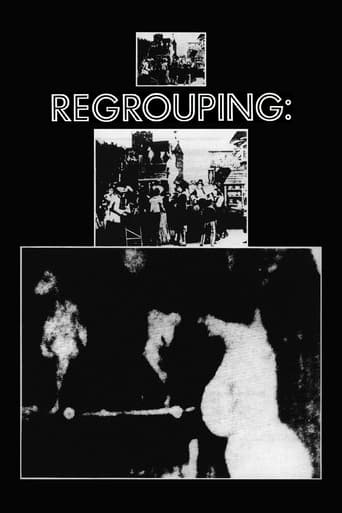
4.6In this experimental film, Borden explores the dynamics among the members of a woman’s group. As she interviews people who know them, such as Joan Jonas, the group shoots ‘artistic’ scenes of themselves – but Borden feels they aren’t fully grappling with issues of sexuality and politics. Are they a serious group – or just friends? After showing an early edit of the film to the group, its members, upset, close ranks. Undeterred, Borden incorporates the group’s arguments into another edit, filming larger groups commenting both on the original one and on consciousness-raising groups in general. Uncredited voices include those of Barbara Kruger and Kathryn Bigelow.
Regrouping
1976
 8.0
8.0The protagonists’ astounding verbal gymnastics and often incomprehensible interactions tend to descend into nonsense, and with the syncopated rhythm of its action and dialogue, this film is reminiscent of the playful and parodying elements of the Beat fantasy Pull My Daisy. The interweaving of documentary and fiction with the syncopated rhythm of its action and dialogue presents an absurd buzz of activity reminiscent of Beckett’s abstract comic grotesque.
Keep Busy
1975
 6.3
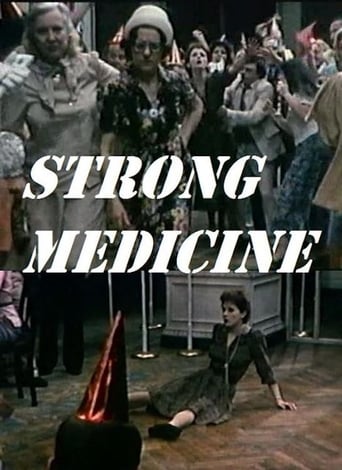
6.3Adaptation of an avant-garde play about Rhoda, a hysterical heroine who feels oppressed by the people around her. She suffers through her birthday party, goes to see a doctor, plans a vacation, argues a lot and even breaks the fourth wall.
Strong Medicine
1981
 NR
NRBased on Robert Heinlein’s 1941 story “Universe,” Double Lunar Dogs presents a vision of post-apocalyptic survival aboard a “spacecraft,” travelling aimlessly through the universe, whose passengers have forgotten the purpose of their mission. As a metaphor for the nature and purpose of memory, the two main characters (portrayed by Jonas and Spalding Gray) play games with images of their past; but their efforts to restore their collective memories are futile, and they are reprimanded by the “Authority” for their attempts to recapture their past on a now-destroyed planet Earth.
Double Lunar Dogs
1984
 NR
NRStill photographs, live video, and superimposed drawings created on a Quantel Paintbox are fused in this visual poem dedicated to a New York City landmark, the Brooklyn Bridge. Emphasizing its strength and beauty, Jonas locates the bridge as an iconic site in this meditative, cryptic study of identity and place. In Brooklyn Bridge, the transformative power of video is used to infuse the static photographs and naturalistic footage of the bridge with a mythic, animistic force, which is heightened by the artist's emblematic inscription of self onto the site.
Brooklyn Bridge
1988
 NR
NRThe film is an adaptation from two sources: Kinesics and Context by Ray L. Birdwhistell, and Choreomania, a performance by Joan Jonas
Paul Revere
1971
Film credits
2010s · 1 titles
1980s · 3 titles
6.3Adaptation of an avant-garde play about Rhoda, a hysterical heroine who feels oppressed by the people around her. She suffers through her birthday party, goes to see a doctor, plans a vacation, argues a lot and even breaks the fourth wall.
Strong Medicine
1981
NRBased on Robert Heinlein’s 1941 story “Universe,” Double Lunar Dogs presents a vision of post-apocalyptic survival aboard a “spacecraft,” travelling aimlessly through the universe, whose passengers have forgotten the purpose of their mission. As a metaphor for the nature and purpose of memory, the two main characters (portrayed by Jonas and Spalding Gray) play games with images of their past; but their efforts to restore their collective memories are futile, and they are reprimanded by the “Authority” for their attempts to recapture their past on a now-destroyed planet Earth.
Double Lunar Dogs
1984
 7.0
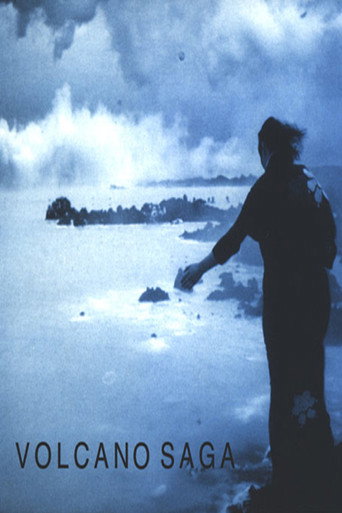
7.0This short film shot in Iceland and New York, which is based on a thirteenth-century Icelandic Laxdeala Saga, features Tilda Swinton as a young woman whose dreams foretell the future.
Volcano Saga
1989
1970s · 5 titles
4.6In this experimental film, Borden explores the dynamics among the members of a woman’s group. As she interviews people who know them, such as Joan Jonas, the group shoots ‘artistic’ scenes of themselves – but Borden feels they aren’t fully grappling with issues of sexuality and politics. Are they a serious group – or just friends? After showing an early edit of the film to the group, its members, upset, close ranks. Undeterred, Borden incorporates the group’s arguments into another edit, filming larger groups commenting both on the original one and on consciousness-raising groups in general. Uncredited voices include those of Barbara Kruger and Kathryn Bigelow.
Regrouping
1976
8.0The protagonists’ astounding verbal gymnastics and often incomprehensible interactions tend to descend into nonsense, and with the syncopated rhythm of its action and dialogue, this film is reminiscent of the playful and parodying elements of the Beat fantasy Pull My Daisy. The interweaving of documentary and fiction with the syncopated rhythm of its action and dialogue presents an absurd buzz of activity reminiscent of Beckett’s abstract comic grotesque.
Keep Busy
1975
 10.0
10.0Jonas intercuts scenes of the Nova Scotia countryside with images of a studio set-up reminiscent of a di Chirico painting. The soundtrack includes both music and spoken excerpts from a journal Jonas kept while travelling in Nova Scotia. I Want to Live in the Country ultimately deals with observation and fantasy, living in the country, and the stifling aspects of the city and one's art.
I Want to Live in the Country (And Other Romances)
1976
 4.0
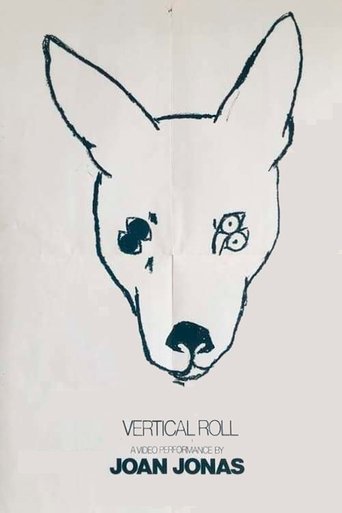
4.0Cast as an “electronic erotic seductress,” the multiple costumes and roles performed by Jonas critically examine the ever-changing, but consistently unequal roles of women. The camera gazes at Jonas, implicating the viewer in the work and further, with her body. Her intentional de-synchronization of the monitor's receiving and transmitting frequencies results in the on-screen image's repeated vertical descent. Creating a sense of fragmentation, the vertical roll relentlessly pounds at the images of the artist as she moves through a series of performed identities. Characterized a "disjunctive self portrait" by the Electronic Arts Intermix, the image content of the work is strongly mediated by the mirror-like function of the camera, scrutinized by the lens and subjected to violence by the vertical roll.
Vertical Roll
1972
 NR
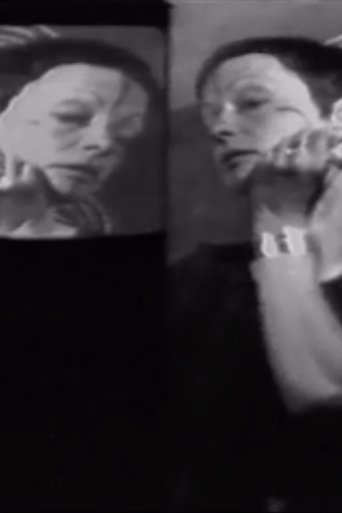
NRIn this early work, Jonas translates her performance strategies to video, applying the inherent properties of the medium to her investigations of the self and the body. Jonas performs in a direct, one-on-one confrontation with the viewer, using the immediacy and intimacy of video as conceptual constructs. Exploring video as both a mirror and a masking device, and using her body as an art object, she undertakes an examination of self and identity, subjectivity and objectivity. Creating a series of inversions, she splits her image, splits the video screen, and splits her identification within the video space, playing with the spatial ambiguity of non-reversed images (video) and reversed images (mirrors). Though Jonas' approach is formalist and reductive, her performance reveals an ironic theatricality. Illustrating the phenomenology of video as a mirror, Left Side Right Side is a classic of early performance-based, conceptual video.
Left Side, Right Side
1972
Behind the camera
NRBased on Robert Heinlein’s 1941 story “Universe,” Double Lunar Dogs presents a vision of post-apocalyptic survival aboard a “spacecraft,” travelling aimlessly through the universe, whose passengers have forgotten the purpose of their mission. As a metaphor for the nature and purpose of memory, the two main characters (portrayed by Jonas and Spalding Gray) play games with images of their past; but their efforts to restore their collective memories are futile, and they are reprimanded by the “Authority” for their attempts to recapture their past on a now-destroyed planet Earth.
Double Lunar Dogs
1984
NRStill photographs, live video, and superimposed drawings created on a Quantel Paintbox are fused in this visual poem dedicated to a New York City landmark, the Brooklyn Bridge. Emphasizing its strength and beauty, Jonas locates the bridge as an iconic site in this meditative, cryptic study of identity and place. In Brooklyn Bridge, the transformative power of video is used to infuse the static photographs and naturalistic footage of the bridge with a mythic, animistic force, which is heightened by the artist's emblematic inscription of self onto the site.
Brooklyn Bridge
1988
NRThe film is an adaptation from two sources: Kinesics and Context by Ray L. Birdwhistell, and Choreomania, a performance by Joan Jonas
Paul Revere
1971
10.0Jonas intercuts scenes of the Nova Scotia countryside with images of a studio set-up reminiscent of a di Chirico painting. The soundtrack includes both music and spoken excerpts from a journal Jonas kept while travelling in Nova Scotia. I Want to Live in the Country ultimately deals with observation and fantasy, living in the country, and the stifling aspects of the city and one's art.
I Want to Live in the Country (And Other Romances)
1976
 NR
NRTwo women kiss.
Two Women
1973
4.0Cast as an “electronic erotic seductress,” the multiple costumes and roles performed by Jonas critically examine the ever-changing, but consistently unequal roles of women. The camera gazes at Jonas, implicating the viewer in the work and further, with her body. Her intentional de-synchronization of the monitor's receiving and transmitting frequencies results in the on-screen image's repeated vertical descent. Creating a sense of fragmentation, the vertical roll relentlessly pounds at the images of the artist as she moves through a series of performed identities. Characterized a "disjunctive self portrait" by the Electronic Arts Intermix, the image content of the work is strongly mediated by the mirror-like function of the camera, scrutinized by the lens and subjected to violence by the vertical roll.
Vertical Roll
1972
 NR
NRA Jamaican fisherman describes fishing practices.
Jamaican Fisherman
2019
 6.0
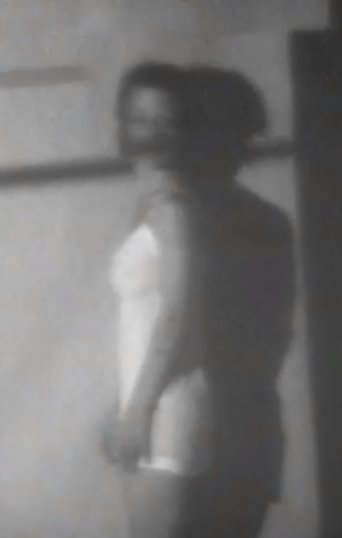
6.0This complex and enigmatic work, which is performed by Jonas and Lois Lane, explores female gestures, poses, the body and narcissism. Mirroring each other with synchronized movements as they perform as alter-egos, Jonas and Lane reference archetypal female gestures and poses from popular and traditional cultures. Throughout the performance, space is dislocated and altered as a formal device — segmented by a swinging bar, superimposed in layers, transformed by subtle changes in light and shadow, or flattened by the video screen. With its evocative personal theater and idiosyncratic vocabulary of gestures, ritual and symbolism, Glass Puzzle is a quintessential Jonas work.
Glass Puzzle
1973
7.0This short film shot in Iceland and New York, which is based on a thirteenth-century Icelandic Laxdeala Saga, features Tilda Swinton as a young woman whose dreams foretell the future.
Volcano Saga
1989
1984 video art by Joan Jonas
Big Market
—
 NR
NRFrenetic silhouettes pass us by.
Shadows/Como
2007
 NR
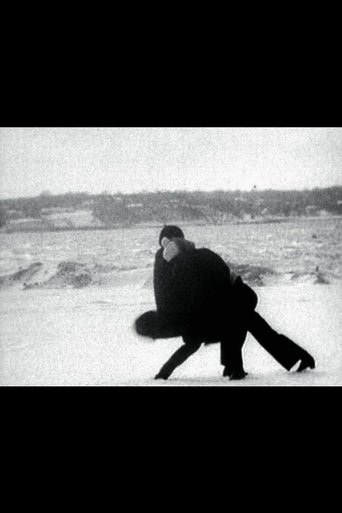
NRCutting between snowy fields and a raw seashore, Jonas focuses on a group of performers moving through a stark, windswept landscape. The 16mm film — silent, black and white, jerky and sped-up — evokes early cinema, while its content locates it in the spare minimalism of the late 1960s.
Wind
1968
Mirage was designed specifically for the screening room of Anthology Film Archives in New York's SoHo neighborhood, where Joan Jonas first performed the piece on several nights over a few weeks in 1976, for an audience of her friends: local artists, musicians, and dancers. In the first performances, Jonas projected images of herself drawing and erasing her marks on a chalkboard—some appropriated from her past works—as well as a five-minute documentary loop of volcanoes erupting and a film of a television turned on its side. She also stepped through a small wooden hoop and completed other live actions. Mirage was the last of a series of black and white video performances completed by Jonas; she would subsequently adopt color technologies. In 2001, Jonas made a new version of Mirage, consisting of a silent, approximately thirty-minute loop which, in the artist’s words, “is a combination of old performances, more chalk drawings and footage shot off the television at that time.”
Mirage
1976
This piece includes many iconographical elements that have evolved in Jonas’s practice since the early 1970s, including the mirror, the hoop and the dog. It epitomises her inventive approach to editing and an illusionistic style characterised by a wry humour. She has described the work as follows:
Mirror Imrprovisation
2005
 NR
NRDisturbances extends Jonas' investigation of mirrored surfaces and spaces, as she explores reflections of movement and images in water. The tape begins with Jonas, like Narcissus, leaning over a reflecting pool. Throughout this lyrical exercise, the viewer sees only reflected images and inversions, disturbances of the water's surface. Figures walking at the edge of the pool are seen as abstracted shimmers, upside down and backwards; shadowy figures move underwater and swim through the pool as in a choreographed dance. This simply rendered, evocative work is a phenomenological study of reflection, as Jonas draws a parallel between the spatial and mirroring effects of water and video.
Disturbances
1974
"Shot vertically and intended to be shown on a video monitor turned on its side, the video May Windows (1976) is a component of the Mirage performance and installations, as well as the related installation Cones/May Windows (After Mirage) II (1976/2014). May Windows features two tall white cones, barely decipherable in the heightened contrast of the black-and-white video that examines changes in sound and light from Jonas’s home studio. Though the video is purposefully so overexposed that the picture plane becomes void of depth, Jonas nonetheless makes space legible through sound. Jonas whistles while walking around the space, and opens and closes the windows, modulating the sound of the street outside. At another point during the video, James Nares and Jonas vocalize into metal cones. [/] —BC and KP" —The Joan Jonas Knowledge Base
May Windows
—
 NR
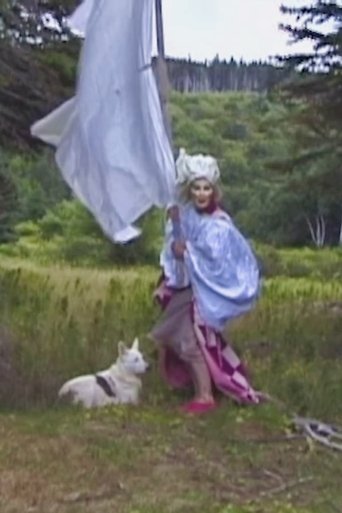
NRJonas's performance piece, an homage to 18th century French outdoor theater, incorporates mythology as well as spontaneously occurring events into the narrative.
Waltz
2003
 NR
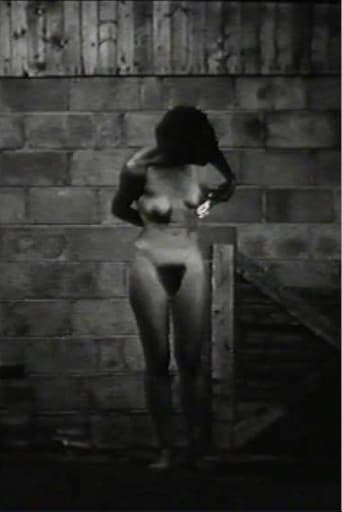
NRIn Mirror Check Jonas uses a small handheld mirror to inspect her naked body in front of an audience. Though her movements were visible to the spectators, Jonas did not allow them to see the fragmented image reflected in the mirror. As the artist recalls, “Mirror Check was inspired by the situation in the late 1960s and early ‘70s of the women’s movement and the idea of a woman reversing the gaze and claiming her body as her own.” First performed as part of Mirror Piece II (1970), the work was subsequently documented on its own and created into its own film. [Overview courtesy of MoMA]
Mirror Check
1974
The video and sculptural installation Ice Drawing (2012) is one component of Jonas’s masterwork installation, Reanimation (2013). It features footage of Jonas creating an abstract drawing using ink and ice (a gesture that she carries out live during the performance). In the installation at the MFA, the projector’s light is refracted through a set of hanging crystals, spilling throughout the gallery and onto our bodies. Each fragment reveals all the spectral components of light, including colors that are imperceptible to the human eye. Implicated in the moment, and connected by the refracted constellation, we watch as the ink spills onto a pristine surface, and ice melts.
Ice Drawing
—
In this seminal exploration of the phenomenology of video as a mirror and as "reality," Jonas, face-to-face with her own recorded image, performs a duet with herself.
Duet
1972
 NR
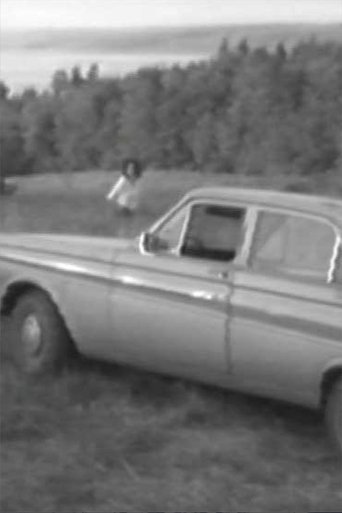
NRBarking is infused with a sense of mystery, the anticipation that something is about to happen. A car is parked outside a house in a rural Nova Scotia landscape. A dog barks into the distance. A woman enters the frame, looks for the object of the dog's barking, and leaves. The camera pans the landscape, revealing nothing. With its intimations of an off-screen narrative, this simple scenario carries an unsettling implication of the limit of vision and the power of what is not seen. [Overview courtesy of Electronic Arts Intermix]
Barking
1973
 NR
NRHe Saw Her Burning, which is based on a 1983 performance, is a provocative narrative collage, a surreal juxtaposition of two narrated texts. A man and a woman begin their respective tales: He saw a woman burst into flames on the street; she saw an American soldier go berserk and drive a tank into a crowd. Produced while Jonas was living in Berlin on an artist's fellowship, the disjunctive narratives are pervaded with a sense of cultural dislocation and alienation. The man and woman occupy separate narrative spaces as they tell their stories, which are intercut with a pastiche of word games, narrative reenactments, filmed sequences, isolated gestures and objects. Memory — elusive and ephemeral, personal and collective — is the catalyst for this complex work.
He Saw Her Burning
1983
 NR
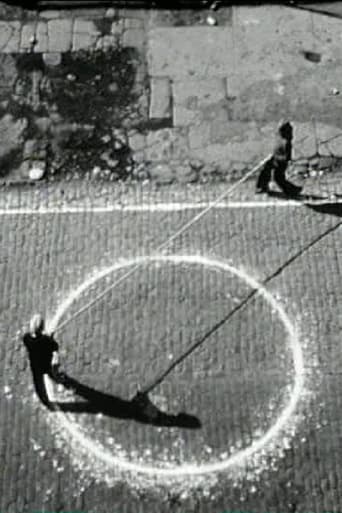
NRWind and Songdelay are two of Joan Jonas’s early performances filmed in the open air, in either natural or industrial environments. Fourteen performers struck together pieces of wood, drew shapes on the ground with props, and used mirrors to refract sunlight while an audience watched them from afar.
Songdelay
1973
Short movie by Joan Jonas.
Merlo
1974
from Point of View: An Anthology of the Moving Image (2003)
Waltz
—
 NR
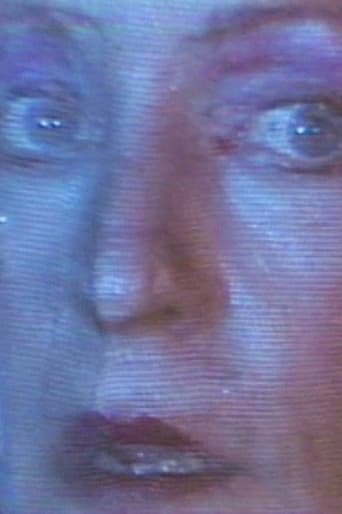
NRIn Upsidedown and Backwards, two fairy tales — The Frog Prince and The Boy Who Went Out to Learn Fear — are told simultaneously, one backwards and one forwards, each interrupting the other. Jonas' ironic use of visual symbolism further inverts the structure and content of the fragmented fairy tale narratives, creating multiple, mirror-image reversals of the texts and their meaning. The inverted and mixed-up tales, which are intercut with Jonas' ritualistic performances, merge into a composition of transformation and sexuality that evokes the tangled subconscious of male and female desire. Jonas performs wearing a veiled doll face as she manipulates childlike objects or partners a skeleton in a danse macabre. Charged with the sublimated fears and fantasies of childhood, the tape's imagery mirrors the fairy tales in its fusion of innocence and horror, dream and nightmare.
Upsidedown and Backwards
1980
NRIn this early work, Jonas translates her performance strategies to video, applying the inherent properties of the medium to her investigations of the self and the body. Jonas performs in a direct, one-on-one confrontation with the viewer, using the immediacy and intimacy of video as conceptual constructs. Exploring video as both a mirror and a masking device, and using her body as an art object, she undertakes an examination of self and identity, subjectivity and objectivity. Creating a series of inversions, she splits her image, splits the video screen, and splits her identification within the video space, playing with the spatial ambiguity of non-reversed images (video) and reversed images (mirrors). Though Jonas' approach is formalist and reductive, her performance reveals an ironic theatricality. Illustrating the phenomenology of video as a mirror, Left Side Right Side is a classic of early performance-based, conceptual video.
Left Side, Right Side
1972
 NR
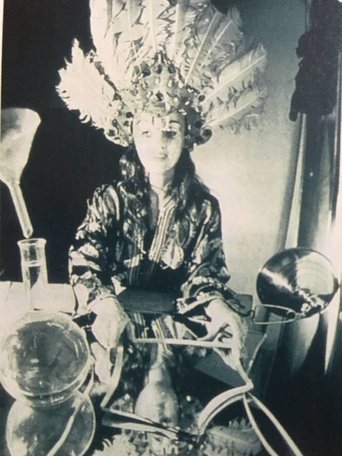
NROrganic Honey's Visual Telepathy is based on Jonas' 1972 performance of the same name, the first in which she used video. In an enigmatic ritual of identity, Jonas performs as herself and as her masked double, Organic Honey. Dressed in a feathered headdress and costumes, Organic Honey is the embodiment of artifice, masquerade and narcissism — a female alter-ego whose guise is a frozen doll's face. This elliptical, nonlinear narrative performance explores themes that are emblematic of Jonas' early video work: The study of female gestures and archetypes, both personal and cultural; the use of disguise and masquerade, ritual objects and ritualized self-examination; and an inquiry into subjectivity and objectivity. The work's formal elements — the layering of mirrors and mirrored images, manipulations of reflective space and spatial ambiguity, and the use of drawing to add a further layering of meaning — are also Jonas' signatures.
Organic Honey's Visual Telepathy
1972
Moving Off the Land celebrates the ocean and its creatures, biodiversity, and delicate ecology.
Moving Off the Land
2018
2015. USA. Directed by Joan Jonas. 4 min.
They Come to Us without a Word [“Wind Sequence” excerpt]
2015
In the film, Jonas uses video as a diaristic construct to chart the passing of personal time through quotidian ritual. Over three different periods in New York and Nova Scotia, she videotaped herself every day, briefly addressing the camera upon waking in the morning and before going to bed at night: "Good Morning." "Good Night." This journal evolves into a self-portrait that is at once distanced and intimate, public and private. Observing herself as the viewer observes her, Jonas addresses the mirror of video as a vehicle for monitoring identity and change in time. Though her minimalist adherence to a controlled system of documentation is a rigorous conceptual conceit, Jonas' repetitive salutations are performed with more than a touch of irony.
Good Night Good Morning
1976
Five-channel video installation which responds to German art historian Aby Warburg’s essay about his visit to the American Southwest.
The Shape, the Scent, the Feel of Things
2004
 NR
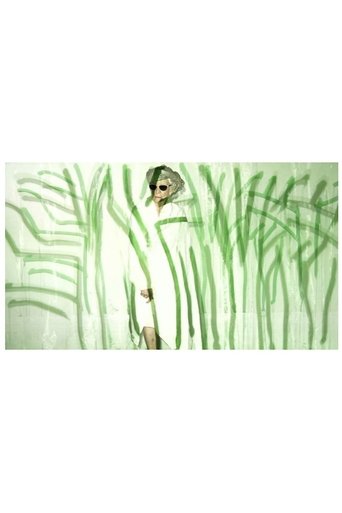
NR2015. USA. Directed by Joan Jonas. Presented as a two-channel diptych: Green Timeline (3:41 min.); Mirror Timeline (3:48 min.). 7 min.
In the Trees
2015
1992/1994. USA. Directed by Joan Jonas. Presented as a two-channel diptych: Berlin Wall (9:39 min.); Berlin Road (9:35 min.). 19 min.
Revolted by the Thought of Known Places...Sweeney Astray
1992
 NR
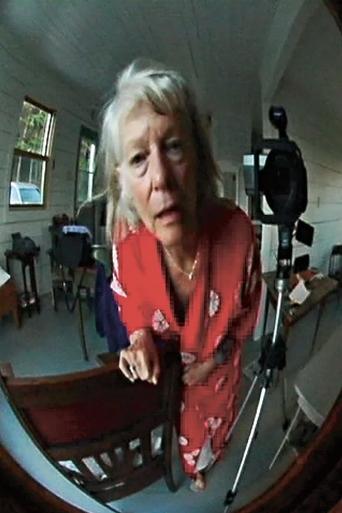
NRThis film was made in the summer of 2006 in Jonas's Nova Scotia home. It reuses the format of a 1976 film in which the artist recorded herself reciting "good night" to the camera before retiring for bed. For Jonas, the repurposing of elements from past films is a strategy that creates a dialogue across time. "The style of performance is straightforward," she observes of this 2006 work, "but more playful or contrived, perhaps affected by the experience of years of performing." Here, Jonas addresses the camera through a convex mirror that distorts her home, a testament to her longstanding interest in manipulating space. [Overview courtesy of MoMA]
My New Theater VI: Good Night Good Morning '06
2006