
Directing
John H. Hawkins
Known for
Directing
Credits
6 titles
Known for
 6.0
First shown on January 30, 1967, FOR LIFE AGAINST THE WAR was an open-call, collective statement from American independent filmmakers disparate in style and sensibility but united by their opposition to the Vietnam War. Part of the protest festival Week of the Angry Arts, the epic compilation film incorporated minute-long segments which were sent from many corners of the country, spliced together and projected. The original presentation of the works was more of an open forum with no curation or selection, and in 2000 Anthology Film Archives preserved a print featuring around 40 films from over 60 submissions.
For Life, Against the War
1967
 NR
An attempt to reproduce some visual hallucinations while on a trip (a number of years ago), done in the major portion with clay animation. On the average, it took one hour to shoot one-half second's viewing time. I felt that clay was the best medium to demonstrate what one might see under the drug experience. –J. H.
LSD Wall
1965
A short journey through some small town Victoriana... –J. H.
Gingerbread
1967
 NR
Co-maker: Willard Maas. A Valentine card from Willard Maas to his wife, Marie Menken, utilizing both animation and live-action photography. A "catch me if you can" game between two real hearts. –J. H.
A Valentine For Marie
1965
 3.0
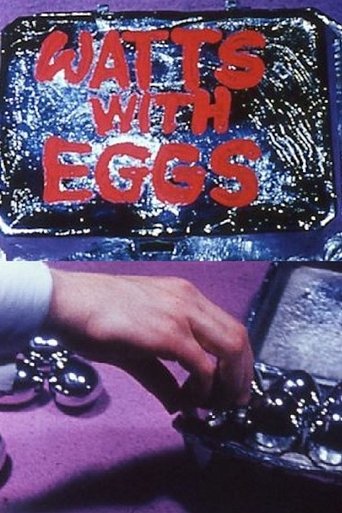
"By 1967, Menken had become interested in the work of Fluxus artist Robert Watts and made a short animation piece, Watts with EGGS, in which she animates his chrome-casted Box of Eggs. The film opens with lights reflected in the eggs (of course), then, through single framing, pixilates a man's hand arranging eggs in different patterns. The hands (those of John Hawkins) fill the box back up with eggs. Next, the eggs do the same routine, but more magically, more serenely, without the assistance of the hands. Menken also introduces a string and a feather duster into animated action, so that the eggs, one by one, seem to be coming directly out of the duster (objects infect objects). By the end, the eggs are magically back in their box." Melissa Ragona
Watts with Eggs
1967
"The fun-and the only fun-is John Hawkins' FLOWERPOT, a simple, frisky romp involving a cavorting couple and fresh colorations." –Howard Thompson, The New York Times, 2/18/1972
Flower Pot
1969
Film credits
Behind the camera
6.0First shown on January 30, 1967, FOR LIFE AGAINST THE WAR was an open-call, collective statement from American independent filmmakers disparate in style and sensibility but united by their opposition to the Vietnam War. Part of the protest festival Week of the Angry Arts, the epic compilation film incorporated minute-long segments which were sent from many corners of the country, spliced together and projected. The original presentation of the works was more of an open forum with no curation or selection, and in 2000 Anthology Film Archives preserved a print featuring around 40 films from over 60 submissions.
For Life, Against the War
1967
NRAn attempt to reproduce some visual hallucinations while on a trip (a number of years ago), done in the major portion with clay animation. On the average, it took one hour to shoot one-half second's viewing time. I felt that clay was the best medium to demonstrate what one might see under the drug experience. –J. H.
LSD Wall
1965
A short journey through some small town Victoriana... –J. H.
Gingerbread
1967
NRCo-maker: Willard Maas. A Valentine card from Willard Maas to his wife, Marie Menken, utilizing both animation and live-action photography. A "catch me if you can" game between two real hearts. –J. H.
A Valentine For Marie
1965
"The fun-and the only fun-is John Hawkins' FLOWERPOT, a simple, frisky romp involving a cavorting couple and fresh colorations." –Howard Thompson, The New York Times, 2/18/1972
Flower Pot
1969