
Directing
Bill Brown
Known for
Directing
Credits
23 titles
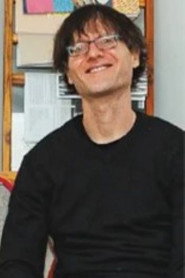
Bill Brown is a media artist interested in ways landscape is interpreted, appropriated, and reconfigured according to human desires, memories, and dreams. His films have screened at venues around the world, including the Rotterdam Film Festival, the London Film Festival, the Sundance Film Festival, and Lincoln Center. A retrospective of his films was shown at the Museum of Modern Art in New York. In addition to his filmmaking, Brown is the co-founder of the Zine Machine: Durham Printed Matter Festival, and the Cosmic Rays Film Festival, an annual showcase of experimental and first-person films.
Known for
 NR
No synopsis available yet.
Document
2011
A spaceman escapes his home world because it'd become a big drag. On Uranus, he finds that life is strange and wonderful.
Uranus
2010
 NR
A week or so after 9/11, Caveh Zahedi and I began to exchange video letters. It was Caveh's idea. We mailed a miniDV tape back and forth to each other. Months would pass between replies. We kept at it for several years. I can't remember why we stopped.
Letters to Caveh (2001-2004)
—
When I was a college kid, Peter Valentine agreed to make a video with me about M.I.T.'s years long effort to evict him from his house. When I finished the video, Peter said he liked it, but he didn't approve of the ending. "It sounds like the cops are coming to haul me away," he said. The thing is, Peter had no intention of leaving that house. And he never did.
Our One
—
 NR
A pocket-sized travelogue about leaving one hometown and looking for the next one. In this film, Brown re-works 16mm footage that he shot years ago during a cross-country road trip from Chicago to Las Vegas. The spatial discontinuities of the road trip are rendered as visual continuities across three frames as Brown goes in search of the next town to fall in and out of love with.
XCTRY
2018
 NR
Commissioned by Ben Russell for 2016 Moogfest screening series, "Future Projections: Memories of the Space Age." Video is eponymously titled for the J.G. Ballard short story.
A Question of Reentry
2016
Film credits
Behind the camera
NRNo synopsis available yet.
Document
2011
A spaceman escapes his home world because it'd become a big drag. On Uranus, he finds that life is strange and wonderful.
Uranus
2010
NRA week or so after 9/11, Caveh Zahedi and I began to exchange video letters. It was Caveh's idea. We mailed a miniDV tape back and forth to each other. Months would pass between replies. We kept at it for several years. I can't remember why we stopped.
Letters to Caveh (2001-2004)
—
When I was a college kid, Peter Valentine agreed to make a video with me about M.I.T.'s years long effort to evict him from his house. When I finished the video, Peter said he liked it, but he didn't approve of the ending. "It sounds like the cops are coming to haul me away," he said. The thing is, Peter had no intention of leaving that house. And he never did.
Our One
—
NRA pocket-sized travelogue about leaving one hometown and looking for the next one. In this film, Brown re-works 16mm footage that he shot years ago during a cross-country road trip from Chicago to Las Vegas. The spatial discontinuities of the road trip are rendered as visual continuities across three frames as Brown goes in search of the next town to fall in and out of love with.
XCTRY
2018
NRCommissioned by Ben Russell for 2016 Moogfest screening series, "Future Projections: Memories of the Space Age." Video is eponymously titled for the J.G. Ballard short story.
A Question of Reentry
2016
 NR
Back in 2005, filmmaker Thomas Comerford was living in Chicago and I was living in Detroit. We decided to make a film together using unsplit Regular 8mm movie film. - BB
Chicago Detroit Split
2005
 7.0
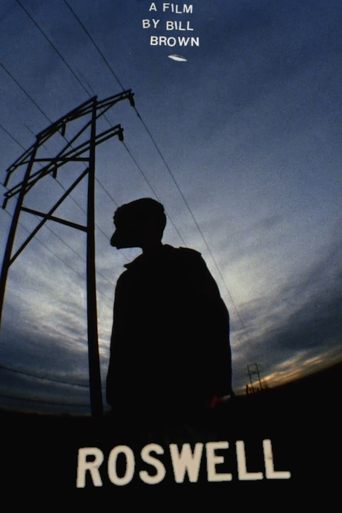
"Bill Brown's Roswell [...] takes a fanciful look at the supposed crash of a flying saucer near Roswell, New Mexico in 1947. [...] Brown...seems to take the event seriously. He wonders what the craft was doing in Roswell of all places, speculating that it was piloted by a 'star boy...joyriding through the cosmos' who 'got lost and lost control.' But Brown also sees his subject playfully, as if through a child's eyes, [...] The fish-eye lens used for some landscape shots curves the horizon line, making the sky seem enclosed-- navigable, traversable. In the film's strongest image, Brown stands facing the camera with a sheaf of papers in hand, as an animated drawing of a spaceship scoots across the paper, suggesting a connection between UFO fantasies and the magical possibilities of cinema." -Fred Camper, Chicago Reader
Roswell
1994
 NR
An essay film about a river and the limits of knowing it. Using Mark Twain’s "Life On The Mississippi" as a road map, Brown travels along the Mississippi River from Memphis, Tennessee to New Orleans and considers ways that river pilots, paddlers, historical re-enactors, and civil engineers attempt to know the river through modeling, measurement, and simulation. Along the way, Brown attempts to survey the river and the landscapes and land uses along its banks as a visible expression of economic transition, political polarization, and environmental change.
Life on the Mississippi
2019
Rooted in the true sense of "independent" in voice and image, The Other Side is a personal essay documentary imbued with magical landscapes and searing observations softly spoken during the director's cinematic trek along the United States-Mexican border. Throughout the 2,000-mile journey, Texas-based filmmaker Bill Brown considers the border as an historical and political geography of aspiration, insecurity, and transition. He talks to undocumented immigrants who have risked their lives to cross the border and to border activists whose politics have put them at odds with the guardians of homeland security. -Film Society of Lincoln Center
The Other Side
2006
In the decade since the events of 9/11/2001, the United States has been engaged in a national act of memorial making. Some of these 9/11 memorials are contested sites, where conflicting visions and voices clash. But most are quiet and deeply personal. This short non-fiction film examines some of these memorials, and the reasons why seven people made the unlikely decision to build them. A woman in Wisconsin hopes to franchise her homemade memorial in all 50 states. A gay priest in Kentucky dedicates a storefront church to a victim of 9/11. A man in New Jersey builds a scale model of the Twin Towers on his front lawn and decorates them with Christmas lights. None of these monument makers had lost any friends or relatives that day. All of them watched the tragedy unfold at a distance, and it is this distance that they hope to cross.
Memorial Land
2012
A short historical-landscape film, directed by Bill Brown.
Mountain State
2003
 NR
Making an obvious nod to Kenneth Anger's "Kustom Kar Kommandos", the film portrays a man gently cleaning and manipulating his camera.
Kustom Kamera Kommandos
2005
In 2003, I crossed the Atlantic on a freight ship and shot some mini-DV footage along the way. As the video record of this trip deteriorates, I transferred it to 16mm Tri-X reversal film to save it from extinction. A meditation on the (in)stability of archival media, memory, and bodies in motion.
Montreal
2024
I lived around the corner from the Henry Horner Homes. I once read an article about the place in the New York Times. The title of the article was "What It's Like To Live In Hell." By the time I moved to Chicago, the projects were empty. The city began to knock down the buildings, one by one, till there was only one building left. It stood there for years. Then the city knocked it down, too.
Chicago Corner
2009
 7.2
As its nuclear missile silos get blown-up, North Dakota scratches its head and wonders what’s next.
Buffalo Common
2002
7.2As its nuclear missile silos get blown-up, North Dakota scratches its head and wonders what’s next.
Buffalo Common
2002
 NR
A Return to The Return to Reason is a tribute to Man Ray's 1923 film "Le Retour à La Raison" (A return to Reason), the first film to use his 'Rayograph' technique in which Man Ray exposed found objects onto film negative. In this film the found object is Man Ray’s digitized film, the first Dada film. The “original” film was digitized with all its aged emulsions, scratches, and splices, then compiled into digital filmstrips. These filmstrips are used to output a dithered and inverted image that the laser engraver may etch onto black 35mm film leader. The film images are created as the laser engraver scratches away the emulsion on the black leader.
A Return to The Return to Reason
2013
A landscape film concerning location (Montréal, St. John's, Regina, and Vancouver), narration, history, and the personal role of the director in the formation of audiovisual art.
Confederation Park
1999
 NR
HUB CITY is a short about Lubbock, Texas, the home of Buddy Holly. It is also about trajectories of death and small towns in general.
Hub City
1997
In this impressionistic documentary film, Sabine Gruffat and Bill Brown travel across Spain to explore responses to the housing crisis of the early 2000s. The filmmakers visit families squatting in failed condo developments; intentional communities of mountain cave dwellers; protest campsites in front of bank branches; and empty apartment buildings transformed into experiments in 'utopian' living.
Speculation Nation
2014
 NR
Perhaps best known for his Spiral Jetty, sculptor Robert Smithson’s interest in landscape and land use was prophetic. In 1973, Texas oil millionaire Stanley Marsh 3 commissioned Smithson to create an earthwork on Marsh’s cattle ranch north of Amarillo, called ‘Amarillo Ramp’.
Amarillo Ramp
2017