

Camera
Sándor Kardos
Born
1944-06-04 (82)
Place of birth
Budapest, Hungary
Known for
Camera
Credits
11 titles
Known for
 NR
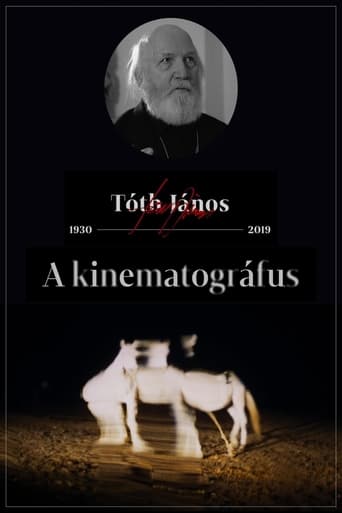
NRIn memory of Janos Toth. The ciematographer on title is no other than János Tóth, who is still the role model and reference point for all Hungarian cinematographers. He has proven his unique talent in all cinematographic genres. In his unmissable features, shorts and documentary films, he set an example to his peers with his tight compositions and his art of light. His experimental cinematographic films, shot with the optics he developed, were far ahead of their time. Our portrait film explores the oeuvre of this exceptional cinematographic artist.
A kinematográfus
2022
The main character, Béla Hackspacher, is a forklift driver. He lives in a small rented flat with his wife Irén, his two children, his mother-in-law and Rózsika, a subtenant who is about to become a dance singer. Béla learns at a community cultural programme that he has a 12 on the toto. The show stops, to great joy. The day arrives, 23 October 1956, when Béla can collect his prize.
Telitalálat
2003
No synopsis available yet.
Himnusz
—
No synopsis available yet.
Végjáték
2006
Ever since I started making films it has bothered me in a certain sense that film images are far too concrete, because technically they try to imitate the sense of space characteristic of everyday life. So the story ignites the imagination only to be slowed down by the images and stops the viewer from taking a flight of fantasy. I have always been searching for an intrinsically different tool in filmmaking. One that could record space in its temporal progression. I would never have thought it existed!
The Grave Digger
2010
No synopsis available yet.
Átváltozás
2009
Film credits
2020s · 2 titles
NRIn memory of Janos Toth. The ciematographer on title is no other than János Tóth, who is still the role model and reference point for all Hungarian cinematographers. He has proven his unique talent in all cinematographic genres. In his unmissable features, shorts and documentary films, he set an example to his peers with his tight compositions and his art of light. His experimental cinematographic films, shot with the optics he developed, were far ahead of their time. Our portrait film explores the oeuvre of this exceptional cinematographic artist.
A kinematográfus
2022
 NR
NRNo synopsis available yet.
Hogyan csináljunk rossz filmet
2023
Behind the camera
The main character, Béla Hackspacher, is a forklift driver. He lives in a small rented flat with his wife Irén, his two children, his mother-in-law and Rózsika, a subtenant who is about to become a dance singer. Béla learns at a community cultural programme that he has a 12 on the toto. The show stops, to great joy. The day arrives, 23 October 1956, when Béla can collect his prize.
Telitalálat
2003
The main character, Béla Hackspacher, is a forklift driver. He lives in a small rented flat with his wife Irén, his two children, his mother-in-law and Rózsika, a subtenant who is about to become a dance singer. Béla learns at a community cultural programme that he has a 12 on the toto. The show stops, to great joy. The day arrives, 23 October 1956, when Béla can collect his prize.
Telitalálat
2003
No synopsis available yet.
Himnusz
—
No synopsis available yet.
Végjáték
2006
Ever since I started making films it has bothered me in a certain sense that film images are far too concrete, because technically they try to imitate the sense of space characteristic of everyday life. So the story ignites the imagination only to be slowed down by the images and stops the viewer from taking a flight of fantasy. I have always been searching for an intrinsically different tool in filmmaking. One that could record space in its temporal progression. I would never have thought it existed!
The Grave Digger
2010
No synopsis available yet.
Átváltozás
2009
Japanese guy meditating on stuff.
Résfilm
2005
Japanese guy meditating on stuff.
Résfilm
2005
 NR
NRThis experimental interactive short film is the most authentic adaptation of Kafka's famous story, The Metamorphosis, where Gregor Samsa one morning finds himself transformed in his bed into a gigantic insect. The film tells the entire story using a subjective camera, experiencing what happens from Gregor's perspective, as Kafka himself wanted it to be according to his own diary. It was shot with a 360 degree spherical remote controlled robotic camera that was directed and programmed to interact with the actors and to create an extremely low- angle view of the set as envisioned from the insect's 1st person perspective. Beyond the film/DVD release this method offers several interactive features available on-line, on interactive DVD and in the form of an art installations. —Barnabas Takacs
Metamorphosis: Immersive Kafka
2010